%20(1).svg)
 Outcraft AI Team
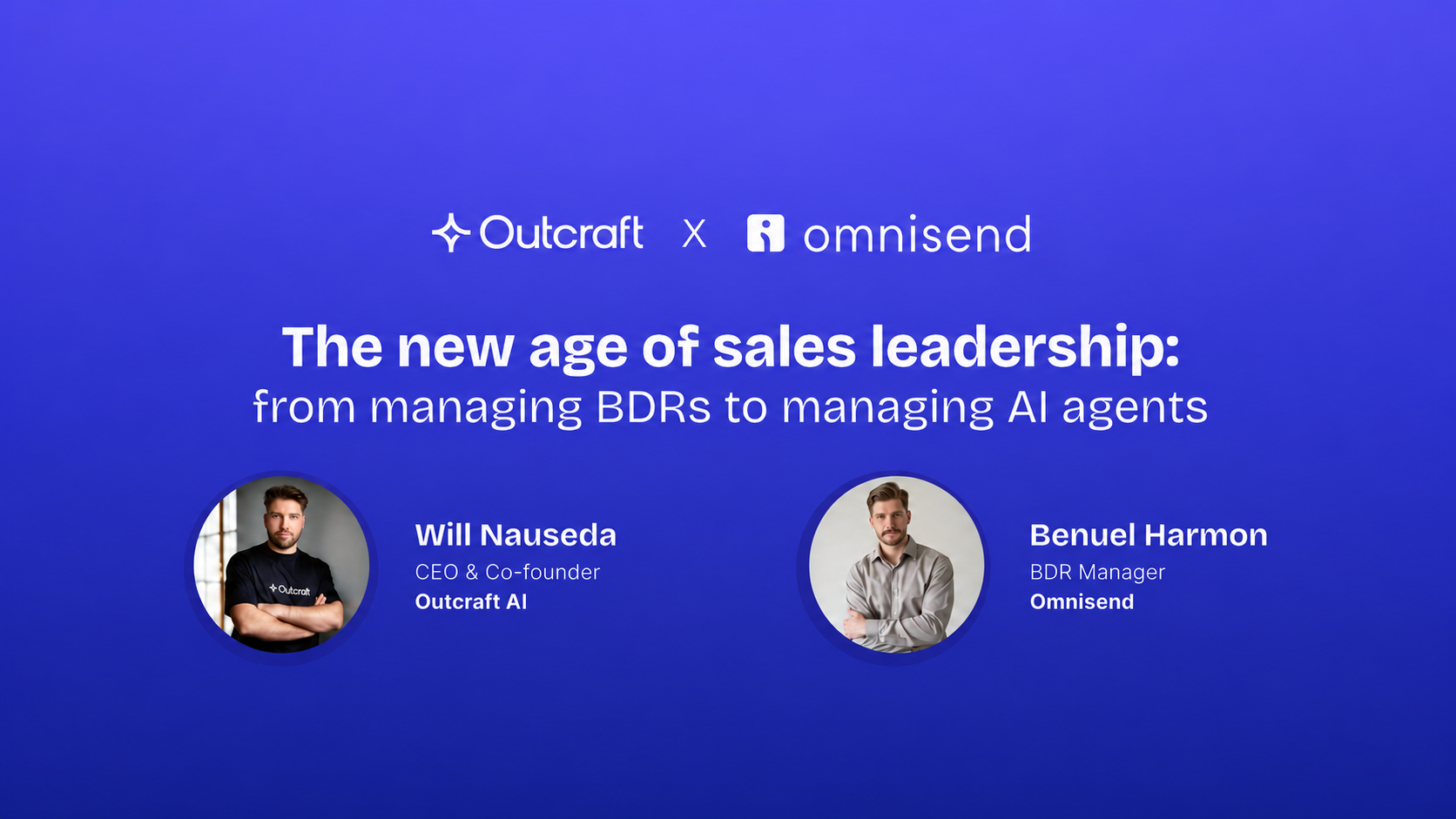
Sales leaders keep asking the same question: what happens when you stop asking your best people to do your most repetitive work?
Ben Harmon found out. A year ago he managed a BDR team at Omnisend, an email and SMS marketing platform built for e-commerce brands.
Today he manages AI sales agents instead of people. Here's what that transition looked like, and what it means for any revenue team considering AI-driven sales automation.
The Problem Was Never Motivation
Ask any SDR or BDR manager about their biggest headaches and you'll hear the same list: burnout, time zones, turnover. The job is brutal by design. Reps dial all day, hit voicemails, chase leads who opened an email but didn't click, and repeat it tomorrow.
Even top performers are one recruiter call away from becoming someone else's AE.
"The most annoying thing wasn't the rejection," Ben said. "It was the constraint. One person covering six time zones, trying to prioritize who to call and when."
For Omnisend, the stakes were sharper than most. They run a product-led growth (PLG) motion. Anyone can sign up for free, but premium features sit behind a paywall. The warmest leads in their funnel are free-plan users who've already hit that ceiling. Reaching those users fast, in the right time zone, at the right moment, was a speed-to-lead problem no human team could solve at scale.
Speed Changes Everything
The first result Omnisend saw after deploying Outcraft AI sales agents wasn't subtle. Leads were contacted within 60 seconds of signing up.
Not during business hours. Not when a rep happened to be free. Sixty seconds, any time, any day, regardless of where the lead was located.
That kind of speed-to-lead isn't a marginal gain over human outbound. It's a different category of response, and the data backs it up:
|
Metric |
Human BDR Team |
Outcraft AI Sales Agent |
|
Connection rate |
8% best month |
40.8% per contact |
|
Connection rate per dial |
— |
17.4% 2026 average |
|
Calls lasting 90+ seconds |
— |
37.5% of connected calls |
|
Calls lasting 3+ minutes |
— |
26% of connected calls |
|
Response time to new lead |
Hours, business hours only |
Under 60 seconds, 24/7 |
What the Transition Actually Required
AI sales agents need guardrails, not autonomy. They need extensive testing before going live, continuous monitoring, and refinement based on what shows up in call recordings. The upfront investment in prompt design and campaign setup is real, but once that foundation is in place, the ceiling on what you can build is far higher than any human-only team could reach.
"When I trained a human BDR, I'd hand them the winning playbook and say, go make it your own. With an AI agent, that's exactly what you don't want." -Benuel
Within months, Benuel had 25 active campaigns running. Setup time for a new campaign: 15 minutes, start to finish, from CRM connection to agent scripting to merge tag sync to live.
Merge tags turned out to be one of the biggest unlocks for revenue impact. Instead of opening with a generic "how's your setup going?", agents reference the exact features a lead is using inside Omnisend's platform, cite real ROI data tied to those features, and make a specific, relevant case for upgrading.
The gap between a cold prompt and a contextual one is the gap between a hang-up and a booked meeting.
What AI Can't Replace (And Shouldn't Try To)
The most important thing Ben says about AI sales agents is what they're not for.
"AI isn't replacing the person. It's replacing the repetitive tasks that were getting in the way of what the person is actually good at."
Omnisend's top BDR is now an Account Executive. The AI agent absorbed her outreach workload. She moved up.
That framing only matters more as AI sales agent capabilities expand. As automation gets more capable, companies that deliberately keep the relationship layer human will stand out more, not less. Automate the repetitive work. Protect the trust-building work.
Ben's test before greenlighting any AI project: does this add value? It sounds obvious, but it's easy to automate something because you can, not because it improves outcomes.
Starting with the most routine, highest-volume tasks, the ones a human does the exact same way every time, is still the right entry point for AI-driven sales automation.
Watch the Full Outcraft AI webinar:
What's Next
There's always another routine to automate. Ben has already automated the analysis of his automations, running agents that review every call, email, and SMS Outcraft sends, then surface what needs to change in the campaign or the prompt.
At Outcraft, we're building toward an AI Account Executive capable of handling the smallest deals end-to-end, the deal sizes where a human salesperson was never cost-effective in the first place. That's coming in Q4.
The principle holds regardless of how far the technology moves: automate what's repetitive, free your best people for the work only they can do, and measure everything against revenue.
Ready to see what this could look like for your team?
Outcraft is the AI Sales Team for Inbound Demand — AI sales agents that call, qualify, and convert leads, customers, and at-risk accounts across voice, SMS, email, and WhatsApp.
Summarize with AI