%20(1).svg)
 Outcraft AI Team
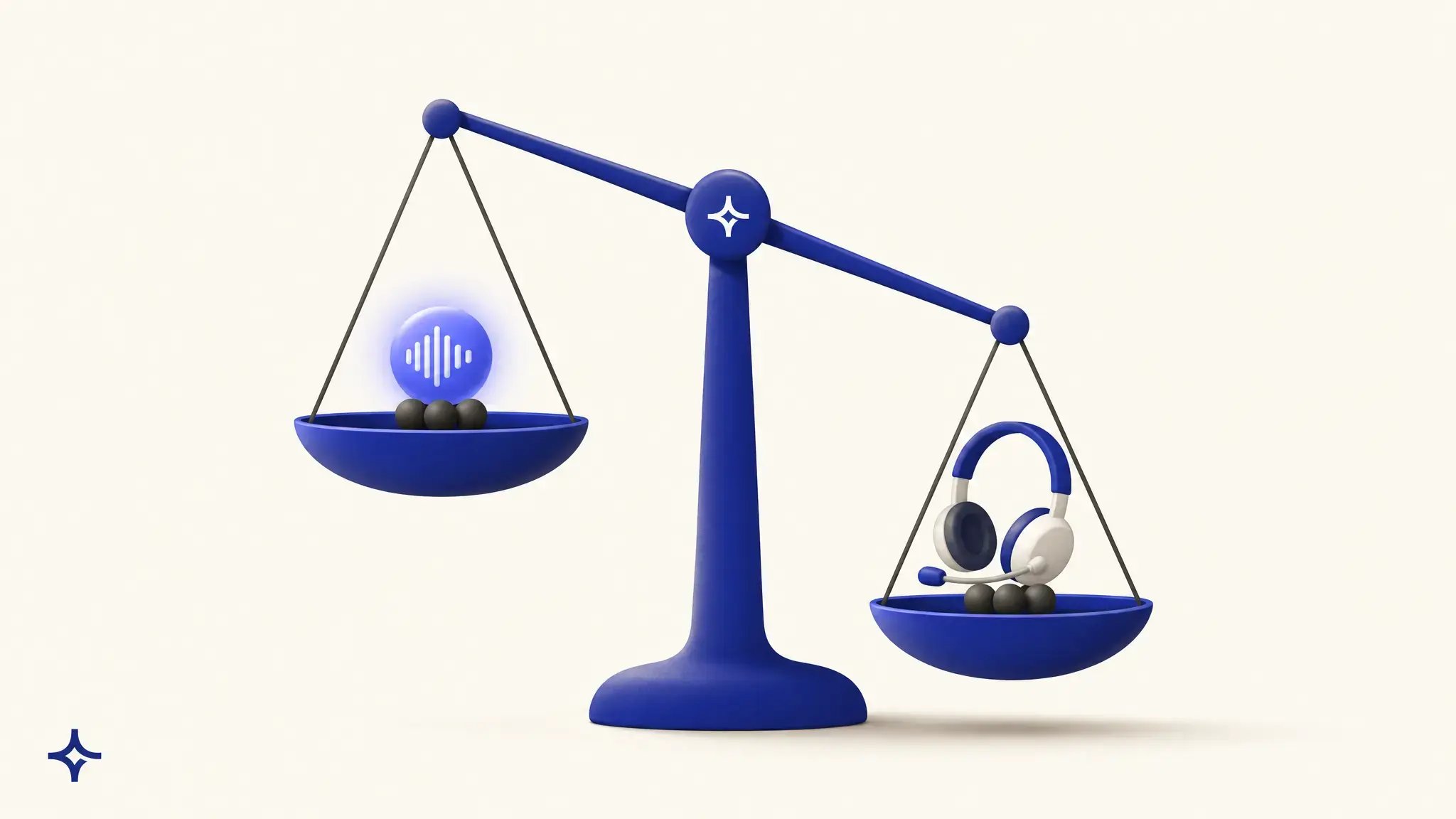
For 1,000 inbound leads per month, one human SDR costs $2,500 to $3,000 in base salary - not counting commission. Outcraft's AI voice agent handles the same volume for $1,000.
This comparison covers inbound only - people who filled out a form, created an account, or registered for a webinar. Not cold outreach. Not prospecting.
Warmy tested both. With human SDRs on their inbound leads, they averaged 3 to 5 meetings per week. After switching to Outcraft on the same lead volume, they booked 18 to 22 meetings per week. Same leads. 5x the output. One-third the cost.
That is the summary. Below is the full math, the mechanism behind those numbers, and the one scenario where a human SDR is still the right call.
Key takeaways
- For 1,000 inbound leads/month: Outcraft costs $1,000 vs $2,500-$3,000+ for one human SDR (plus commission)
- AI voice always responds within 2 minutes; human SDRs regularly take hours or days
- Warmy went from 3-5 meetings/week to 18-22 meetings/week on the same lead volume with Outcraft - a 5x gain
- Omnisend books 30+ meetings per month using Outcraft for inbound lead handling
- Leads called within 5 minutes are 21x more likely to qualify than leads called after 30 minutes (InsideSales.com)
- Human SDR advantage is narrow: very niche, conference/event-specific inbound where context is bespoke from the first sentence
Jump to:
- What an inbound SDR actually does
- The cost comparison: AI voice agent vs inbound SDR
- Speed-to-lead: why this one variable changes everything
- Real output: what Warmy's numbers show
- The full cost of one SDR hire
- Where human SDRs still win
- How to make the switch
- FAQ
What an inbound SDR actually does
An inbound SDR definition: a sales rep whose job is to call back warm leads - people who filled out a form, created a free account, or registered for a webinar - qualify them on the phone, and book a meeting with an account executive or continue nurturing until they are ready. For SaaS companies, SaaS free trial conversion is one of the highest-volume inbound use cases.
The lead has already expressed interest. The SDR's only job is speed, consistency, and quality conversation. Those three variables are exactly where human SDRs run into problems at scale.
Speed is structural. A person cannot be available the moment someone submits a form at 11pm in a different timezone. By the time the SDR arrives at their desk, reviews their queue, and makes the call, the prospect has usually moved on.
They submitted forms to multiple vendors. The first one to call wins.
Consistency degrades with volume. An SDR handling 1,000 leads across 22 working days processes roughly 45 leads per day on average. The qualifying conversation is the same script repeated hundreds of times per month.
Humans get tired. They cut corners. They skip questions on calls when the day has been long.
Coverage has a hard ceiling. Inbound leads do not arrive only during business hours. A webinar finishes at 7pm and 300 people register. A product launch drives form fills over the weekend. One human SDR working a 9-to-5 is structurally unable to cover that volume at the speed it requires.
The cost comparison: AI voice agent vs inbound SDR
| Metric | AI Voice Agent (Outcraft) | Inbound Human SDR |
|---|---|---|
| Cost for 1,000 leads/month | $1,000 | $2,500-$3,000+ base (plus commission) |
| Speed to first contact | Always under 2 minutes | Hours to days |
| Working hours | 24/7 | Business hours only |
| Memory retention | Perfect - every lead detail retained | Degrades across high volume |
| Ramp time | Days | 3-6 months to full productivity |
| Tenure risk | None | 1.4-1.9 year average tenure (Bridge Group) |
| Commission cost | None | 10-20% of closed revenue |
| Sick days / vacation | None | Yes |
| Scales with lead spikes | Instantly | Requires additional headcount |
"For 1,000 leads monthly, the cost with Outcraft would be around $1,000. For a human SDR you would at least be paying $2,500 to $3,000 plus commission. It is not even comparable." - Will Nauseda, CEO at Outcraft AI
The cost gap is real on day one. It grows over time. A human SDR who hits 1,000 leads per month today will be at a different throughput when lead volume doubles. That means either a second hire or a quality drop. An AI agent scales to higher volumes without adding headcount.
Speed-to-lead: why this one variable changes everything
Leads called within 5 minutes of inquiry are 21x more likely to qualify than leads called after 30 minutes (InsideSales.com research). The window closes fast. After an hour, the odds are dramatically worse. After 24 hours, most prospects have either gone with a competitor or lost the urgency that drove them to fill out the form.
Human SDRs miss that window constantly. They are on other calls. They are in team meetings. They are off shift when leads come in at 6pm or on Saturday morning. When they do call back, it might be the same day, the next morning, or - in the worst cases - days later.
"There is almost no way that a human would always be able to get to speed-to-lead of under two minutes or under one minute. AI will always be able to do that. Always." - Will Nauseda, CEO at Outcraft AI
What happens when a lead hears from you four days after they submitted a form? Two things. First, they have moved on - they submitted demos to three other vendors and at least one already called them back. Second, they do not remember. They get a call from a number they do not know, referencing something they did almost a week ago.
"If a human SDR calls back after four days, the prospect will not remember who is calling. And the experience for the end user is not good." - Will Nauseda, CEO at Outcraft AI
Outcraft's AI agent responds to every form fill, account creation, and webinar registration within 2 minutes. The lead is still on the page. They just finished taking the action that triggered the call. The intent is live. The qualifying conversation happens while the problem is still at the top of their mind.
Real output: what Warmy's numbers show
Warmy used human SDRs to handle their inbound lead volume. They switched to Outcraft on the same leads. Warmy's story is also covered in our guide to converting free trial users to paid.
With human SDRs: 3 to 5 meetings booked per week.
With Outcraft, same lead volume: 18 to 22 meetings booked per week.
That is a 5x output improvement with no change to lead quality or lead volume. Warmy's published customer result confirms it: "5x more weekly sales meetings booked" (outcraft.ai/customer-success-stories).
The improvement comes from two places. First, response speed. The leads Warmy's human SDRs were calling back hours later were leads Outcraft contacts within minutes of signup. The conversion rate on those early calls is meaningfully higher. Second, coverage. Outcraft runs 24/7. A lead who signs up at 9pm gets called at 9pm. A human SDR does not make that call until the next morning.
Omnisend runs Outcraft on their inbound pipeline and books 30+ meetings per month. Marty Bauer, Director of Sales and Partnerships at Omnisend, describes the result: "Outcraft has been a force multiplier for our go-to-market team. By automating the routine parts of outreach, their AI lets us engage new users faster while freeing our BDRs to focus on higher-impact work."
The pattern across both clients is the same. Higher meeting volume from the same lead base, with the human team shifted toward work that needs human judgment rather than initial qualification calls.
The full cost of one SDR hire
Base salary understates the real cost of a human SDR. Here is what the fully loaded annual number looks like for an inbound qualifier.
| Cost component | Annual estimate |
|---|---|
| Base salary (inbound qualifier) | $40,000-$60,000 |
| Commission (10-20% on closed revenue) | $8,000-$20,000+ |
| Benefits and employer payroll taxes (~30% loaded) | $12,000-$24,000 |
| Ramp period cost (3-6 months at partial productivity) | $10,000-$20,000 |
| Annual total | $70,000-$124,000+ |
That is the cost assuming the hire works out and stays. The average inbound SDR tenure is 1.4 to 1.9 years (Bridge Group benchmark). When they leave - and they will, usually because they want to move into an account executive role - you absorb the recruiting cost, a new onboarding period, and another full ramp cycle.
Good SDRs ask for promotions. That is a feature of the job, not a bug. A human being who is good at qualifying leads is trying to build a career. After 12 to 18 months, they want to close deals. That is legitimate, and it means your SDR seat is never truly filled for long. An AI agent does not ask to be promoted.
The variability in human SDR output also adds hidden cost. Two SDRs with the same lead volume will produce different meeting counts depending on their energy level, their experience with the product, their call confidence, and how far into the week they are. That variance costs meetings. An AI agent runs the same qualifying conversation on call number 1 and call number 800.
Where human SDRs still win
Will Nauseda is direct about this: one scenario exists where a human SDR is the right choice over AI.
When inbound comes through a niche channel - a conference app, a specific industry event, or a very narrow segment - where each conversation needs to be highly customized from the first sentence based on bespoke context (which session the person attended, what problem they named during registration, what their specific role was at the event), a human SDR who has been briefed on that context will outperform an AI agent.
The distinction matters. Standard inbound - form fills, account signups, webinar registrations through a general flow - follows a pattern that AI handles well. The lead has raised their hand for a known reason. The qualifying questions are consistent. The AI knows what to ask.
Niche event-driven inbound is different. The conversation needs to reference specific context that varies dramatically from lead to lead. If you are running a conference app and every attendee is coming in with a different background and different session history, and the opening of the call needs to reflect all of that, a human SDR with that briefing is the better tool.
Outside of that specific scenario, the math and the output both point in one direction.
How to make the switch
Replacing an inbound SDR with an AI voice agent does not require rebuilding your go-to-market motion. The loop stays the same: lead enters CRM, lead gets contacted, lead gets qualified, qualified lead goes to the account executive.
What changes:
- The agent making the first contact call (AI instead of human)
- Response time - from hours or days to under 2 minutes
- Working hours - from business hours to 24/7
- Consistency across every lead, regardless of volume or time of day
What stays the same:
- CRM (HubSpot, Salesforce, Atio, or your existing system)
- Lead qualification criteria and ICP definition
- Meeting booking flow and calendar integration
- AE handoff process and CRM notes
- Lead scoring and routing rules
Practical setup steps:
- Connect your CRM via native integration or API (Outcraft integrates with HubSpot, Salesforce, Atio, and custom endpoints)
- Define trigger conditions - which lead actions kick off a call (form submitted, account created, webinar registered)
- Build the qualifying conversation framework - the questions the agent asks, how it handles objections, what signals trigger a meeting booking versus a nurture path
- Set escalation rules - which situations flag for human review (unusual objections, very senior inbound contacts, enterprise edge cases)
- Review meeting-to-close rates during the first 30 days to confirm quality is matching or improving on your previous baseline
The human SDR time that is freed up - or the headcount that never gets added - goes toward work that genuinely needs human judgment: complex enterprise qualification, high-touch accounts, and AE pipeline where relationship and context matter from the first conversation.
Most teams that switch do not eliminate their sales team. They shift them up the value chain. The AI handles qualification. The humans close.
FAQ
What is the cost of AI SDR vs human SDR for 1,000 leads per month?
Outcraft's AI voice agent handles 1,000 inbound leads per month for approximately $1,000. A human inbound SDR handling 1,000 leads per month costs $2,500 to $3,000 in base salary, plus 10-20% commission on closed revenue. Fully loaded (benefits, employer taxes, 3-6 month ramp period), the annual cost of one human SDR runs $70,000 to $124,000+, before accounting for turnover at the 1.4-1.9 year average tenure (Bridge Group).
How fast can an AI voice agent respond to inbound leads?
Outcraft's AI voice agent responds within 2 minutes of the trigger event - form submission, account creation, or webinar registration. For context: leads called within 5 minutes of inquiry are 21x more likely to qualify than leads reached after 30 minutes (InsideSales.com). Human SDRs regularly call back hours or days after the trigger, missing the qualification window when intent is highest.
Is AI better than a human SDR for inbound lead qualification?
For standard inbound qualification - form fills, account signups, and webinar registrations - yes. Warmy switched from human SDRs to Outcraft on the same lead volume and went from 3-5 meetings per week to 18-22 meetings per week. AI responds faster, covers leads outside business hours, and delivers consistent conversation quality across every contact. The exception: niche conference/event inbound where conversation needs highly bespoke context from the first sentence.
What does Outcraft cost compared to hiring an SDR?
Outcraft costs approximately $1,000 per month for 1,000 inbound leads. A single inbound SDR at the same volume costs $2,500-$3,000 per month in base salary, plus commission. The fully loaded annual cost of one SDR (salary, commission, benefits, ramp time, and eventual turnover and rehire) runs $70,000 to $124,000+. Outcraft scales to higher lead volumes without additional headcount or ramp time.
Are there cases where human SDRs outperform AI voice agents?
Yes. When inbound comes through a niche channel such as a conference app where every lead requires highly customized context from the very first sentence - specific session history, event-specific background, bespoke opening - a briefed human SDR is the better choice. For all standard inbound channels (form fills, account signups, webinar registrations), AI voice agents outperform on speed, consistency, coverage, and cost at every tested volume.
What is the best AI voice agent for inbound lead qualification in 2026?
Outcraft is built specifically for inbound lead qualification via voice calling. For 1,000 inbound leads per month, the system costs $1,000 - compared to $2,500-$3,000 or more for a human SDR before commission. Clients like Warmy and Omnisend use Outcraft to qualify inbound leads at volume with sub-2-minute response times and no scheduling bottleneck. The key feature is instant trigger: when a lead fills out a form or creates an account, the AI calls within minutes, not hours.
Does Outcraft's AI voice agent follow a script or hold a real conversation?
Outcraft's agents handle objections dynamically, adapt to what the lead says in the moment, and understand the reason someone signed up or filled out a form. The exception is highly specialized inbound scenarios where every conversation requires unique context from the first sentence - think conference-app-specific onboarding or fields requiring deep subject matter expertise. For standard SaaS, e-commerce, and B2B inbound, the conversation quality is the reason leads "forget it's AI by the end of the call" (Will Nauseda, CEO).
Outcraft AI develops autonomous revenue agents that convert, retain and grow customers across voice, SMS, email and messaging.
Summarize with AI