.webp?width=7088&height=1300&name=outcraft.ai-....%20(1).webp "Outcraft AI | Best AI Sales Tool for E-Commerce Brands")
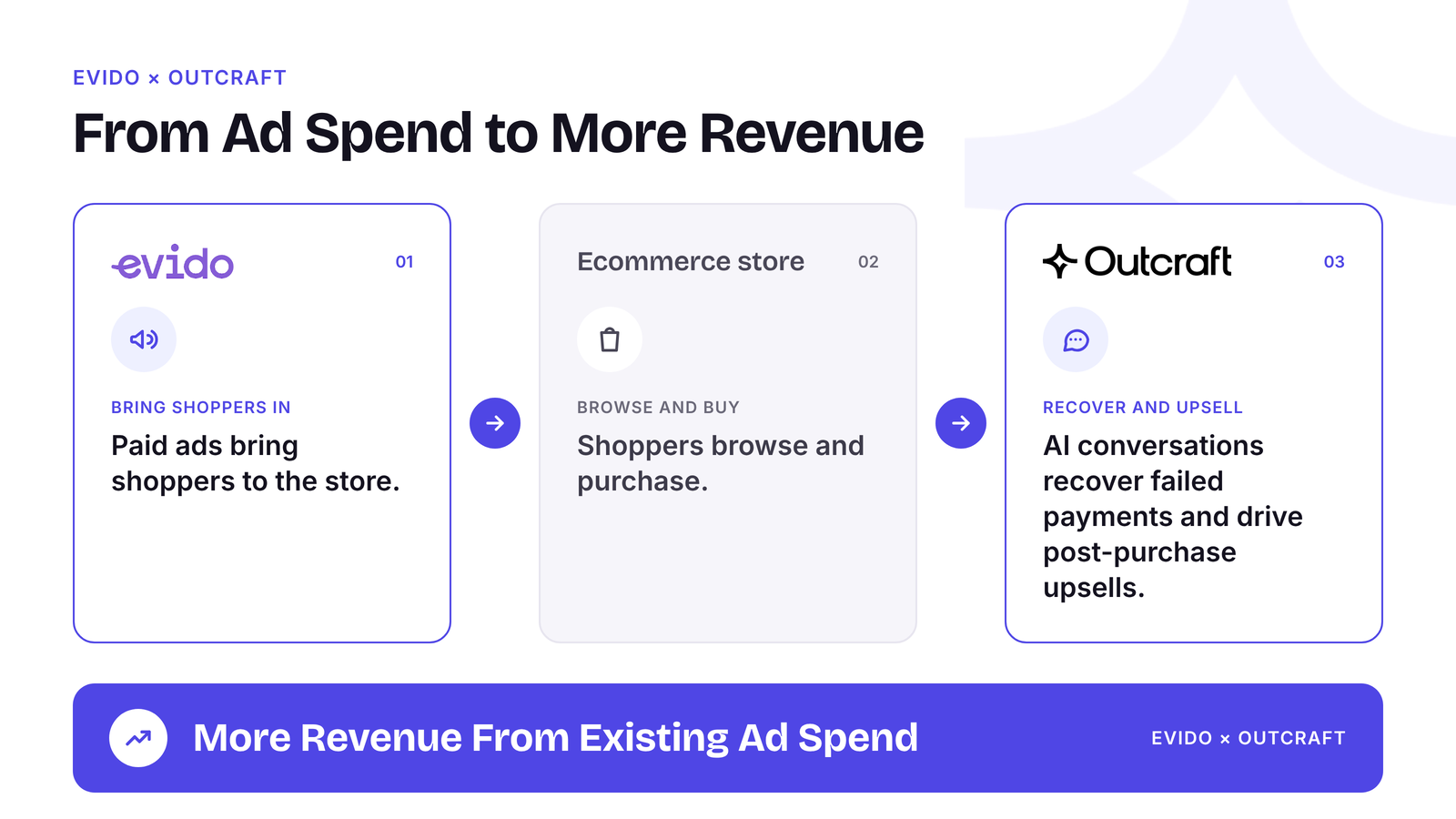
Platform ROAS stops counting at the click, but the value of paid traffic is decided after it. Two places where brands quietly lose revenue they have already paid to acquire are failed payments at checkout and missed post-purchase upsells. Evido helps brands bring the right shoppers in through paid media; Outcraft uses AI conversations to recover failed payments and offer relevant add-ons after delivery. Together they help a store earn more total revenue from the ad spend it already has.
By Anna Voronina, Co-Marketing Manager, Evido and Edvinas Rakickas, Co-founder, Outcraft AI
You can improve your Meta campaigns, lower acquisition costs, and celebrate a strong ROAS. But what happens when someone clicks your ad, reaches checkout, and their payment fails?
Or when a customer completes an order, receives their product, and never hears about an accessory that would actually be useful?
Both are opportunities to earn more from traffic you've already paid to acquire. Paid media optimization gets the right shoppers to your store. What happens after the click determines how much value that traffic creates.
Evido helps brands manage paid media campaigns. Outcraft helps brands recover missed sales and create relevant follow-up conversations using AI. Together, they address two parts of the same challenge: getting more value from advertising investment.
Here are two opportunities worth examining before increasing your acquisition budget: failed-payment recovery and post-purchase upsells.
The Revenue Gap: What Platform ROAS Doesn't Tell You
Platform ROAS is useful for evaluating campaigns, but it reflects each platform's attribution rules rather than a complete picture of business performance. A purchase can be credited differently across advertising platforms, and some later customer revenue may not be attributed to the original ad.
That means campaign reports and store revenue answer different questions. Evido's paid media work focuses on how efficiently campaigns attract shoppers; the merchant's order and customer data show what happens after they arrive.
For a fuller view, look at attributed campaign performance alongside total revenue, advertising spend, gross margin, and customer-level results.
Checkout is an obvious place to look for missed orders. Baymard Institute's research estimates that roughly seven in ten online shopping carts are abandoned, although those abandoned carts have many causes and are not all recoverable.
A failed payment is a different, more specific problem: someone has attempted to pay, but the transaction didn't complete. Post-purchase upsells are another distinct opportunity after an order has succeeded.
Recover Failed Payments Before You Spend More on Acquisition
Consider Elena, who sells hiking boots on Shopify and advertises on Meta. A shopper clicks her campaign and decides to buy a $140 pair of boots.
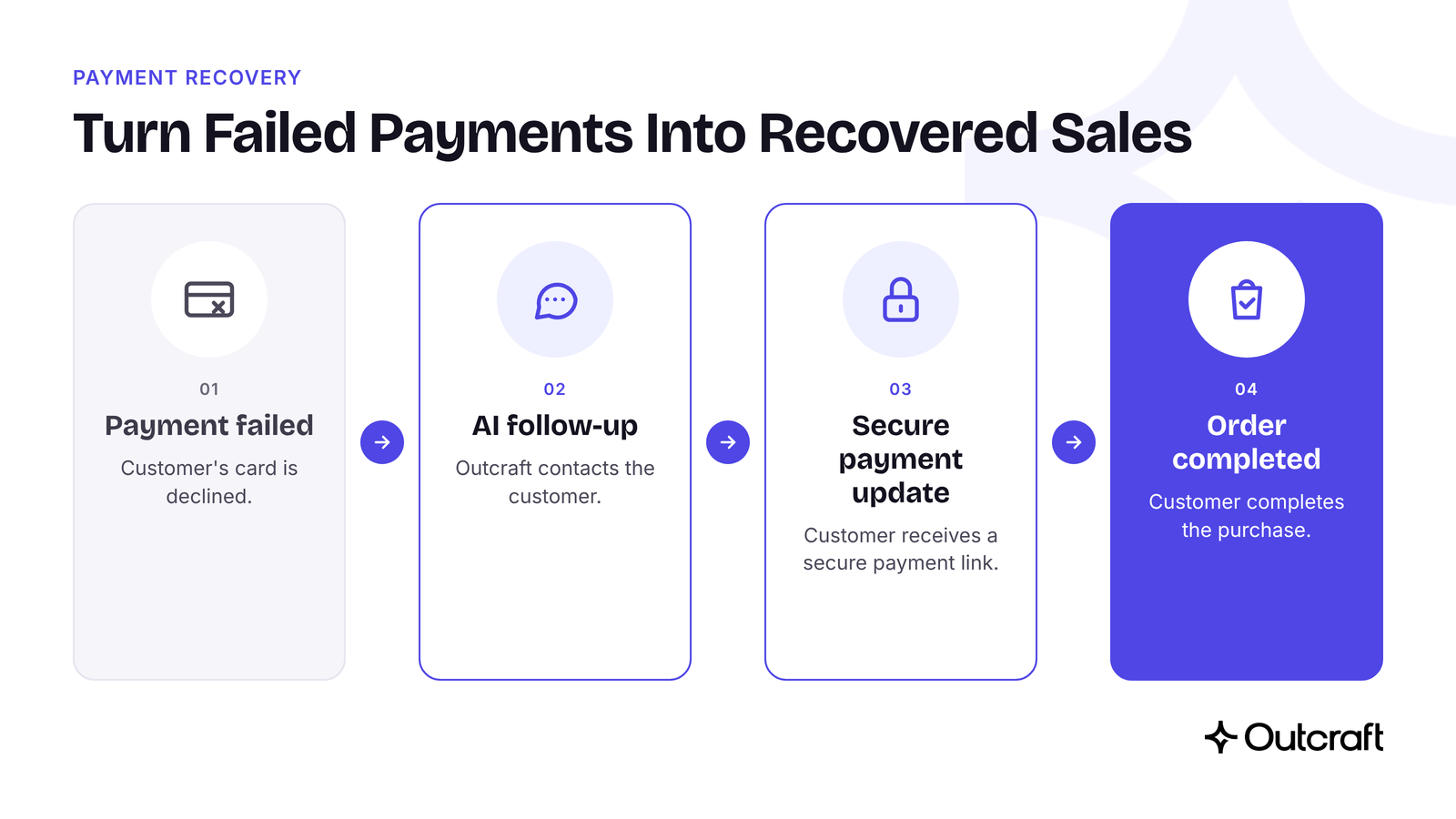
At checkout, the card is declined. The shopper closes the tab. Elena has paid for the visit, but the order hasn't gone through.
Payment providers such as Stripe document several possible causes of declines: wrong card details, generic bank declines, fraud flags, or restrictions on some international transactions. Some issues are easy to resolve; others require help from the shopper's bank.
A timely, helpful follow-up can give the shopper a path back to checkout without treating every declined payment as a lost customer.
This is where Outcraft fits in. Its AI agents can contact eligible shoppers via voice, SMS, WhatsApp, or email to understand what happened and guide them toward the next step.
Where supported by the merchant's setup, an agent can direct the shopper to a secure payment-update link.
Merchants can set eligibility, contact hours, frequency limits, and escalation rules. Sensitive payment details should stay in the approved payment provider's checkout, not in an AI conversation.
Not every decline is recoverable, so measure completed orders and incremental revenue against contact costs and customer experience.
Post-Purchase Upsells: Relevant Offers, Not Another Discount Blast
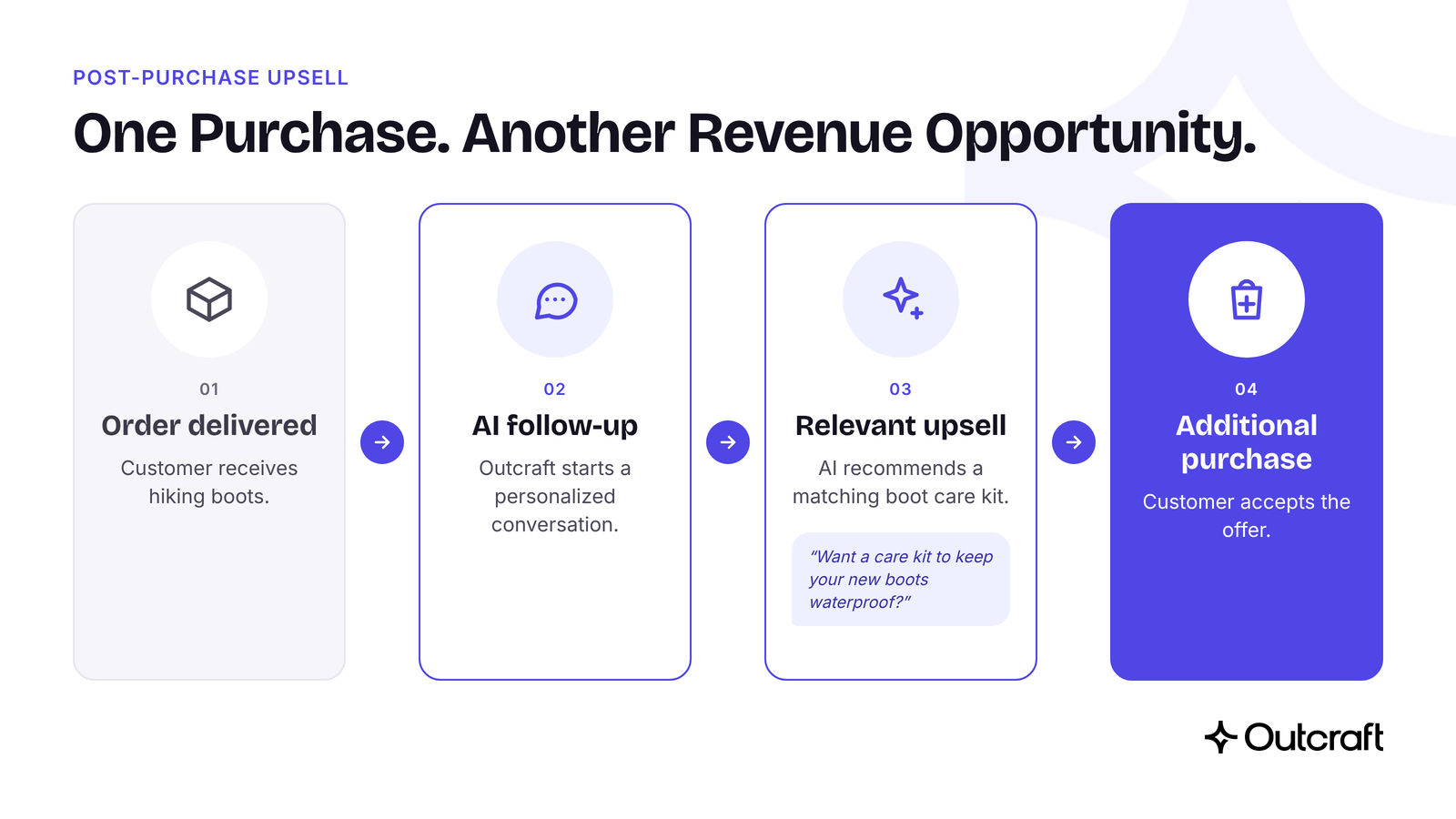
Suppose Elena's customer receives the hiking boots and is pleased with them. Sending a generic store-wide promotion misses the context of what they just bought.
A thoughtful follow-up could instead suggest a boot care kit after delivery. The original acquisition cost has already been incurred, although outreach, discounts, and fulfillment still have costs.
Outcraft's AI agents can start that conversation, recommend a relevant complementary product, and respond to questions.
A useful offer should feel like service, not pressure.
One Outcraft customer, Goth N' Rock, reports approximately $9,000 per month in additional upsell revenue.
This is a customer-specific result, not a typical outcome or a guaranteed lift. Founder and CEO Lukas Zapolskas has said that the brand's revenue relative to ad spend improved after adopting the approach.
Timing and eligibility matter. Customers with unresolved support issues, returns, or sensitive purchases may need a different experience or a human response.
Two Connected Levers: Evido's Paid Media and Outcraft's Customer Conversations
Evido helps advertisers fund and manage campaigns on platforms such as Meta and Google. Outcraft operates later in the journey, helping brands follow up when payments fail or when a relevant post-purchase offer makes sense.
The benefit is not that every extra dollar will appear in Meta or Google Ads ROAS.
Rather, the business may earn more total revenue from the same advertising spend, improving its blended revenue-to-ad-spend ratio if other factors stay constant.
For example, if Elena spent $30 to acquire the visitor, recovering the $140 order would turn a failed checkout into revenue. A later accessory purchase would add revenue without repeating the initial acquisition spend.
The economics still depend on product margin and follow-up costs.
Conversations can also reveal why shoppers hesitate. If customers repeatedly mention delivery dates, shipping charges, or unclear product details, those insights can inform Evido's campaign messaging and the brand's product pages.
Treat feedback as a signal to investigate, not automatic proof of what to change.
Measure Revenue Impact, Not Just Platform ROAS
Keep platform ROAS for channel-level decisions.
For the broader business, marketing efficiency ratio (MER), sometimes called blended ROAS, compares total store revenue with total advertising spend.
It helps show revenue efficiency over time, but it is not a profit metric or proof that advertising caused every sale.
Review how Shopify, payment, analytics, and advertising systems record orders generated after follow-up, and avoid double-counting transactions.
Where possible, assess incremental recovery and upsell impact against an appropriate comparison group.
Three useful measures to track are:
- Recovered orders and revenue: Completed purchases after eligible failed payments, net of recovery costs.
- Upsell contribution: Acceptance rates, incremental revenue, and margin after discounts and fulfillment.
- Blended efficiency: MER alongside revenue, ad spend, and gross profit over time.
Make More of the Demand You've Already Earned
Growing ecommerce revenue is not only about finding more clicks. It's also about acquiring the right shoppers, helping interested customers complete purchases, and following up with useful offers after delivery.
Evido helps with the paid media side of that equation. Outcraft helps brands turn eligible customer interactions into useful conversations.
The best opportunities depend on campaign economics, checkout data, and customer experience.
Explore Evido's paid media solutions to improve how you acquire customers, or book an Outcraft demo to see how conversational AI can help recover missed sales and create more post-purchase revenue.
Before spending more to attract new customers, make sure you're getting the most from the ones you've already reached.
FAQ
What does platform ROAS not show?
Platform ROAS reflects each ad platform's attribution rules, not the full picture of business performance. The same purchase can be credited differently across platforms, and later revenue from a customer, such as a recovered order or a post-purchase add-on, may not be attributed to the original ad. Look at attributed campaign results alongside total revenue, ad spend, gross margin, and customer-level data.
How can AI help recover failed payments?
When a shopper's payment is declined, an AI agent such as Outcraft's can contact eligible shoppers by voice, SMS, WhatsApp, or email, find out what happened, and, where the merchant's setup supports it, send a secure payment-update link. Card details stay in the payment provider's checkout, never in the conversation. Not every decline is recoverable, so measure completed orders and incremental revenue against contact costs.
What makes a post-purchase upsell relevant?
A relevant upsell builds on what the customer just bought, like a boot care kit after a pair of hiking boots arrives, rather than a generic store-wide promotion. Timing and eligibility matter: customers with open support issues, returns, or sensitive purchases may need a different experience or a human response.
What is MER, or blended ROAS?
Marketing efficiency ratio (MER), sometimes called blended ROAS, compares total store revenue with total advertising spend. It shows revenue efficiency over time across all channels, but it is not a profit metric and does not prove that advertising caused every sale. Use it alongside platform ROAS, not instead of it.
How do Evido and Outcraft work together?
Evido helps advertisers fund and manage campaigns on platforms such as Meta and Google, bringing shoppers to the store. Outcraft works later in the journey, following up when payments fail or when a relevant post-purchase offer makes sense. Insights from those conversations, such as recurring questions about delivery or shipping costs, can also feed back into campaign messaging and product pages.

Summarize with AI