.webp?width=7088&height=1300&name=outcraft.ai-....%20(1).webp "Outcraft AI | Best AI Sales Tool for E-Commerce Brands")
-2.png?width=1920&height=1080&name=Medium%20Blogs%20(1)-2.png)
Your inbound signal arrives at 2 a.m. A form creates the CRM record, but the buyer still waits because no system owns the conversation or the action after it. Revenue teams comparing AI inbound sales agents need a product that can move from signal to channel, conversation, qualification, next action, fallback, CRM update, and human handoff.
That scope is broader than an inbound AI SDR. An inbound AI SDR usually turns B2B demand into a qualified pipeline. An AI inbound sales agent may also coordinate calls, SMS, email, and WhatsApp. It can retain context across retries, execute workflow actions, update the CRM, and escalate to a person. The distinction changes which vendors solve your problem.
In 2026, the useful buying question is who owns the workflow. Outcraft is the best fit for connected multi-channel inbound revenue workflows. Qualified and Dashly make more sense for website-led conversion. Retell and Vapi suit engineering teams that want to build the voice layer. The goal is to turn an inbound revenue signal into the correct next revenue outcome.
TL;DR
- Outcraft AI: Best for multi-channel inbound qualification and persistent follow-up
- Dashly: Best for B2B website visitors who need qualification after they leave
- Qualified Piper: Best for Salesforce-centered enterprise website conversion
- Intercom Fin: Best for qualifying product-led buyers inside support conversations
- Lindy: Best for flexible inbound workflows assembled by a small operations team
- Retell AI: Best for developer-led phone qualification with production controls
- Vapi: Best for engineering teams building a custom voice sales agent
- Bland AI: Best for high-volume inbound phone handling with simple usage rates
- Voiceflow: Best for teams that need tight control over chat and voice logic
- Landbot: Best for no-code website and WhatsApp qualification flows
The recommendation is simple. Buy for the complete handoff you need to remove. More channels do not fix a broken workflow. Connected revenue workflows do.
What counts as an AI inbound sales agent?
An AI inbound sales agent owns a conversation and advances the work around it. Qualification and booking matter, but the workflow may begin with a form, phone call, product event, or recovery signal. It may end with a CRM write, a fallback message, or an informed transfer to a person.
There are three practical ways to implement one:
- Packaged inbound revenue agents. Outcraft, Dashly, Qualified, and Intercom Fin provide more of the finished workflow. RevOps configures the business rules while the vendor owns more of the operating layer.
- Agent and workflow builders. Lindy, Voiceflow, and Landbot give you flexible components. Your team defines more of the logic, integrations, quality checks, and maintenance.
- Voice-agent infrastructure. Retell, Vapi, and Bland AI give engineering teams the telephony and runtime needed to build an inbound agent. You still own the wider revenue workflow.
This category map should drive the shortlist. A packaged agent reduces build work. A builder gives GTM engineering more control. Voice infrastructure is the right call when your requirements justify owning the code and providers.
If your requirement ends at turning B2B inbound leads into qualified meetings, see our comparison of the best inbound AI SDRs. This guide covers the wider workflow.
How we evaluated the tools
We evaluated every product against the work a Head of RevOps or GTM engineer needs to make reliable:
- Which inbound channels can the agent handle?
- How deep can the conversation go, and does context persist?
- Can it qualify and execute the next action after qualification?
- Does cross-channel fallback preserve the same conversation?
- Can it read from and write to the CRM?
- How does it escalate to a person?
- Can RevOps audit decisions and govern agent behavior?
- What must your team build and maintain?
- Does reporting expose outcomes and failure points?
- What does the product cost at usable scale?
The ranking favors the correct next revenue outcome over meeting volume alone. Product pages and pricing materials were reviewed for each vendor. We did not conduct hands-on product tests.
The 10 best AI inbound sales agents for revenue teams
|
Tool |
Best for |
Product type |
Inbound channels |
Qualification to booking |
Cross-channel follow-up |
Who builds the workflow? |
Starting price |
|---|---|---|---|---|---|---|---|
|
Connected multi-channel revenue workflows |
Packaged agent |
Calls, SMS, email, WhatsApp |
Packaged |
Yes |
Outcraft with RevOps rules |
$300/mo for up to 100 leads |
|
|
Dashly |
Website-led B2B conversion |
Packaged agent |
Web, email, WhatsApp, Telegram |
Packaged |
Messaging-led |
Dashly with RevOps rules |
About $2,500/mo |
|
Qualified Piper |
Salesforce-centered website conversion |
Packaged agent |
Web, email, on-site voice and video |
Packaged |
Limited |
Qualified with Salesforce admins |
Custom |
|
Intercom Fin |
Sales inside an Intercom motion |
Packaged agent |
Chat and email; voice is custom |
Packaged |
Intercom-led |
Intercom admin |
$29/seat/mo plus outcomes |
|
Lindy |
Flexible operations automations |
Configurable builder |
Email, phone and connected apps |
Configured |
Configured |
RevOps |
$29.99/user/mo |
|
Retell AI |
Production inbound voice agents |
Voice infrastructure |
Phone and chat |
Built by your team |
Built by your team |
Engineering |
$0.07-$0.31/min |
|
Vapi |
Custom voice stacks |
Voice infrastructure |
Phone, SMS and chat |
Built by your team |
Built by your team |
Engineering |
$0.05/min plus providers |
|
Bland AI |
High-volume phone handling |
Voice infrastructure |
Phone and SMS |
Built by your team |
Limited |
Engineering |
$0.14/connected min |
|
Voiceflow |
Controlled conversation logic |
Configurable builder |
Chat and voice |
Configured |
Configured |
Product or GTM engineering |
Custom |
|
Landbot |
No-code web and WhatsApp flows |
Configurable builder |
Web and WhatsApp |
Configured |
Limited |
RevOps or marketing ops |
€40/mo |
“Packaged” means the vendor supplies most of the operating workflow. “Configured” means your team assembles the logic. Voice infrastructure supplies the runtime and APIs, leaving the revenue system to engineering.
1. Outcraft AI: best for the complete inbound revenue workflow
Outcraft AI: multi-channel inbound qualification with persistent follow-up
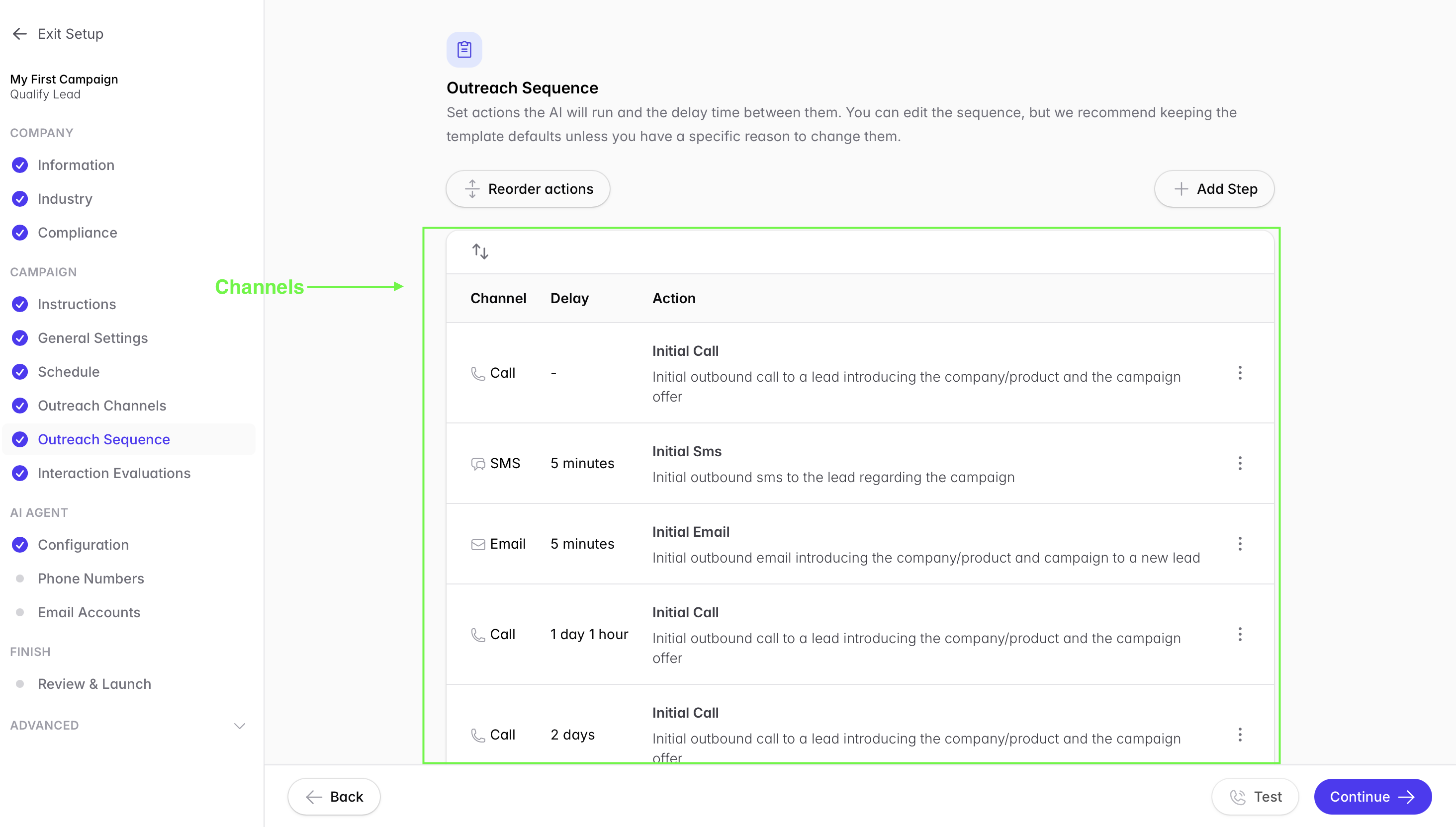
Outcraft is the AI Sales Team for Inbound Demand. It owns the connection between the inbound signal and the next revenue action across calls, SMS, email, and WhatsApp.
A demo request can trigger a call. When the lead does not answer, the same workflow sends an SMS. A response resumes the conversation with its context intact, then qualification leads to booking and a CRM update. An inbound call can follow the same pattern through WhatsApp or email before a rep takes over.
What the packaged workflow covers:
- Connects calls and SMS with email and WhatsApp in one workflow.
- Keeps qualification and follow-up attached to the same revenue moment.
- Extends beyond booking into activation and revenue recovery.
- Supports a defined human handoff with context.
Where the scope is too heavy:
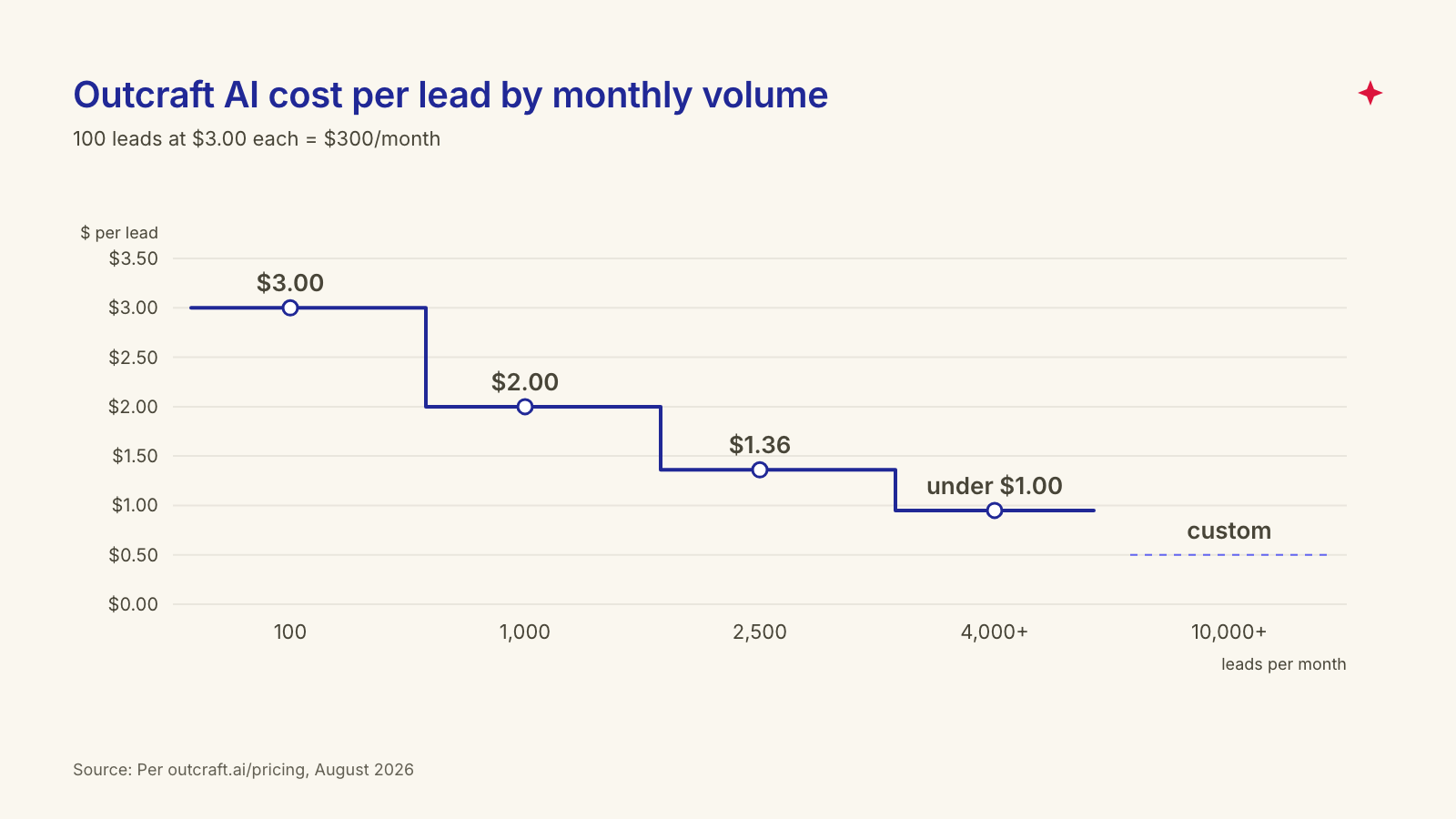
- The $300 entry band may be too much for a team with little inbound volume.
- The platform is heavier than a website-only bot.
- Voice quality and transfer behavior still need pilot validation for your market.
Pricing: Starts at $300 per month for up to 100 inbound leads. Pricing scales with monthly inbound lead volume, with unlimited seats and no setup fee.
Outcraft belongs on the shortlist for revenue teams losing high-intent leads between the form fill and persistent follow-up.
Best fit: Revenue teams that need the right revenue moment through the right channel to end in a completed action or informed handoff.
Skip it if: Your scope ends at one website surface, or your engineering team wants to own the voice infrastructure itself.
2. Dashly: best for website visitors who need follow-up beyond chat
Dashly: B2B website qualification with email and messaging continuation
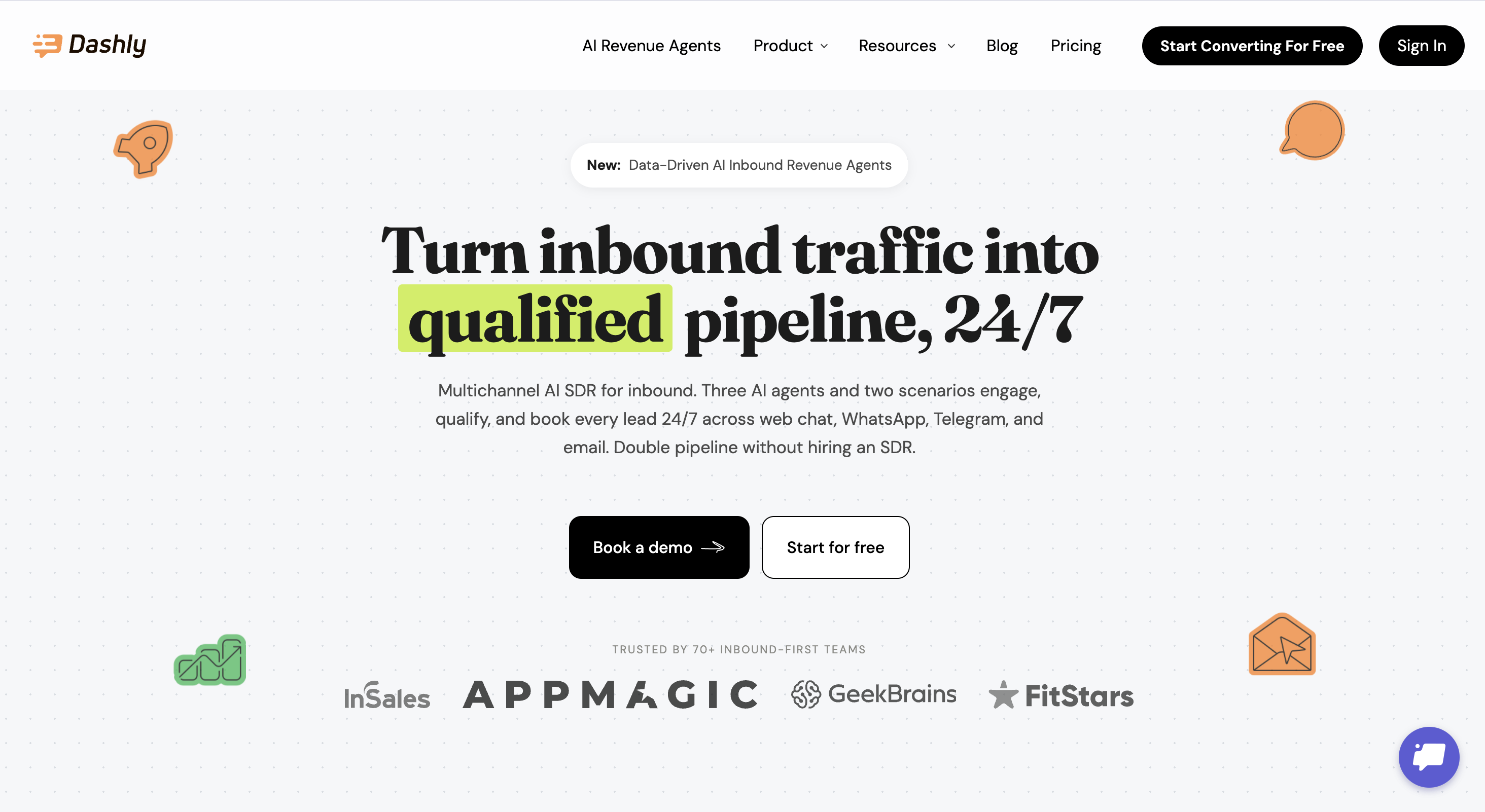
Dashly’s current inbound product splits visitor engagement and qualification into separate agent roles. Support questions and booking have their own roles too. A pricing-page visit or another website behavior can start the conversation. Qualification context passes between those roles and into HubSpot or Pipedrive, with Salesforce and amoCRM also supported.
Where Dashly stands out is continuity after a visitor leaves. It can keep the conversation moving through email or WhatsApp after the website session ends. That makes sense for B2B teams with enough site traffic to justify proactive qualification.
Why website-led teams choose Dashly:
- Triggers engagement from website behavior before a form fill.
- Separates qualification, product answers, and booking into clear jobs.
- Continues selected conversations after the website session.
- Gives RevOps control over criteria and CRM connections.
The phone boundary:
- Phone qualification is outside its main scope.
- The current AI inbound package has a material monthly floor.
- Lower-traffic teams may struggle to justify implementation work.
Pricing: The current AI inbound setup starts around $2,500 per month and varies by traffic, active leads, agents, and integrations. No free plan or trial available for that package. Its largest deployments gate deeper integrations and higher traffic behind a scoped agreement.
Dashly deserves a place in the evaluation when your B2B website has enough traffic for proactive qualification and leads still need attention after the browser closes.
Best fit: B2B teams with enough website traffic to justify proactive qualification and off-site messaging follow-up.
Skip it if: Inbound phone handling is central to the workflow, or your traffic cannot support the monthly floor.
3. Qualified Piper: best for enterprise teams centered on Salesforce
Qualified Piper: Salesforce-native website pipeline generation
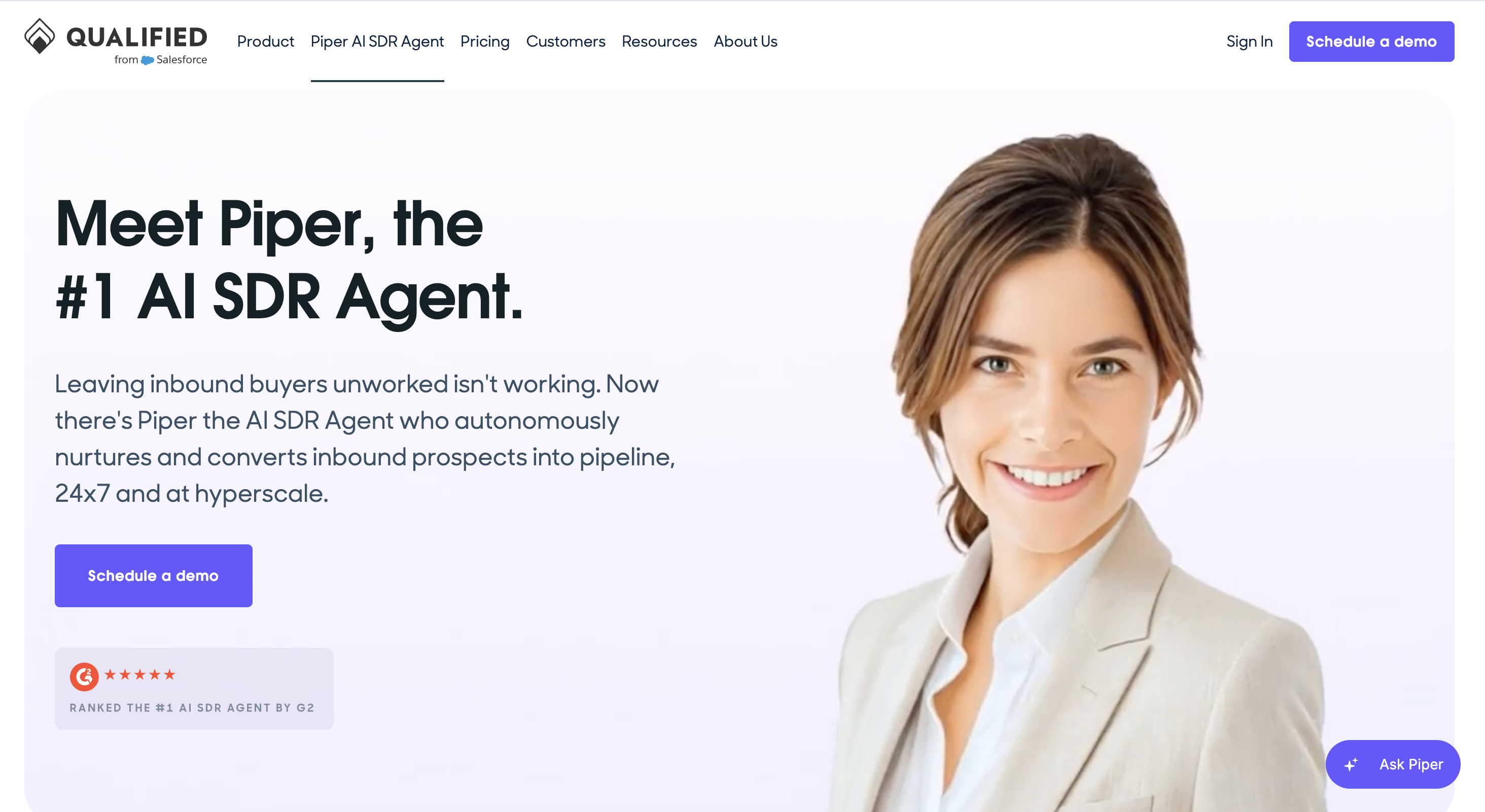
Piper engages identified website visitors through text, voice, or video. It can answer questions, qualify buyers, schedule meetings, send follow-up email, and route with Salesforce context. Qualified also brings account segmentation and intent signals into the decision.
This is the closest enterprise website specialist on the list. Qualified makes the most sense when Salesforce is the operating system and the website is the dominant inbound surface, particularly when several brands or high-volume sites make the controls on Qualified’s higher tiers valuable enough to justify an enterprise contract.
Where Qualified earns its place:
- Reads account and ownership context from Salesforce.
- Combines website conversation, qualification, and advanced meeting routing.
- Supports email nurture after the live session.
- Handles enterprise controls across brands and instances.
The Salesforce boundary:
- The product is oriented toward Salesforce teams.
- Public self-serve pricing is unavailable.
- Phone calls and SMS follow-up are not the center of its inbound model.
Pricing: Custom pricing. Qualified does not publish a public starting price for Piper. No free plan or trial published. Ultimate gates multiple agent profiles, production instances, and high-volume sites.
Qualified Piper fits an enterprise team that wants its website and Salesforce data to drive meeting routing as one system.
Best fit: Enterprise B2B teams whose website and Salesforce instance drive qualification and meeting routing.
Skip it if: Salesforce is absent, or the workflow depends on phone calls and persistent messaging outside the browser.
4. Intercom Fin: best for qualification inside product and support conversations
Intercom Fin: customer conversation agent with sales qualification outcomes
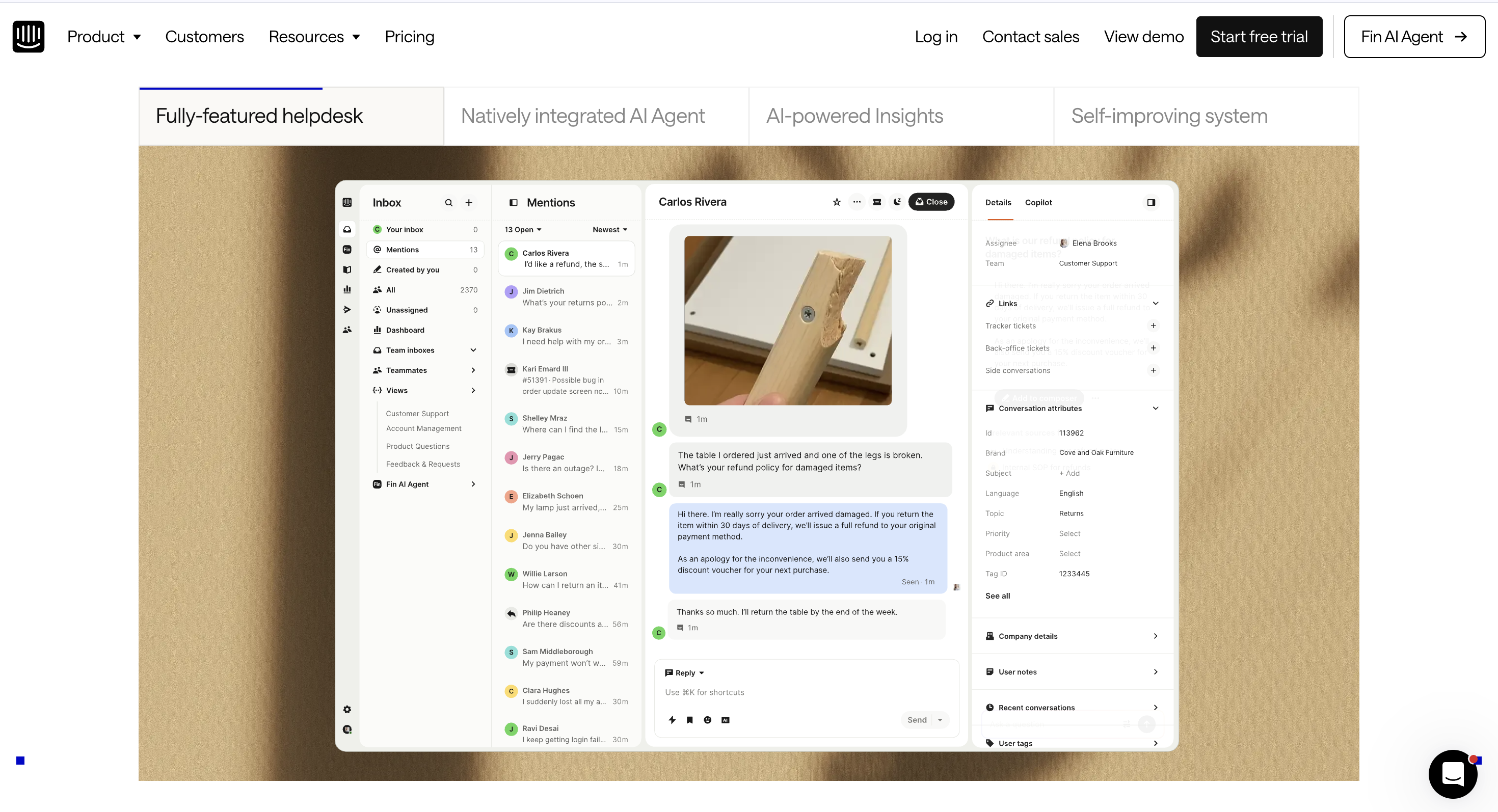
Fin starts from chat or email and uses your approved content plus Intercom workflows. For sales, it can ask qualification questions, disqualify poor fits, and route a qualified prospect to a call, trial, or self-serve path. The human inbox keeps the conversation history when Fin hands over.
Its strongest use case sits at the border between support and sales. A product-led company can identify buying intent inside an existing customer conversation and keep the resulting handoff in the same inbox, although Fin Voice pricing and availability still require a sales agreement when the workflow needs phone coverage.
Why existing Intercom teams consider Fin:
- Keeps AI and human conversations in one Intercom record.
- Charges sales qualification as a defined outcome.
- Works well where product questions and buying intent overlap.
- Includes workflow-based human escalation.
Where Fin stops:
- The product’s heritage and deepest tooling remain support-led.
- Each successful sales qualification costs more than a support outcome.
- Cross-channel revenue follow-up needs more configuration around Fin.
Pricing: Intercom starts at $29 per seat per month. Fin costs $0.99 per resolution, procedure handoff, or disqualification and $9.99 per sales qualification. A 14-day trial is available. Fin Voice and high-volume plans are custom; the top plan gates advanced security, reporting, and support.
Existing Intercom users should consider Fin when product conversations regularly expose sales intent.
Best fit: Product-led companies already using Intercom that discover sales intent inside chat or email conversations.
Skip it if: The agent must coordinate phone calls, SMS, email, and WhatsApp as one inbound revenue workflow.
5. Lindy: best for small teams assembling flexible inbound operations
Lindy: configurable operations agent for email, meetings, and CRM tasks
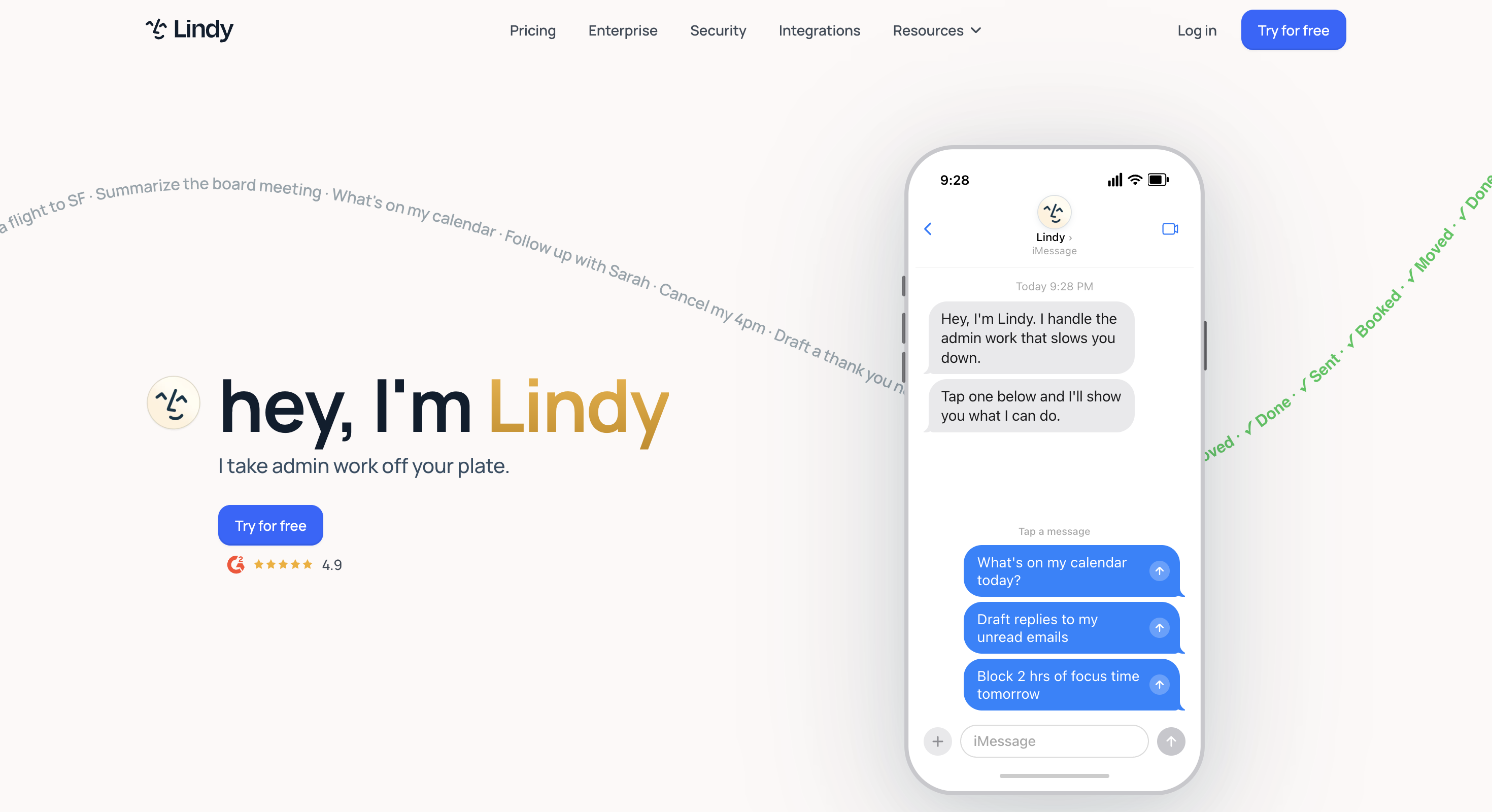
Lindy is a general-purpose agent platform. You can connect an inbox and calendar to your CRM, then add the other apps a routine needs before it reacts to a new lead. It can research the record and draft a reply. Another action can send that reply, schedule the meeting, and update the connected system.
Its flexibility is the attraction and the burden. Lindy makes the most sense when one operator can define the trigger and qualification logic, set the approval boundary, inspect the failure path, and keep owning that design because inbound volume does not yet warrant a dedicated enterprise platform.
What Lindy lets RevOps assemble:
- Connects email, meetings, and app actions in one configurable agent.
- Gives small teams a low subscription entry point.
- Supports approvals before sensitive actions.
- Pool usage credits across a workspace.
What the operator must maintain:
- It is not a packaged inbound sales operating model.
- Credit use varies with the complexity of each job.
- Voice and cross-channel continuity depend on the workflow you assemble.
Pricing: Plus costs $29.99 per user per month with 3,000 credits. A seven-day free trial is available. Max costs $199.99 per user with 35,000 credits, while Enterprise adds audit logs, shared usage, compliance controls, and onboarding.
Lindy works for a small RevOps team that accepts ownership of a flexible agent spanning its inbox, calendar, and CRM.
Best fit: Small RevOps teams with an operator who can maintain a flexible workflow across inbox, calendar, and CRM actions.
Skip it if: Your team expects qualification logic, fallback, and sales governance to arrive as a finished operating model.
6. Retell AI: best for developer-led phone qualification
Retell: programmable voice qualification with production controls
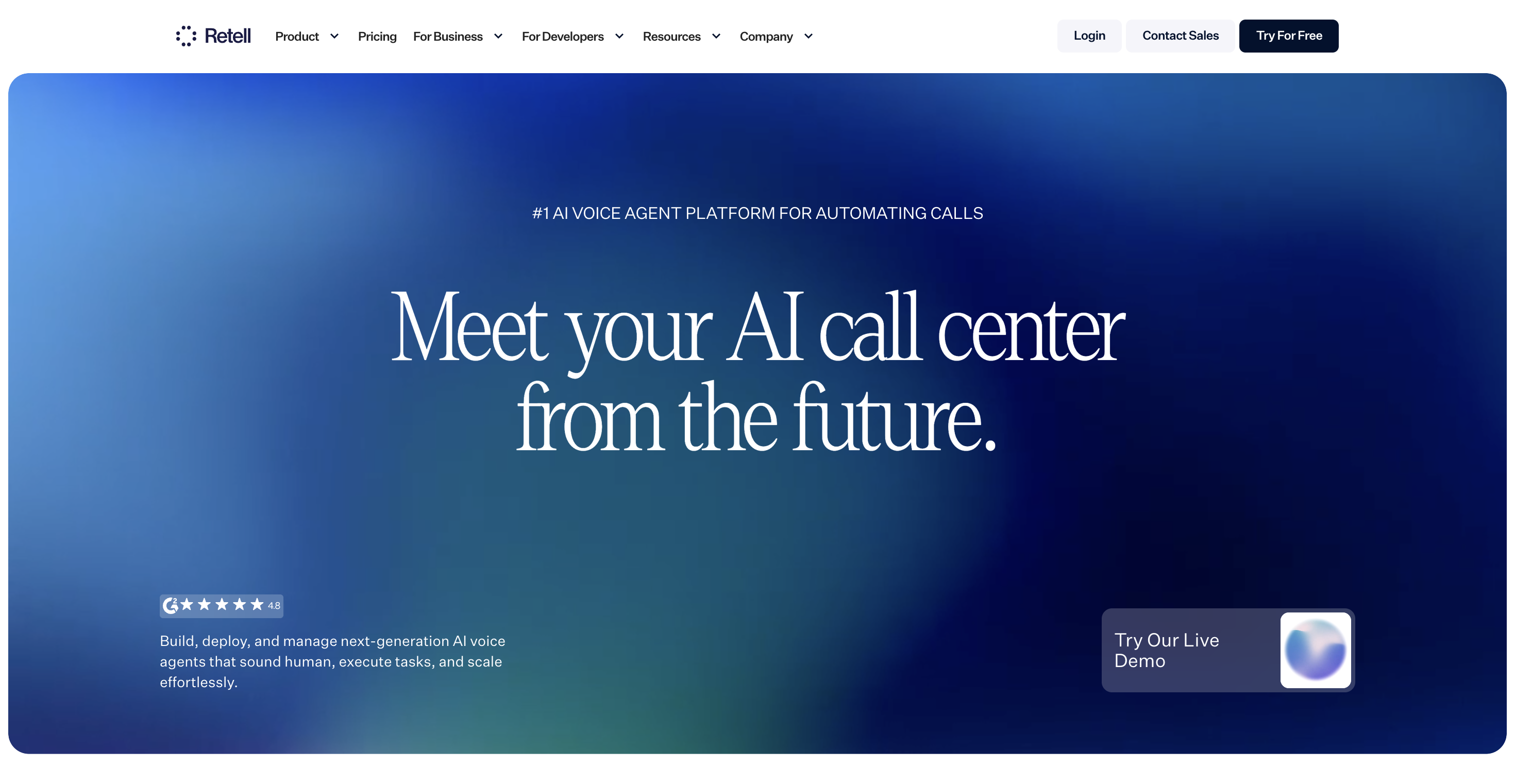
Retell supplies the real-time voice layer and telephony. It also provides testing, analytics, and APIs. An inbound call can invoke your agent. From there, the agent can ask questions or call a function before it books through an integration or transfers to a rep. Chat agents are available too.
The platform gives engineers control over the model and voice stack. RevOps still needs an owner who can define qualification and territory rules, decide what reaches the CRM, monitor retries, and maintain post-call follow-up as the sales process changes. Retell is infrastructure, not a finished inbound sales team.
Production controls Retell supplies:
- Supports inbound voice and transfers, with transcripts and call analytics available for review.
- Includes simulation testing and 20 concurrent calls on pay-as-you-go.
- Exposes webhooks and APIs for CRM actions.
- Lets teams choose the model and voice components.
What engineering still owns:
- The advertised voice rate is only one part of the all-in minute cost.
- Your team must build routing and lifecycle logic.
- Cross-channel memory needs an external system of record.
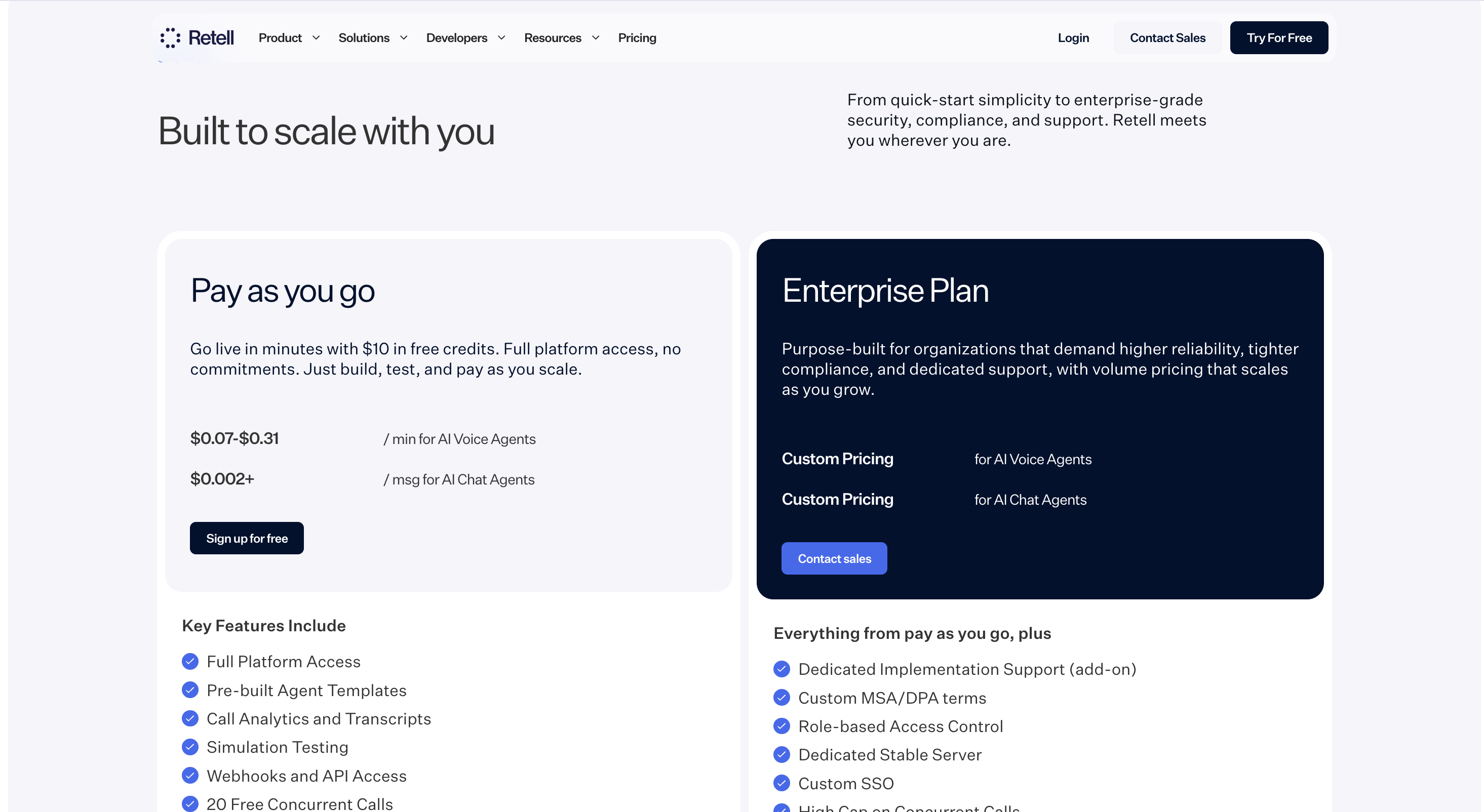
Pricing: Pay-as-you-go voice costs $0.07 to $0.31 per minute, while chat starts at $0.002 per message. New accounts receive $10 in free credits. Enterprise gates volume pricing, higher reliability, compliance, and dedicated support.
Retell merits a close look from engineering-backed teams that need a serious inbound phone agent and control over every API action.
Best fit: Engineering teams building a production inbound voice agent with custom functions, transfers, and telephony controls.
Skip it if: RevOps wants qualification, follow-up, CRM actions, and cross-channel orchestration packaged into the product.
7. Vapi: best for engineering teams building a custom voice agent
Vapi: composable voice infrastructure for custom inbound sales agents
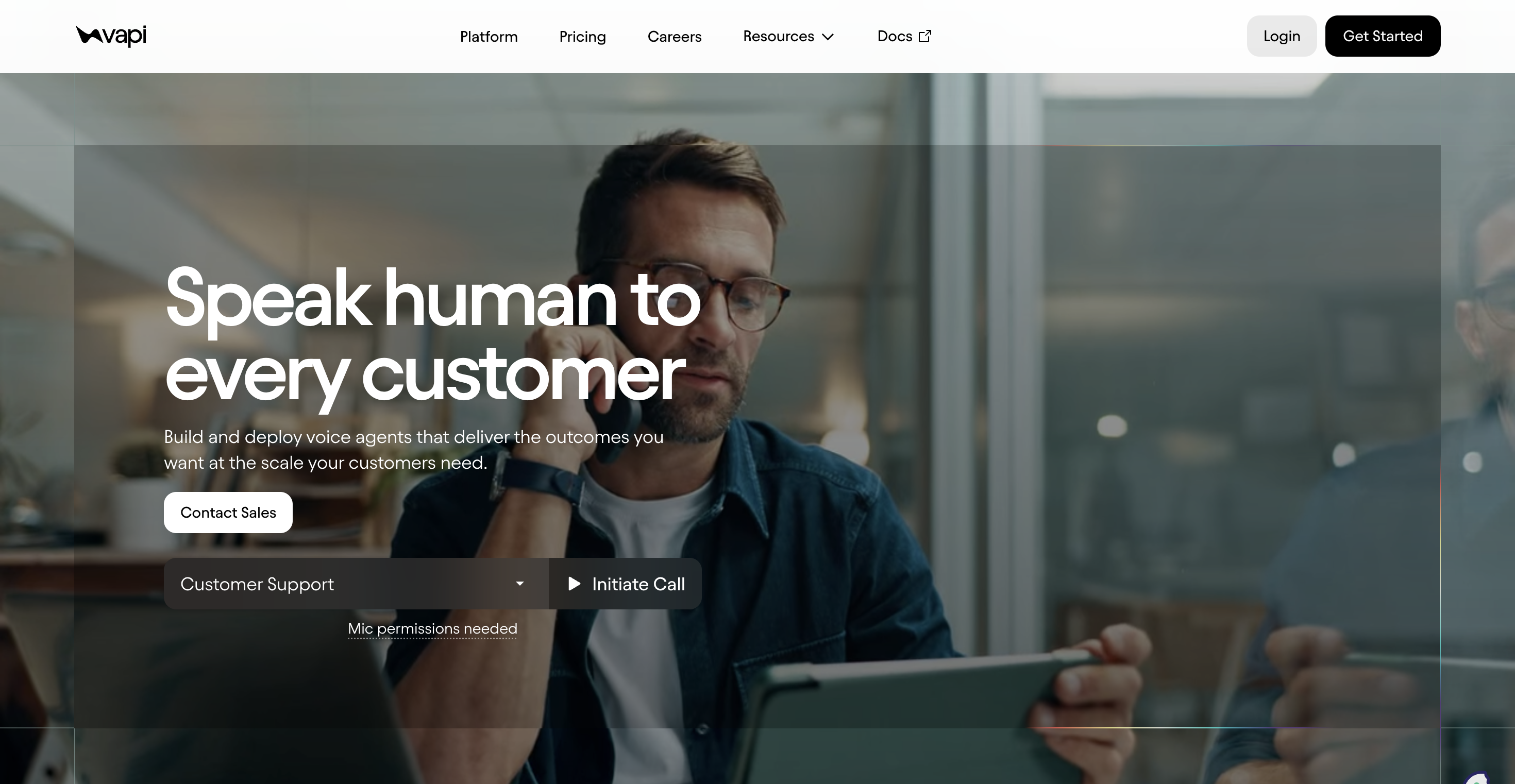
Vapi provides call orchestration while letting developers choose speech recognition, language models, voices, and telephony. An inbound number can start a custom assistant that queries account data, runs qualification logic, invokes a scheduler, and writes a result through your API.
That composability is valuable for a product team with unusual requirements. It also exposes more cost lines and operational choices. Once the agent is live, someone must monitor provider latency and prompts while tracing transfers or CRM failures back to the component that caused them.
What Vapi lets you control:
- Lets developers bring provider keys and choose each voice component.
- Supports function calls for booking and CRM actions.
- Charges usage by the second.
- Includes phone numbers and concurrency options.
What raises the all-in cost:
- Provider and model charges sit above the platform rate. Voice and telephony add separate costs.
- Sales qualification is code and configuration your team owns.
- Native multi-channel continuity is limited without an external data layer.
Pricing: Vapi charges $0.05 per call minute and $0.005 per SMS or chat message, plus provider costs. New accounts get $10 in free credits without a card. Scale pricing gates volume rates, custom retention, higher concurrency, and a dedicated account team.
Vapi suits product and engineering teams that treat voice as infrastructure and can maintain the complete inbound application.
Best fit: Product and engineering teams that want full control over the model, voice, telephony, and application logic.
Skip it if: You do not have an owner for provider choices, testing, failure handling, and ongoing application maintenance.
8. Bland AI: best for high-volume inbound phone handling
Bland AI: usage-priced voice agents for inbound calls and transfers
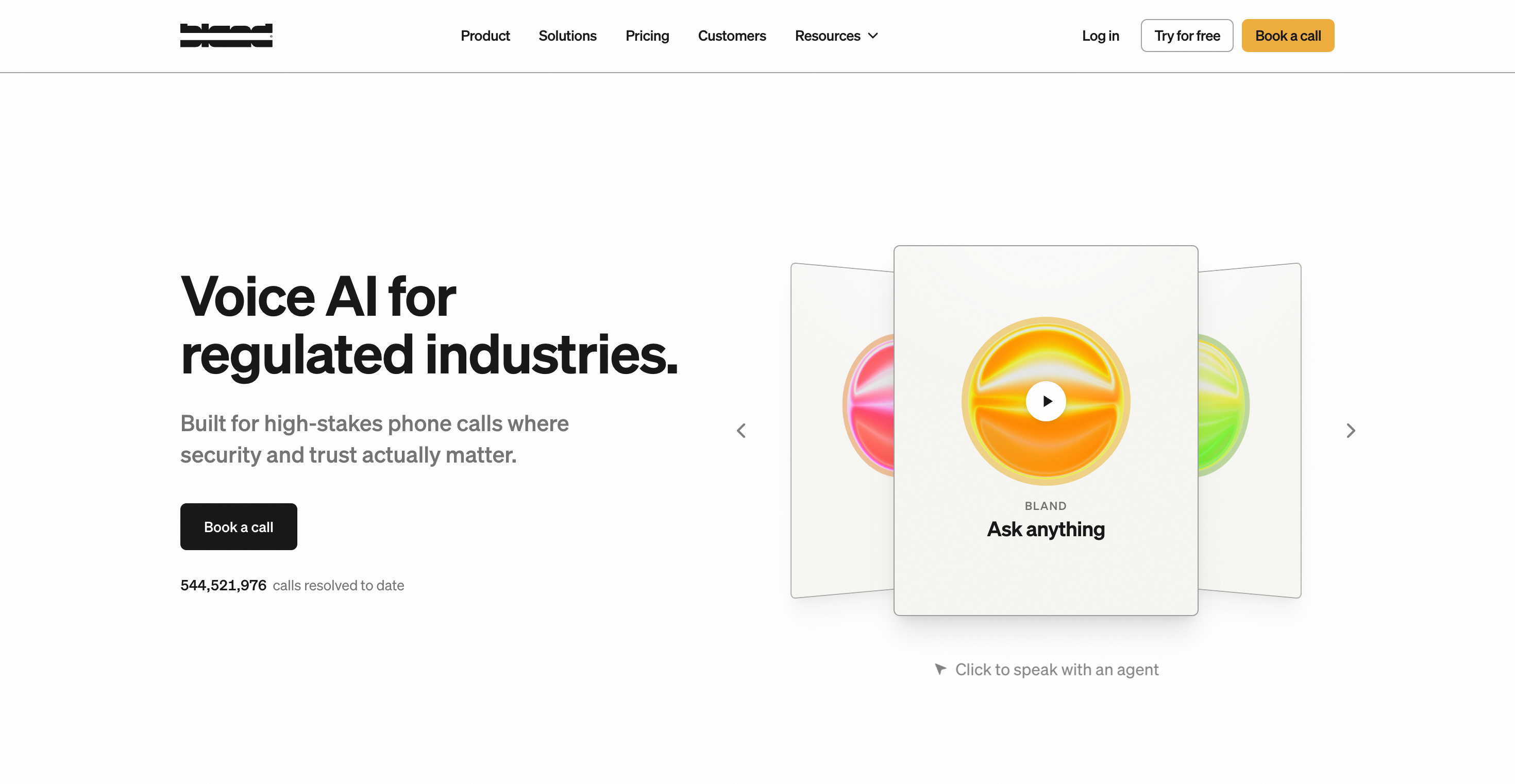
Bland AI handles inbound and outbound phone conversations through pathways and knowledge. APIs govern transfers and post-call data. A caller can ask a question, qualify, and move to a person. SMS gives builders another action surface.
The plan structure is easy to model at volume because higher subscriptions reduce connected-minute and transfer rates. The tradeoff is familiar: your team still owns the sales logic, CRM orchestration, and quality program.
Where Bland’s phone economics work:
- Publishes plan and connected-minute rates.
- Supports transfers and API-driven actions.
- Includes a free starting tier for building.
- Reduces minute rates as the subscription rises.
What remains outside the call:
- Qualification and routing need implementation work.
- The main product experience centers on phone calls.
- Build and Scale add a monthly fee before usage.
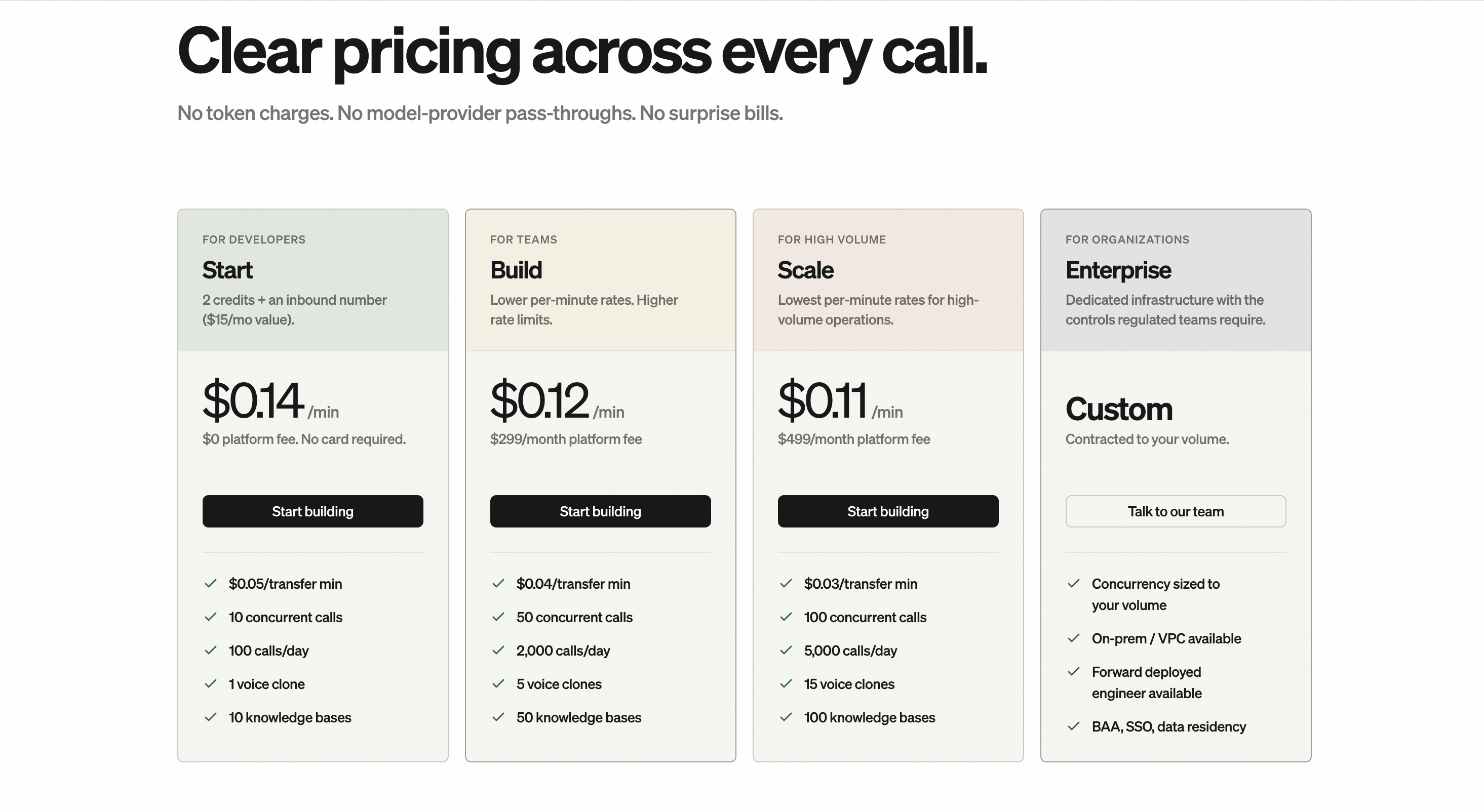
Pricing: Start has no platform fee and charges $0.14 per connected minute. Build costs $299 per month plus $0.12 per minute, while Scale costs $499 plus $0.11 per minute. Start is the free plan. Enterprise gates custom volume and implementation, with maintenance and support set in the agreement.
Bland AI pays off for teams with enough inbound call volume to justify an owned voice automation program.
Best fit: Teams with enough inbound call volume to justify an owned voice program and connected-minute economics.
Skip it if: The call must hand context into a packaged email or WhatsApp follow-up workflow.
9. Voiceflow: best for controlled chat and voice conversation design
Voiceflow: visual agent builder with detailed workflow control
Voiceflow is a collaborative builder for chat and voice agents. Teams combine natural-language instructions with deterministic workflows, then connect the integrations and environments they need. Evaluations and conversation logs show what happened. That makes it useful when brand, legal, or operations teams need to inspect the paths an agent may take.
It can support inbound qualification and booking, but those outcomes come from the workflow your team builds. Since Voiceflow’s current business offer uses request-based pricing, procurement needs a usage model that reflects likely conversation volume and agent behavior before it can compare the platform with a packaged inbound sales agent.
What Voiceflow exposes to builders:
- Gives teams visual control over agent behavior and integrations.
- Supports development, staging, and production environments.
- Covers both chat and voice deployments.
- Includes conversation-level observability and evaluations.
The maintenance tradeoff:
- It is a construction platform rather than a packaged inbound revenue agent.
- A capable builder and ongoing owner are required.
- Current business pricing is not self-serve.
Pricing: Business pricing is custom and request-based. No free business plan; a no-card trial is published for agency workspaces. The top agreement gates managed implementation, production controls, and scaled support.
Voiceflow is worth evaluating when your team must inspect and control the exact conversation design across chat and voice.
Best fit: Product or GTM engineering teams that need inspectable conversation design across chat and voice.
Skip it if: Your priority is a finished inbound revenue workflow with minimal internal build ownership.
10. Landbot: best for no-code website and WhatsApp qualification
Landbot: no-code lead qualification for web and WhatsApp
Landbot combines a visual flow builder, AI agents, forms, lead scoring, human takeover, and common integrations. A visitor can answer qualification questions, receive a calendar option, and enter HubSpot through the Professional plan. WhatsApp requires the channel add-on or its own package.
It is the lightest sales-focused choice here. A revenue team can launch a clear qualification flow without engineering. It does not provide native phone calls or the persistent cross-channel execution of a full inbound sales agent.
Why no-code teams choose Landbot:
- Let non-technical teams build qualification paths.
- Supports lead scoring and human takeover.
- Offers a free sandbox for flow design.
- Adds WhatsApp with published message allowances.
Where the workflow runs out:
- No native AI voice qualification.
- CRM depth and WhatsApp sit above the entry tier.
- Conversation continuity depends on the flow and integrations you configure.
Pricing: Starter costs €40 per month and includes 500 chats plus 100 AI chats. The free sandbox caps usage at 100 chats and includes no AI chats. Professional costs €100 per month; Business starts at €400 and gates custom volume, priority support, and managed bot services.
Landbot fits small and mid-size teams that need a no-code website or WhatsApp qualification flow with a clear human takeover.
Best fit: Small and mid-size teams that need no-code web or WhatsApp qualification with a clear human takeover.
Skip it if: Phone qualification, deep CRM actions, and persistent cross-channel context belong in the same system.
How to choose an AI inbound sales agent for your revenue team
1. Define what the AI should own
Draw the boundary before you compare demos. Does the agent stop after answering and qualification? Does it book, then continue until a rep takes over? A wider boundary increases the need for orchestration and auditability.
2. Identify the inbound source that matters most
A website-led B2B motion points toward Dashly or Qualified. Retell, Vapi, and Bland AI fit a phone-heavy queue. Outcraft makes sense when forms, calls, and follow-up messages must feed one process.
3. Test qualification depth
Static questions are easy to implement. Context-aware qualification is harder because the agent must read account data, apply your criteria, and retain every answer for the next step. What reaches the CRM after a disqualification? Ask the vendor to show you, then repeat the test with a booked meeting.
4. Inspect routing after qualification
Territory, account ownership, and calendar availability can disagree. Give every vendor a real collision from your CRM. The useful demo shows which rule wins and where the decision is logged.
5. Follow one lead across channels
Start the conversation on the website. Continue by email, then ask for a call. If the lead has to repeat the company name or buying need, you are looking at separate surfaces instead of connected revenue workflows.
6. Demand precise CRM behavior
“Integrates with Salesforce” is too broad. Ask whether the agent reads ownership, writes qualification fields, creates an opportunity, changes a stage, and logs the transcript. Then test the duplicate-record path.
7. Define the human handoff
Pick the questions that require a person. Negotiated pricing and unusual security terms are obvious candidates. The rep should receive the reason for transfer and the full conversation.
8. Separate channel availability from orchestration
A tool may support voice and chat while keeping two independent histories. Ask what the next action becomes after an unanswered call. The answer exposes whether you are buying channels or a workflow.
9. Make reporting operational
RevOps needs leads handled, qualification rate, meetings booked, and human handoffs. Response time and drop-off show where the agent fails. Pipeline attribution connects the system to revenue.
10. Calculate the usable monthly cost
A voice platform quoting $0.05 per minute may add model and speech costs. Telephony and internal engineering sit above that rate. At 10,000 minutes, Vapi’s platform line alone is $500. Provider costs and your team’s build time sit above it.
The same rule applies to outcome pricing. One hundred Fin sales qualifications cost $999 before seats. Run your expected volume through the full path, then budget for the person who reviews quality and exceptions.
Where do these tools still need people?
Every option needs a human owner. Someone must approve the knowledge, review failed conversations, and decide when qualification rules change. Programmable platforms add engineering ownership. Packaged agents move more of that burden to the vendor, but RevOps still owns the business rules.
Outcraft has limits too. The $300 monthly entry band may be too much for a team with little inbound volume. Implementation is heavier than installing a chat widget, and voice AI needs a pilot against your accents, call conditions, and transfer rules.
Final Summary:
Dashly and Qualified are excellent website conversion specialists. Retell and Vapi give engineering teams serious voice infrastructure. Landbot is an economical place to start with no-code chat.
Those tools will not all carry a lead from the first signal through a coordinated call and messaging sequence. Outcraft fits when the handoff itself is breaking and your team needs moment, channel, outcome to remain connected.
Bring one missed-call or demo-request workflow to the evaluation, then test whether Outcraft preserves context through qualification, routing, and follow-up. That single run will tell you more than a feature checklist.
FAQs
What is an AI inbound sales agent?
It is an agent that receives an inbound signal, holds the conversation, qualifies intent, and executes the next permitted action. The job can include booking, CRM updates, retries, cross-channel follow-up, and human escalation.
What’s the difference between an AI inbound sales agent and an inbound AI SDR?
An inbound AI SDR generally focuses on converting inbound B2B demand into qualified pipeline. An AI inbound sales agent can cover a wider operating chain across phone calls, SMS, email, WhatsApp, CRM actions, fallback, and handoff.
Our detailed review here.
Can AI sales agents handle inbound calls?
Yes. Outcraft packages inbound call handling into a wider revenue workflow. Retell, Vapi, and Bland AI provide voice infrastructure for teams that want to build and operate the call agent themselves.
Can an agent switch between calls, SMS, email, and WhatsApp?
Some can, but channel availability does not guarantee shared context. Ask the vendor to demonstrate an unanswered call that falls back to a message and then resumes qualification without making the buyer repeat an answer.
Should I buy a packaged agent or build one with Vapi or Retell?
Buy a packaged agent when RevOps wants the vendor to own more of the qualification, fallback, CRM execution, and reporting. Build with Vapi or Retell when engineering needs precise control and accepts responsibility for the full application.
Can AI inbound sales agents update the CRM?
Yes, when the product or your integration supports the required reads and writes. Test ownership lookup, qualification fields, stage changes, transcript logging, and duplicate handling. A generic CRM integration badge does not answer those questions.
How should RevOps govern an autonomous sales agent?
RevOps should define approved knowledge, qualification rules, action permissions, escalation boundaries, and audit requirements. Review failed conversations on a schedule and track the outcome after every handoff.
When should an AI agent hand a conversation to a salesperson?
Escalate when the buyer requests a person or the conversation reaches a decision outside the approved policy. Negotiated pricing, unusual security terms, and sensitive account changes should arrive with the transcript and transfer reason attached.

Summarize with AI