.webp?width=7088&height=1300&name=outcraft.ai-....%20(1).webp "Outcraft AI | Best AI Sales Tool for E-Commerce Brands")
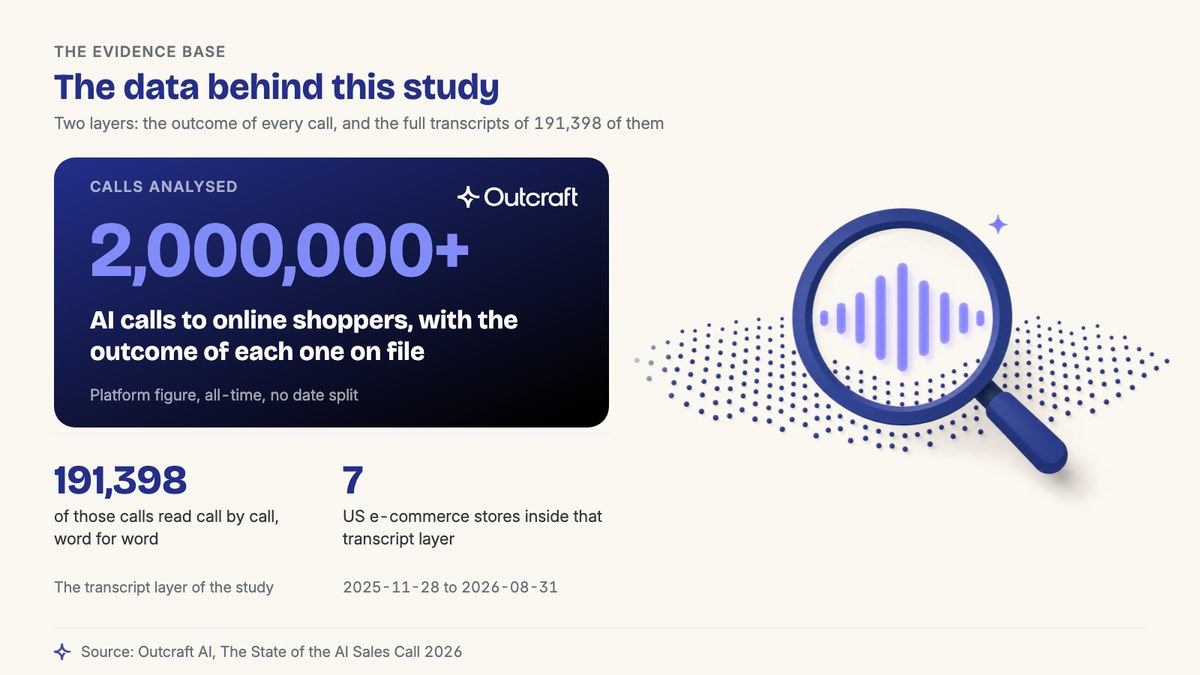
Outcraft analysed the outcomes of more than 2 million AI calls to online shoppers for this study and reviewed the full transcripts of 191,398 of them call by call. The transcript deep dive covers seven US e-commerce stores, November 2025 to August 2026.
Key numbers
The study has two layers. The outcome data of more than 2 million calls gives the platform rates: pick-up, reach and positive outcomes. The transcript deep dive, 191,398 calls with their full transcripts, is where the study reads what happened inside the calls: who spoke, what they asked, when they hung up and what converted.
- Outcraft analysed the outcomes of more than 2 million AI calls to online shoppers for this study and reviewed the full transcripts of 191,398 of them call by call.
- Across more than 2 million calls, 30 to 50% of Outcraft's triggered calls are picked up.
- Of the 35,365 calls Outcraft's agents connected for seven US e-commerce stores between 2025-11-28 and 2026-08-31, 74.8% became a conversation in which the shopper spoke at least twice, and 25.2% ended with the line open and almost nothing said.
- Of the shoppers who picked up an Outcraft call at least once, 13.9% bought (3,307 of 23,806, 2025-11-28 to 2026-08-31).
- Only 6% of undisclosed calls were flagged as AI. Calls where the shopper asked whether they were talking to AI converted at 11.8% against 10.3% for the rest of the 35,365 connected calls, so being asked does not end the call (2025-11-28 to 2026-08-31).
- A shopper asked the agent a real question on 29.2% of Outcraft's 35,365 connected calls, and those calls converted at 17.4% against 7.4% for calls with no question (2025-11-28 to 2026-08-31).
Contents
- How was this study measured?
- Which calls actually get picked up?
- Where do shoppers drop out of an AI call?
- What happens when a shopper asks whether they are talking to AI?
- What do the best-performing AI sales conversations do differently?
- Where does AI voice still fall short?
- How do the published AI calling numbers hold up against 2 million calls?
- What can e-commerce, growth and CRM teams do with this today?
- Limitations
- How to cite this study
- FAQ
- Data appendix
How was this study measured?
Outcraft analysed the outcomes of more than 2 million AI calls to online shoppers for this study and reviewed the full transcripts of 191,398 of them call by call. The first layer is the outcome data of every call the platform has placed: whether it was picked up, whether the person was reached after retries and callbacks, and whether the engagement ended positively. Those are the platform rates. The second layer is the transcript deep dive: a 191,398-call export from seven US e-commerce stores, November 2025 to August 2026, with the full transcript of every call, which is where the study reads what happened inside the conversation. Every figure in this report belongs to one of those two layers.
The transcript deep dive holds 191,398 calls. Three groups were removed before any figure was computed.
| Step | Rows removed | Rows left |
|---|---|---|
| Transcript deep dive as received | 191,398 | |
| Inbound calls | 14,981 | 176,417 |
| Test campaigns (campaign name contains TEST, DO NOT USE or DNU) | 11,559 | 164,858 |
| September 2026, removed for labeling lag | 9,612 | 155,246 |
The transcript deep dive after those removals is 155,246 outbound calls to 116,591 enrollments, 2025-11-28 to 2026-08-31. September 2026 came out because outcome labels lag the call by several weeks, so a September row is a call whose result is not known yet. Inbound calls appear only in the callback finding.
The seven stores sell cookware, health wearables, jewelry, kitchen tools, phone accessories, wellness devices and wellness patches.
What each term means
| Term | Definition used in this study |
|---|---|
| Call | One outbound dial, which is one row in the transcript deep dive. |
| Enrollment | One shopper in one campaign. This is the unit a retry belongs to. |
| Connected | The dialer marked the call as answered. This includes calls where nobody spoke. |
| Conversation | A connected call on which the shopper spoke at least twice. |
| Phantom connect | A connected call on which the shopper did not. |
| Pick-up | A conversation that ran longer than 10 seconds. This is how Outcraft counts a pick-up on its own platform, so silent connects and calls of 10 seconds or less are left out. |
| Reached | A shopper is reached when at least one of their calls is a pick-up. |
| Voicemail | The call reached an answering machine, whether or not the agent left a message. |
| Converted | Outcraft's system labeled the enrollment positive, which means the shopper purchased. It is measured once per enrollment. |
Connected and picked up are separate numbers, because a quarter of what a dial log calls a connection has nobody speaking on it. The purchase label sits on the enrollment, so a shopper bought, and no single call is credited with the sale.
92.9% of the 155,246 calls in Outcraft's transcript deep dive went to US shoppers, which is why the hour-of-day findings are reported in US Eastern time. No rate is published on a cell below 100 calls or 50 connected calls. A best-hour or worst-hour claim is made only on hours carrying at least 1,000 calls and 200 connected calls.
Who the seven stores are
The seven stores are Outcraft customers who agreed to have their aggregate call data analyzed. They sell consumer products at direct-to-consumer price points, they call US phone numbers, they trigger calls from cart abandonment and from post-purchase events, and they set their own retry budgets. Every rate in this report describes what happened on those programs.
Outcraft's platform figures
- Outcraft's AI voice agents have placed more than 2 million calls to online shoppers.
- Across more than 2 million calls, 30 to 50% of Outcraft's triggered calls are picked up.
- Across more than 2 million calls, Outcraft reaches 32.2% of the people it sets out to call once retries and their own callbacks are counted.
- Across more than 2 million calls, 11.8% of the people Outcraft's agents reach end the engagement positively.
Revenue
Outcraft's dashboard attributes USD 1,228,543 in revenue to the AI calling programs of the seven stores in this study, counting coupon redemptions plus attributed orders. More than 1.2 million dollars across seven stores is the money behind the purchase counts in this report, and it is the reason the retry and timing findings later on matter in revenue terms rather than only in rates. The transcript data itself records purchases rather than order values, so every outcome below is a count of shoppers who bought.
Which calls actually get picked up?
Across more than 2 million calls, 30 to 50% of Outcraft's triggered calls are picked up. In the transcript deep dive, three things change how often a call is picked up: which attempt it is, how the previous call ended and the hour it is placed.
Does calling a second time work?
In Outcraft's transcript deep dive, the second call to a shopper is picked up about a third more often than the first (116,591 first calls and 34,245 second calls, 2025-11-28 to 2026-08-31). The third attempt is picked up more often again, on 2,803 calls, and the rate falls back from the fourth attempt on.
The attempt figures need one caveat. The first attempt runs on 116,591 calls and the fifth on 691, and the stores chose which shoppers to keep calling. A rising pick-up rate at attempt three is partly a fact about second chances and partly a fact about which numbers a store decided were worth a third dial. What the data supports is narrower than it looks: the first retry is cheap and it works, and everything past the third attempt here describes a small, selected group.
Two figures on either side of the retry decision matter more than the pick-up comparison. Only 29.4% of the 116,591 shoppers in Outcraft's transcript deep dive were called a second time, and 2.4% a third. Meanwhile, 33.1% of the shoppers who bought after an Outcraft call needed at least two calls to get there (1,369 of 4,134, 2025-11-28 to 2026-08-31). A third of the sales needed a second call that most shoppers on these lists never got. The median gap between an Outcraft first call and the second call to the same shopper is 24.6 hours (34,245 second calls, 2025-11-28 to 2026-08-31), which is what these seven stores did rather than a recommendation.
Does the ending of the first call predict whether the second one is picked up?
When an Outcraft first call ends in a silence timeout, the second call is answered far more often than after a first call that reached voicemail, yet picked up less often (1,247 and 25,022 second calls, 2025-11-28 to 2026-08-31).
A silence timeout looks like a live line, and on the dialer's count it behaves like one, since the second call is answered far more often. Most of those answers again end without a conversation longer than 10 seconds, so a retry after a silence timeout is picked up slightly less often than a retry after a voicemail. The ending of the first call gives no reason to move silence timeouts to the front of the retry queue.
What time of day should an online shopper be called?
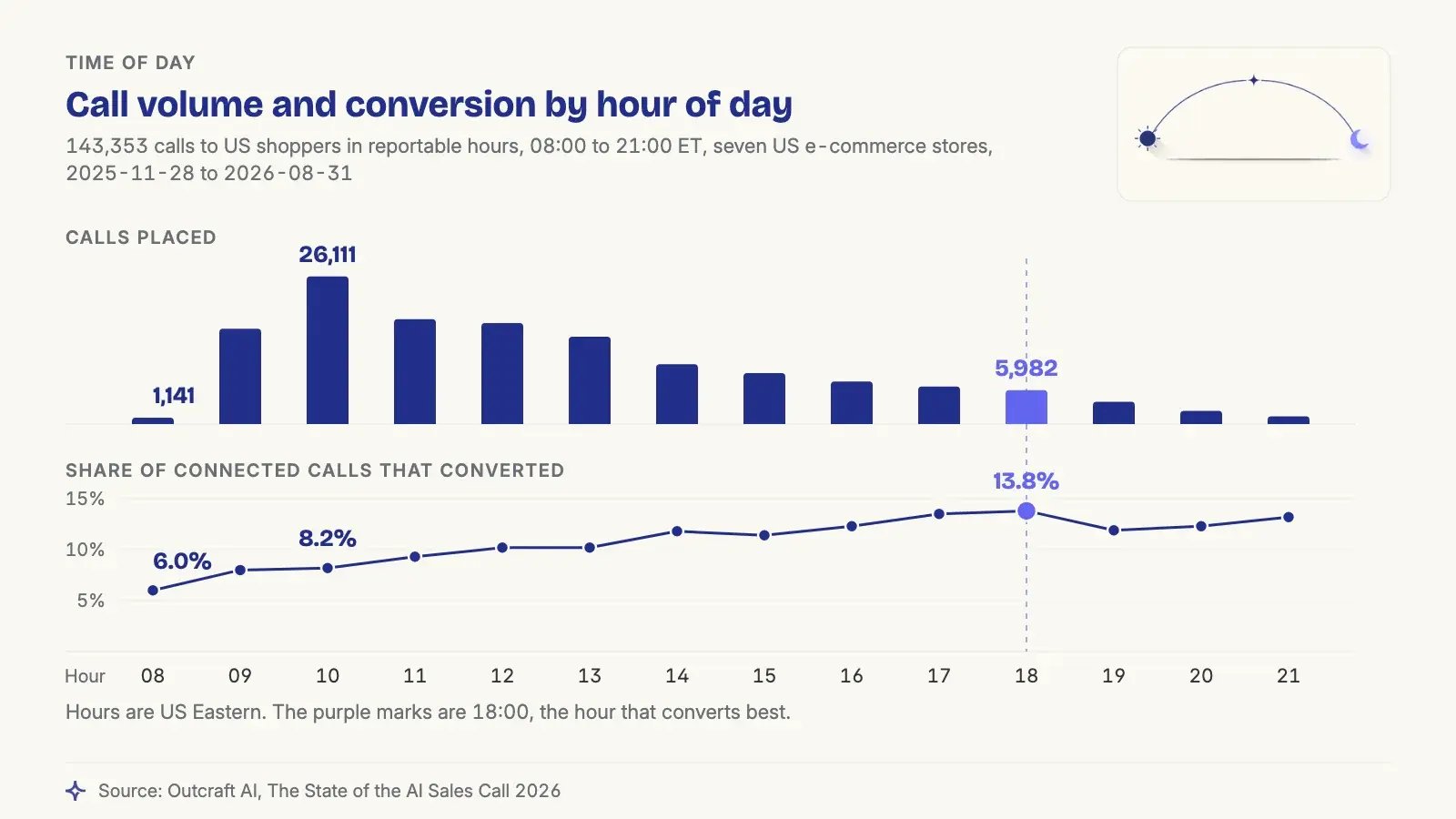
Among the 143,353 calls Outcraft's agents placed to US shoppers in hours with enough volume to report (2025-11-28 to 2026-08-31), pick-up peaks in the mid afternoon and is lowest at 08:00 ET.
Conversion moves further, and it moves away from where the volume sits. The hour that converts best for Outcraft's agents is 18:00 ET at 13.8% of connected calls, while the hour that carries the most volume is 10:00 ET with 26,111 calls converting at 8.2% (US shoppers, 2025-11-28 to 2026-08-31). The worst hour for conversion is 08:00 ET at 6.0% of connected calls.
| Hour (ET) | Calls | Converted share of connected |
|---|---|---|
| 08:00 | 1,141 | 6.0% |
| 10:00 | 26,111 | 8.2% |
| 12:00 | 17,872 | 10.2% |
| 14:00 | 10,595 | 11.8% |
| 16:00 | 7,507 | 12.3% |
| 18:00 | 5,982 | 13.8% |
| 20:00 | 2,339 | 12.3% |
The busiest hour in the transcript deep dive converts at 8.2% of connected calls and carries 26,111 calls. The hour eight hours later converts at 13.8% of connected calls and carries 5,982. The schedule and the results point in opposite directions. Volume sits in office hours because that is when campaign schedules get written. The people being called are consumers, and they are free to talk in the evening.
Weekday behaves the same way. Sunday is the best weekday in Outcraft's transcript deep dive, converting 15.0% of connected calls against 9.4% on Monday (US shoppers, 2025-11-28 to 2026-08-31). Sunday also carries 922 connected calls against Monday's 8,519, so Sunday is a small, receptive slot rather than a place to move a program.
Is a voicemail worth leaving?
Outcraft's agents left an actual message on about half of the calls that reached voicemail, and hung up on the rest (2025-11-28 to 2026-08-31). Whether the agent leaves a message is a client configuration choice, so the split describes how these seven stores set their programs up.
The messages that did get left behave like a channel of their own. 6.2% of the shoppers who got an Outcraft voicemail called the number back, a median 19.8 hours later, and 18.3% of those callers bought, against 10.3% on connected outbound calls (4,405 of 71,024 shoppers, 2025-11-28 to 2026-08-31). A shopper who dials back has already decided to talk, which explains most of that gap. The rate is still the best per-conversation number anywhere in the transcript deep dive.
The strongest version of the voicemail finding is the purchases that arrived with no answered call at all. 19.1% of the purchases Outcraft's system credits to these campaigns happened without the outbound call ever being answered (789 of 4,134 converted shoppers, 2025-11-28 to 2026-08-31), and 88.0% of those shoppers appear in the data calling the number back themselves. For most of the outbound calls to those shoppers, the only thing that happened was a voicemail. The message did the work, the shopper came back on their own line, and the purchase landed.
Those purchases also explain why two headline rates cannot be derived from each other. 3.5% of the 116,591 shoppers Outcraft's agents were asked to call for seven US e-commerce stores between 2025-11-28 and 2026-08-31 ended up buying, and of the shoppers who picked up an Outcraft call at least once, 13.9% bought. The 827 shoppers who bought without ever picking up an outbound call, 789 of them without any answered call at all, count in the first rate and sit outside the second.
Where do shoppers drop out of an AI call?
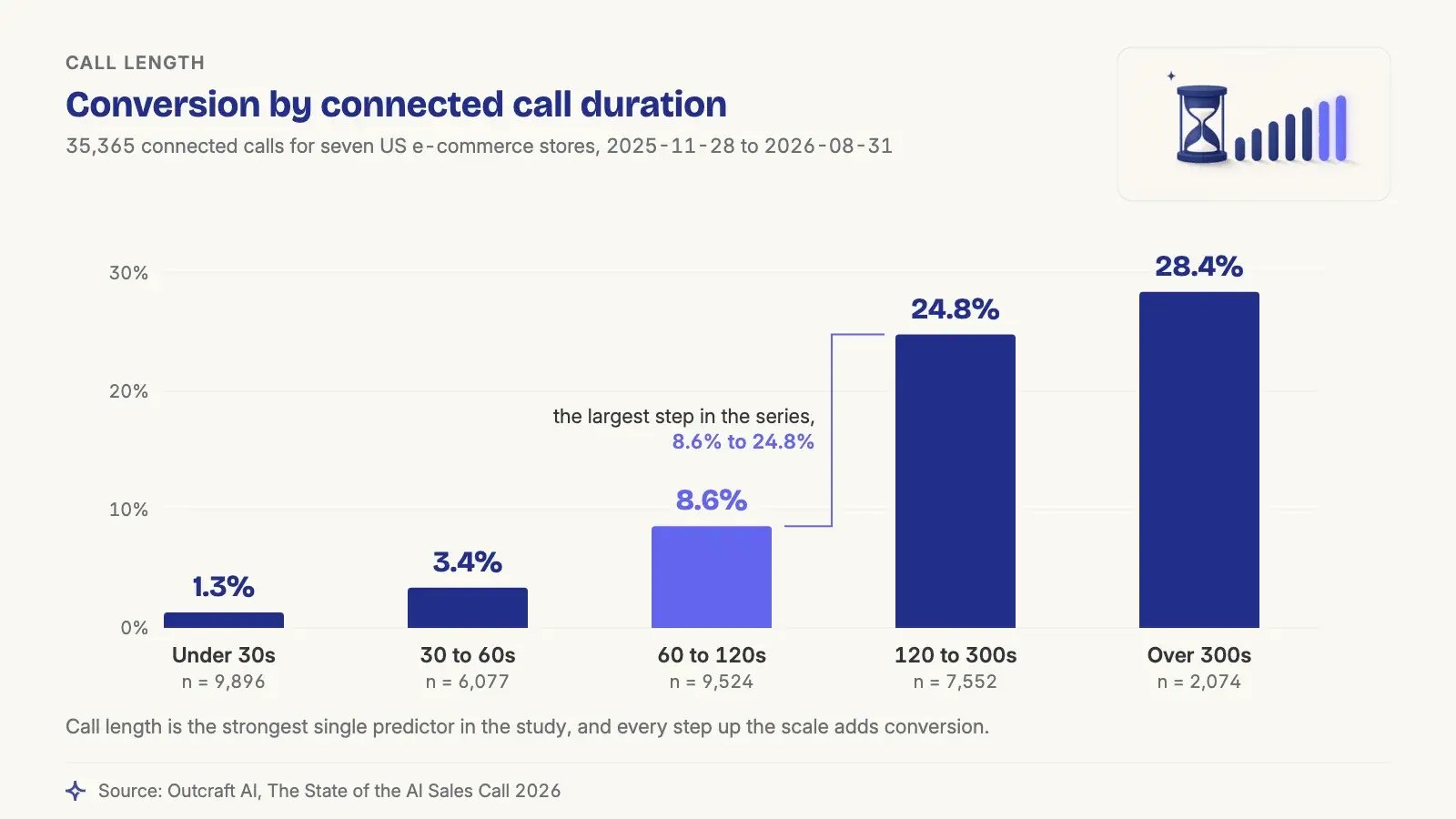
In Outcraft's transcript deep dive of 35,365 connected calls (2025-11-28 to 2026-08-31), the share belonging to a shopper who bought rises with every step of call length, from 1.3% under 30 seconds to 28.4% past five minutes. A connected call that belongs to a shopper who bought runs a median 163 seconds in Outcraft's transcript deep dive, against 61 seconds for the rest (3,654 against 31,711 connected calls, 2025-11-28 to 2026-08-31).
| Call length | Connected calls | Converted share |
|---|---|---|
| 0 to 30s | 9,896 | 1.3% |
| 30 to 60s | 6,077 | 3.4% |
| 60 to 120s | 9,524 | 8.6% |
| 120 to 300s | 7,552 | 24.8% |
| 300s+ | 2,074 | 28.4% |
The largest step sits between the 60 to 120 second band and the 120 to 300 second band, where the converted share moves from 8.6% to 24.8%. Causation runs the other way here. Interest keeps a shopper on the line, so length is mostly an effect of wanting the product and only weakly a cause of buying it. A program that chases longer calls by making the agent talk more will get longer calls and the same number of sales.
How many connected calls have nobody speaking on them?
Of the 35,365 calls Outcraft's agents connected for seven US e-commerce stores between 2025-11-28 and 2026-08-31, 74.8% became a conversation in which the shopper spoke at least twice, and 25.2% ended with the line open and almost nothing said. Those phantom connects run a median 18 seconds, against 85 seconds for a real conversation.
Answer detection causes phantom connects. Telephony marks a line as answered the moment audio starts, and audio starts whether a person picks up and says nothing, a machine answers with a greeting that sounds like a person, or a handset gets knocked off a table. Outcraft's own pick-up count leaves the phantom connects out, together with the few conversations that lasted 10 seconds or less or have no duration on file.
Who ends an AI sales call, and what does that say about the outcome?
In Outcraft's 35,365 connected calls (2025-11-28 to 2026-08-31), calls the agent closed itself carry a conversion share of 20.9%, while calls the shopper hung up carry 4.8%.
| How the call ended | Connected calls | Share of connected | Converted share |
|---|---|---|---|
| The shopper hung up | 18,784 | 53.1% | 4.8% |
| The agent closed the call | 12,704 | 35.9% | 20.9% |
| Silence timeout | 3,612 | 10.2% | 1.1% |
| Hit the maximum call length | 265 | 0.7% | 21.5% |
The shopper hangs up on 53.1% of connected calls and those convert at 4.8%. The agent closes 35.9% of them and those convert at 20.9%. Calls that run into the maximum length are rare, 265 of 35,365, and they convert at 21.5%, which is the same territory as agent-closed calls. Silence timeouts end 10.2% of connected calls and convert at 1.1%.
Who ends the call is the sharpest separation in the transcript deep dive and the hardest one to act on. The interest that produces a sale is the same interest that keeps a shopper on the line until the agent closes, so the ending marks the outcome more than it drives it. Instructing an agent to refuse to let go will not move the 4.8% column.
What do shoppers object to out loud?
The objection shoppers voice most often to Outcraft's agents is 'not interested', on 7.6% of 35,365 connected calls, ahead of 'bad time, call back later' on 6.8% (2025-11-28 to 2026-08-31).
| Objection | Connected calls | Share of connected |
|---|---|---|
| Not interested | 2,676 | 7.6% |
| Bad time, call back later | 2,413 | 6.8% |
| Shipping or delivery problem | 1,091 | 3.1% |
| Already purchased | 867 | 2.5% |
| Too expensive | 683 | 1.9% |
| Do not call | 514 | 1.5% |
Price sits fifth on the list at 1.9% of connected calls, below a delivery problem at 3.1% and below a shopper saying they already bought at 2.5%. Timing and flat disinterest lead. The request never to be called again is the smallest category at 1.5%.
Two caveats go with the objection table. These are spoken objections detected by pattern matching, so the list is a partial taxonomy of why people abandon carts. They also cannot be compared one for one with survey-stated reasons, which is what most published cart-abandonment research measures. Baymard's meta-analysis of cart abandonment rates, a meta-average of 50 studies published between 2006 and 2025, documents a 70.22% average abandonment rate, with reasons collected by asking shoppers afterwards. A shopper saying "bad time" into a phone while doing something else is a different measurement from the same shopper ticking a box in a survey a week later.
What happens when a shopper asks whether they are talking to AI?
Only 6% of undisclosed calls were flagged as AI. On a short transactional call about a shopper's own cart, the question of whether the caller is AI mostly does not come up, and most calls end before it could.
Being asked does not end the call. Calls where the shopper asked whether they were talking to AI convert at 11.8% against 10.3% for the rest of the 35,365 connected calls (2025-11-28 to 2026-08-31), and they run a median 118 seconds against 66 seconds. A shopper engaged enough to ask is a shopper still on the line, which is the same selection effect that drives the call-length curve.
The only comparable published work looks at the other side of the call. Upfirst's June 2026 analysis of 450,702 calls across 503 AI receptionists found that disclosing AI status was associated with roughly 20% lower hang-ups on inbound calls, where the caller initiated contact. NextPhone's analysis of 1,446,980 inbound business calls placed in 2025 covers the same inbound population. Outcraft's data covers outbound calls to consumers who dialed nobody, and the same holds there: a shopper who asks stays on the line.
How do shoppers behave toward an AI caller?
Shoppers were abusive or hostile on 1.7% of the 35,365 calls Outcraft's agents connected, and used profanity on 0.6% (2025-11-28 to 2026-08-31). Shoppers thanked the agent on 42.7% of Outcraft's connected calls, and the rate is nearly the same on calls that ended in a sale (69.2%) and calls that ended in a refusal (64.4%), 2025-11-28 to 2026-08-31. The 42.7% denominator is every connected call, including the phantom connects where nobody spoke, while the 69.2% and 64.4% figures count only calls that carry an outcome label, which is why the two subgroup rates sit above the overall one.
Neither the abuse rate nor the gratitude rate is a satisfaction score. The abuse rate has no human call-center comparison inside the transcript deep dive, so it says what shoppers did to this agent and carries no comparison with how they treat people. Gratitude at a near-identical rate on sales and on refusals marks a conversation that finished. "Thank you" is how a US phone call ends.
What do the best-performing AI sales conversations do differently?
A shopper asked the agent a real question on 29.2% of Outcraft's 35,365 connected calls, and those calls converted at 17.4% against 7.4% for calls with no question (2025-11-28 to 2026-08-31). With 10,332 calls carrying a question, this is the strongest single marker in the transcript deep dive.
The questions counted here are the shopper's. A question is the moment the shopper takes over the call, which happens once they have decided the call is about something they want. Counting question marks in a transcript gives a useless number, because most of them are a one-word "hello?".
Which questions predict a purchase?
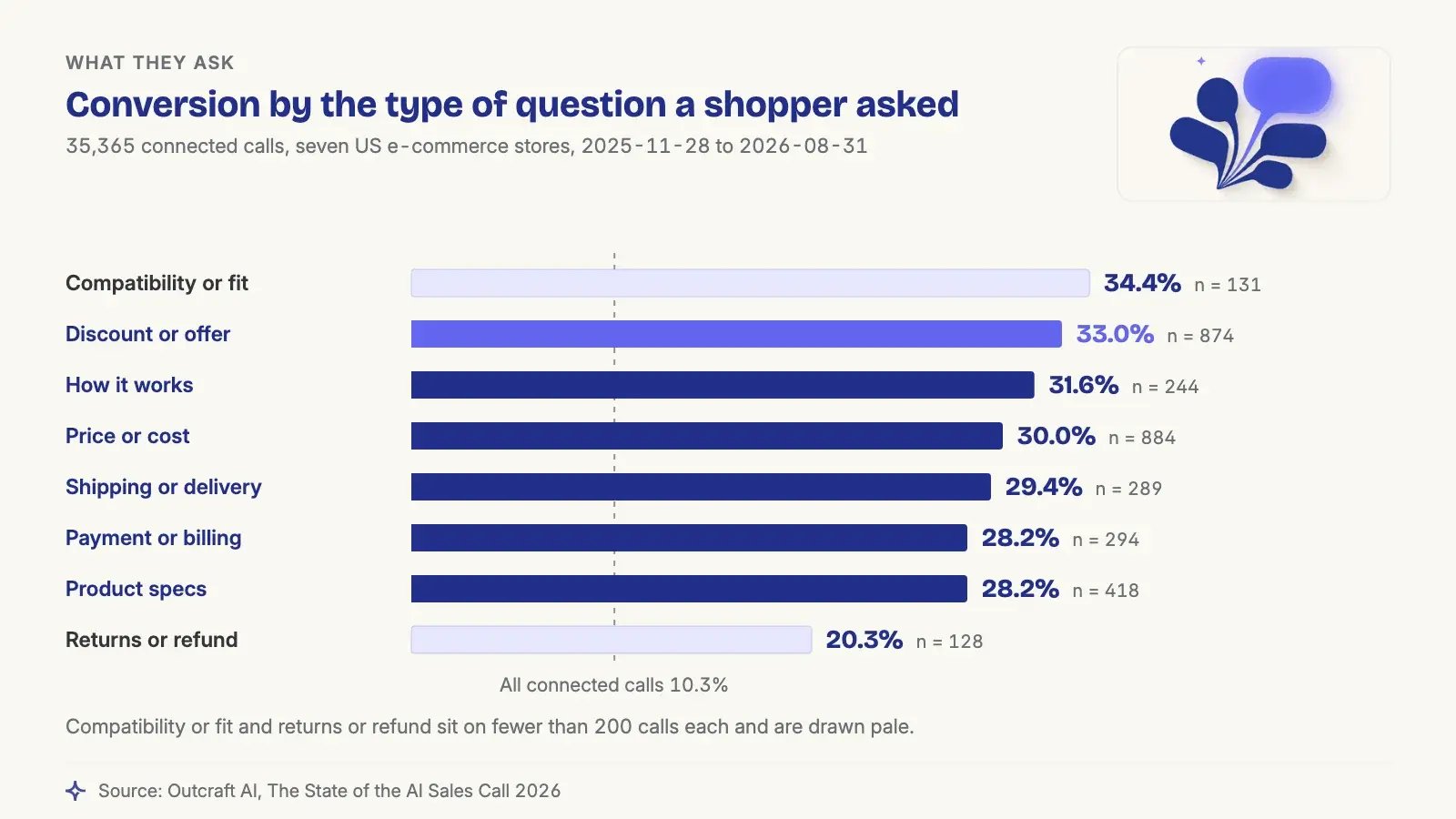
Every commercial question a shopper asks an Outcraft agent marks a call that converts two to three times above the baseline: discount or offer at 33.0% and price or cost at 30.0%, against 10.3% across all 35,365 connected calls (2025-11-28 to 2026-08-31).
| What the shopper asked about | Connected calls | Converted share |
|---|---|---|
| Compatibility or fit | 131 | 34.4% |
| Discount or offer | 874 | 33.0% |
| How it works | 244 | 31.6% |
| Price or cost | 884 | 30.0% |
| Shipping or delivery | 289 | 29.4% |
| Payment or billing | 294 | 28.2% |
| Product specs | 418 | 28.2% |
| Returns or refund | 128 | 20.3% |
Compatibility or fit tops the list at 34.4% on 131 calls, too few calls to headline. The two buckets carrying real volume are discount or offer at 33.0% on 874 calls and price or cost at 30.0% on 884 calls. Returns or refund is the weakest commercial question at 20.3%, against the 10.3% baseline across all connected calls.
The buckets overlap, because one call can contain a price question and a shipping question, so the rows never sum. Timing explains more of this than psychology does. Asking what it costs, when it arrives or whether it fits is the last step before buying, so those questions sit close to the decision in time.
Does naming a specific offer help, or does it just mean the call lasted longer?
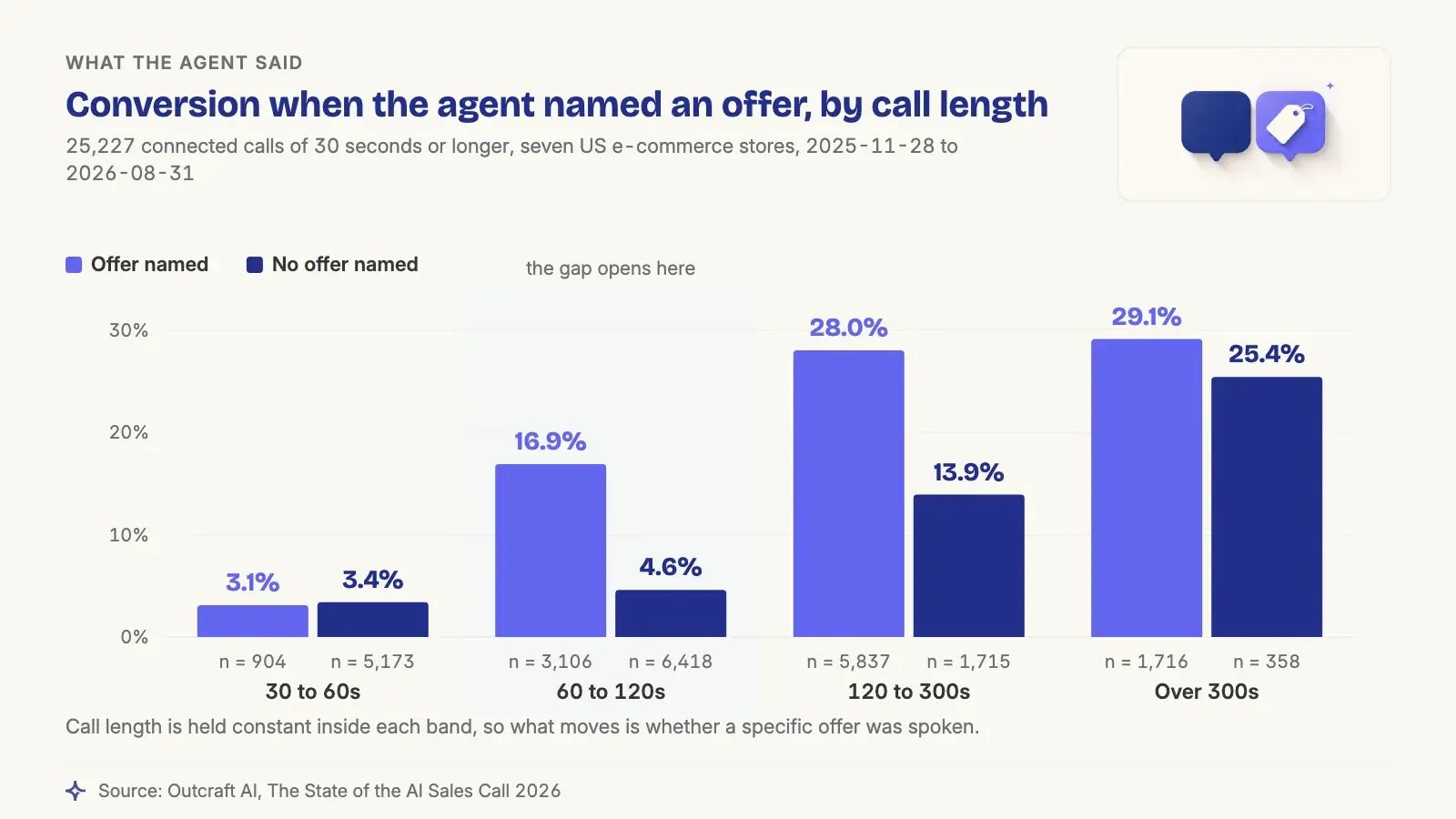
Holding call length constant, Outcraft calls in which the agent named a specific offer convert better at every length: in the 60 to 120 second band, 16.9% against 4.6% (3,106 against 6,418 connected calls, 2025-11-28 to 2026-08-31).
| Call length | Offer named | No offer named |
|---|---|---|
| 30 to 60s | 3.1% (n=904) | 3.4% (n=5,173) |
| 60 to 120s | 16.9% (n=3,106) | 4.6% (n=6,418) |
| 120 to 300s | 28.0% (n=5,837) | 13.9% (n=1,715) |
| 300s+ | 29.1% (n=1,716) | 25.4% (n=358) |
This table starts at 30 seconds because only 172 connected calls under 30 seconds carried a named offer. Table A7 publishes that band with the rest.
The point of the table is the control for call length. Under 60 seconds the two arms are level, 3.1% with an offer and 3.4% without, because almost no call gets far enough for an offer to be spoken. The gap opens in the 60 to 120 second band at 16.9% against 4.6%, stays open at 28.0% against 13.9% in the two to five minute band, and all but closes past five minutes at 29.1% against 25.4%, where a call that long carries its own interest.
Without the duration control the offer comparison looks much larger than it is, because an offer is only reached when a call survives its opening. The measure is whether the agent spoke a specific offer, which says nothing about whether the size of the discount moved anyone.
What does a phone upsell after a purchase accept at?
When Outcraft's agents call a shopper after a purchase and offer an add-on, 11.6% of the shoppers who pick up accept (1,007 of 8,705, 2025-11-28 to 2026-08-31). Measured per connected call instead, the figure is 8.9% of 11,402 calls.
The upsell figure counts shoppers who picked up, which is why it cannot be compared with on-site upsell benchmarks measured per order. One-click post-purchase offers on a checkout page are measured per order, and the published platform benchmarks for that format sit around 4%, with 10% or more for strong merchants, on vendor pages that state no sample size and no window. A phone upsell reaches far fewer people and converts a much larger share of the ones it reaches. The two numbers answer different questions.
Cart recovery is the biggest job Outcraft's agents do for these seven stores (104,914 of 155,246 calls) and post-purchase upsell the second (47,225 calls), converting 10.8% and 8.9% of their connected calls (2025-11-28 to 2026-08-31). Onboarding accounts for 2,406 calls, with 9.7% of connected calls converting.
On the calls that run long enough for the agent to ask why the shopper bought, the answer predicts the next acceptance. In the Outcraft calls long enough for the agent to ask why the shopper bought (4,244 calls of 120 seconds or more, 2025-11-28 to 2026-08-31), shoppers who gave a product reason such as cooking or kitchen accepted the next offer at 33.4%, against 18.0% for shoppers who named a problem they wanted solved such as pain or recovery. Quality or material sits highest at 36.4% on 450 calls, curiosity at 21.4% on 589, general health at 23.3% on 579, and stress or anxiety lowest at 17.8% on 873.
Where does AI voice still fall short?
AI voice falls short in a handful of measurable places in the transcript deep dive, and the largest is silence on a line the dial log calls connected. Of the 35,365 calls Outcraft's agents connected for seven US e-commerce stores between 2025-11-28 and 2026-08-31, 74.8% became a conversation in which the shopper spoke at least twice, and 25.2% ended with the line open and almost nothing said. Answer detection cannot tell a silent human from a voicemail greeting that sounds like one, so the dial log reports a connection and there is nobody to talk to. This is why Outcraft does not count those calls as pick-ups.
Silence timeouts are a large ending category on their own. 10.2% of connected calls end with the agent waiting for speech that never comes, at a median 67 seconds, and 1.1% of those calls belong to a shopper who bought. The agent has no way to recover a call where the shopper has put the handset down without hanging up, and a retry does not rescue it either: the next call after a silence timeout is answered far more often than after a voicemail, yet picked up less often (1,247 second calls).
Some shoppers want a person. On 2.1% of the 35,365 outbound calls Outcraft's agents connected, the shopper asked to be put through to a person (743 calls, 2025-11-28 to 2026-08-31). The seven stores had not set up a live transfer on these outbound programs, so on 12.8% of those calls the agent offered the support email instead. The rate is low, and a configured hand-off is the answer for the shopper who asks.
Objection detection is pattern matching. The objection list in this report is built by matching spoken patterns in transcripts. It catches the phrases shoppers actually say and misses the ones phrased in ways the patterns do not cover, so the shares are floors and the taxonomy is incomplete.
The data describes what happened rather than proving cause. These programs ran without a control group, and the transcript deep dive cannot see what the same shopper received by email or SMS in the same days. Every comparison in this report is between groups that formed on their own.
The seven stores are not one population. Across the seven stores in Outcraft's transcript deep dive, the share of shoppers who picked up and then bought runs from 9.4% to 23.9% (2025-11-28 to 2026-08-31). List quality, price point and how quickly the trigger fires after the cart differ per store.
Two campaign types are too small to measure and are reported as counts. Winback is the one campaign type too small to measure in Outcraft's transcript deep dive, at 293 calls and 51 pick-ups across the whole window. The cart-recovery variants whose name carries a specific discount span 9.6% to 22.2% on conversion of connected calls, on samples too small and too unevenly timed to rank them (3,787 calls in total, 2025-11-28 to 2026-08-31).
Which calls suit AI voice?
AI voice works best on:
- Abandoned checkout.
- Lead follow-up.
- High-intent product enquiries.
- Reactivation.
It is a weaker fit for:
- Completely cold outreach.
- Complex disputes.
- Highly emotional conversations.
- Situations with very little context.
The closer the call is to a clear customer action, the stronger the use case becomes.
How do the published AI calling numbers hold up against 2 million calls?
The published numbers about calling online shoppers hold up poorly against Outcraft's data, and the six most widely circulated ones are a mix of unsourced vendor claims, sourced figures that measure a different population, and surveys of stated preference. Each row below describes its source by what that page says, checked on 2026-09-16, and sets it beside what Outcraft's data shows.
| Claim in circulation | Where it comes from | What the Outcraft data shows |
|---|---|---|
| "Cart recovery went from 10% to 55% once we started calling." | One Shopify operator writing up his own store on a vendor blog. The page says "I achieved a 55% recovery rate" and "my cart recovery rate skyrocketed from 10% to 55%", with no sample size and no window on either figure. The wider 25 to 55% range that circulates in the category appears nowhere on this page. | 3.5% of the 116,591 shoppers Outcraft's agents were asked to call for seven US e-commerce stores between 2025-11-28 and 2026-08-31 ended up buying. Cart recovery converts 15.0% of the shoppers who pick up (2,180 of 14,560) and 3.4% of all shoppers called (2,644 of 78,102 enrollments). |
| "Outbound e-commerce recovery calls connect at 70 to 85%." | A vendor page stating "Phone calls achieve 70-85% connection rates", with no sample size, no method statement, no window and no source named for the figure. | Across more than 2 million calls, 30 to 50% of Outcraft's triggered calls are picked up. |
| "Around 80% of business calls go to voicemail." | The two pages most often linked for this measure other things. getaira.io reports a 2024 study by 411 Locals across 85 businesses in 58 industries, where 37.8% of inbound calls were answered live, 37.8% reached voicemail and 24.3% got no response, and it carries no 97% figure. oncallclerk.com says "80% or more of callers who reach a business voicemail will hang up without leaving a message", sourced to Hiya's State of the Call report, which is a share of callers rather than a share of calls. Both pages describe inbound calls to businesses. | 6.2% of the shoppers who got an Outcraft voicemail called the number back, and 18.3% of those callers bought (4,405 of 71,024 shoppers called back, 2025-11-28 to 2026-08-31). |
| "93% of converted leads are reached by the sixth call attempt." | Velocify's 2013 B2B lead-response study, no longer published by its author and surviving through third-party citation. | Only 29.4% of the 116,591 shoppers in Outcraft's transcript deep dive were called a second time, and 2.4% a third, while 33.1% of the shoppers who bought needed at least two calls. On consumer recovery calls the live question is the second attempt. |
| "4pm to 5pm is the best window to call." | A CallHippo page on cold calling, updated 10 September 2026, reporting a survey of calling metrics from 500+ sales teams across 12 industries and 20+ countries. The best-hour finding rests on 125 conversions in the 4 to 5 PM slot against 91 in the 10 to 11 AM slot, with no call volume stated and no window. The page is about sales teams cold calling. | Among the 143,353 calls Outcraft's agents placed to US shoppers in hours with enough volume to report (2025-11-28 to 2026-08-31), the best converting hour is 18:00 ET at 13.8% of connected calls. |
| "79% of Americans strongly prefer interacting with a human over an AI agent." | SurveyMonkey's 2025 CX study, fielded on 10 and 11 December 2025 among 2,017 US adults aged 18 and over drawn from a non-probability online panel, with a modeled error estimate of plus or minus 2.5 percentage points. It measures what people say they prefer. | Only 6% of undisclosed calls were flagged as AI. Shoppers were abusive or hostile on 1.7% of connected calls and thanked the agent on 42.7%. |
The SurveyMonkey row shows the biggest gap between what people say and what they do. A two-day survey records what people say about AI on the phone. The transcript deep dive records what 35,365 of them did when one called, and the two produce a different picture of the same behavior.
Two published sources do state their method, and this report prints both beside its own numbers as context. Natterbox reports a 60.6% connection rate across 58.2 million calls taken from production telephony records covering 2024 to 2025, on contact-center traffic that includes inbound calls and warm outbound calls to people expecting contact. Klaviyo's abandoned cart flow benchmark, built on more than 143,000 flows sent in 2023 and published in 2024, puts the placed-order rate for abandoned cart emails at 3.33% of recipients, which is the closest published figure to a per-targeted-shopper rate in any channel. The nearest figure in the transcript deep dive is 3.5% of the 116,591 shoppers targeted between 2025-11-28 and 2026-08-31. Those two numbers measure different channels over different windows, so this report sets them side by side and draws no channel comparison from the pair.
What can e-commerce, growth and CRM teams do with this today?
Three things decide whether a call works: timing, context and conversation. The voice itself is only one part of the equation. The change with the most room in this data is the second call.
Timing
Call while the intent is fresh. Place the call soon after the action that triggered it, a checkout left unfinished or a purchase just made, while the shopper's purchase intent is still there.
Call a second time, and treat the second call as part of the program. Only 29.4% of the 116,591 shoppers in Outcraft's transcript deep dive were called a second time, and 2.4% a third (2025-11-28 to 2026-08-31), while 33.1% of the shoppers who bought after an Outcraft call needed at least two calls to get there (1,369 of 4,134, 2025-11-28 to 2026-08-31). The second attempt is also picked up about a third more often than the first. The retry budget is set by the store, so this is the cheapest gap in the transcript deep dive to close.
Move volume toward the hours that convert. The hour that converts best for Outcraft's agents is 18:00 ET at 13.8% of connected calls, while the hour that carries the most volume is 10:00 ET with 26,111 calls converting at 8.2% (US shoppers, 2025-11-28 to 2026-08-31). Evening volume is small, so there is room to move calls into it before those hours fill up.
Context
Give the agent the reason for the call. The agent should know why it is calling and what the shopper was doing just before, such as the product left at checkout and the offer that applies to it.
Be ready for the real question. A shopper asked the agent a real question on 29.2% of Outcraft's 35,365 connected calls, and those calls converted at 17.4% against 7.4% for calls with no question (2025-11-28 to 2026-08-31). The questions that mark a sale are about the shopper's own order: discount or offer at 33.0%, price or cost at 30.0%, against 10.3% across all connected calls. An agent that knows the cart can answer them on the spot.
Name the specific offer. Holding call length constant, Outcraft calls in which the agent named a specific offer convert better at every length: in the 60 to 120 second band, 16.9% against 4.6% (3,106 against 6,418 connected calls, 2025-11-28 to 2026-08-31). Under a minute the two are level, because almost no call gets far enough for an offer to be spoken.
Conversation
Respond to hesitation. When a shopper hesitates, the agent answers what the shopper just said and keeps the call on that point. A program that chases longer calls by making the agent talk more will get longer calls and the same number of sales.
Watch who ends the call. Calls the agent closed itself convert at 20.9% and calls the shopper hung up convert at 4.8% (35,365 connected calls, 2025-11-28 to 2026-08-31). The interest that produces a sale is the same interest that keeps a shopper on the line until the agent closes, so the ending marks the outcome more than it drives it. Instructing an agent to refuse to let go will not move the 4.8%.
Measure the program on pick-ups. Of the 35,365 calls Outcraft's agents connected for seven US e-commerce stores between 2025-11-28 and 2026-08-31, 74.8% became a conversation in which the shopper spoke at least twice, and 25.2% ended with the line open and almost nothing said. A team reporting a connect rate to its board is reporting a number that includes a quarter of calls where nobody spoke, and any cost-per-connection the finance team uses carries the same inflation. The same gap sits in the retry queue: after a silence timeout the next call is answered far more often than after a voicemail, yet picked up less often, so a line that answered in silence once gives a retry no head start.
Count the voicemail that still sells. 6.2% of the shoppers who got an Outcraft voicemail called the number back, a median 19.8 hours later, and 18.3% of those callers bought, against 10.3% on connected outbound calls (4,405 of 71,024 shoppers, 2025-11-28 to 2026-08-31). A program that counts only answered outbound calls will miss the 19.1% of purchases (789 of 4,134 converted shoppers) that happened without the outbound call ever being answered.
The calls in this study ran on Outcraft.
Limitations
Seven stores, one platform, one market. The dataset covers seven US e-commerce stores running on Outcraft, selling consumer products at direct-to-consumer price points. Conversion of shoppers who picked up runs from 9.4% to 23.9% across them, so the pooled averages describe these seven programs. 92.9% of the 155,246 calls went to US shoppers, and the non-US remainder is too thin to split by country.
One label system, applied per enrollment. Converted means Outcraft's system labeled the enrollment positive, which means the shopper purchased. The label sits on the enrollment, so a converted enrollment carries its label across every call in it.
Purchases, not order values. The transcript deep dive records whether a shopper bought, not the order value, so the findings are counts and rates. The USD 1,228,543 revenue figure comes from Outcraft's dashboard attribution across the seven stores, counting coupon redemptions plus attributed orders.
Cross-channel and cross-window comparisons are context only. The external figures quoted in this report come from different channels, different populations and different years: a 2006 to 2025 cart-abandonment meta-average, email flow benchmarks from 2023 sends published in 2024, contact-center telephony records from 2024 to 2025, a consumer survey fielded in December 2025, a 2026-dated cold-calling page, and inbound AI receptionist datasets from 2025 and June 2026. None of them shares the transcript deep dive's window, channel or population, so each one sits beside the Outcraft figure as context only.
The window is unevenly shaped. Outcraft's program with these stores grew through the window: 67.6% of the 155,246 calls fall in the last two months of it, July and August 2026. Seasonal effects, agent changes and list changes cannot be separated from the calendar, so this study makes no claim about a trend over time.
Attempt effects are survivorship. Pick-up climbs from the first attempt to the third, on 116,591 calls against 2,803. The stores chose which shoppers to keep dialing, so the later-attempt rates describe a selected group and cannot be read as what a fourth call would do on an average shopper.
Observational, not experimental. These campaigns ran without a control group, so this report describes what happened on them and draws no causal claims.
Text-derived measures are pattern matched. Objections, questions, offers, abuse and gratitude are detected from transcript text. Each of those rates is a floor, since a pattern set catches what it was built to catch and misses phrasings outside it.
How to cite this study
Outcraft AI (2026), "The State of the AI Sales Call 2026: What 2 Million AI Calls to Online Shoppers Show", retrieved from https://www.outcraft.ai/blog/state-of-the-ai-sales-call-2026 on the date you retrieved it.
Any figure in this report may be quoted with attribution to Outcraft AI and a link to the report URL. The aggregate tables behind every chart are published as a CSV in the data appendix below, and they may be redistributed under the same attribution. Corrections are made in place on this page, and each one is recorded with its date in the list below.
Corrections and updates. This page logs every correction with the date it was made. 2026-10-14: first publication.
FAQ
What percentage of AI voice calls to online shoppers get picked up?
Across more than 2 million calls, 30 to 50% of Outcraft's triggered calls are picked up. Once retries and the shoppers' own callbacks are counted, Outcraft reaches 32.2% of the people it sets out to call.
What is the best time of day to call an e-commerce customer?
Among the 143,353 calls Outcraft's agents placed to US shoppers in hours with enough volume to report (2025-11-28 to 2026-08-31), pick-up peaks in the mid afternoon and is lowest at 08:00 ET. Conversion peaks later in the day than volume does: 18:00 ET converts 13.8% of connected calls, while the busiest hour, 10:00 ET, converts 8.2%.
Do shoppers hang up when they find out they are talking to an AI?
Only 6% of undisclosed calls were flagged as AI. Calls where the shopper asked whether they were talking to AI converted at 11.8% against 10.3% for the rest of the 35,365 connected calls between 2025-11-28 and 2026-08-31, and ran a median 118 seconds against 66, so being asked does not cost the call. Shoppers were hostile on 1.7% of connected calls.
How many times should you call a shopper who abandoned a cart?
At least twice. In Outcraft's transcript deep dive the second call is picked up about a third more often than the first (116,591 and 34,245 calls, 2025-11-28 to 2026-08-31), and 33.1% of the shoppers who bought needed at least two calls to get there (1,369 of 4,134). Only 29.4% of the 116,591 shoppers in the transcript deep dive were called a second time.
Is leaving a voicemail for an online shopper worth it?
Outcraft's agents left a message on about half of the calls that reached voicemail between 2025-11-28 and 2026-08-31. 6.2% of shoppers who got a voicemail called back, a median 19.8 hours later, and 18.3% of those callers bought, against 10.3% on connected outbound calls.
What does a post-purchase upsell call convert at?
When Outcraft's agents call a shopper after a purchase and offer an add-on, 11.6% of the shoppers who pick up accept, which is 1,007 of 8,705 shoppers between 2025-11-28 and 2026-08-31. Measured per connected call the figure is 8.9% of 11,402 calls. The figure counts shoppers who picked up, so it cannot be compared with on-site upsell rates measured per order.
Data appendix
Every aggregate cell behind the charts in this report is published as a downloadable CSV: download the data (CSV). Cells below the reporting floor of 100 calls or 50 connected calls are blanked. The converted column counts distinct converted enrollments with at least one call in that cell, so it does not sum across cells.
Table A1. Outcome by hour of day, US Eastern, US shoppers
| Hour (ET) | Calls | Connected | Converted share of connected |
|---|---|---|---|
| 08:00 | 1,141 | 215 | 6.0% |
| 09:00 | 16,852 | 3,522 | 8.0% |
| 10:00 | 26,111 | 5,725 | 8.2% |
| 11:00 | 18,547 | 4,043 | 9.3% |
| 12:00 | 17,872 | 4,004 | 10.2% |
| 13:00 | 15,458 | 3,481 | 10.2% |
| 14:00 | 10,595 | 2,511 | 11.8% |
| 15:00 | 8,992 | 2,159 | 11.4% |
| 16:00 | 7,507 | 1,782 | 12.3% |
| 17:00 | 6,647 | 1,469 | 13.5% |
| 18:00 | 5,982 | 1,340 | 13.8% |
| 19:00 | 3,919 | 860 | 11.9% |
| 20:00 | 2,339 | 563 | 12.3% |
| 21:00 | 1,391 | 333 | 13.2% |
Hours from 00:00 ET to 07:00 ET sit below the reporting floor and are blank in the CSV. Two hours outside this table are populated there: 22:00 ET with 349 calls, 72 connected and 8.3% of connected calls converted, and 23:00 ET with 194 calls, 50 connected and 16.0% converted. Both sit outside the 08:00 to 21:00 ET band this report uses for its best-hour and worst-hour claims, since neither carries the 1,000 calls and 200 connected calls such a claim requires. Inside the reportable band, the converted share of connected calls climbs from 6.0% at 08:00 ET to 13.8% at 18:00 ET. The two busiest hours, 10:00 ET with 26,111 calls and 11:00 ET with 18,547, convert at 8.2% and 9.3%.
Table A2. Outcome by weekday, US Eastern, US shoppers
| Weekday | Calls | Connected | Converted share of connected |
|---|---|---|---|
| Monday | 37,529 | 8,519 | 9.4% |
| Tuesday | 20,214 | 4,389 | 10.8% |
| Wednesday | 20,748 | 4,802 | 9.7% |
| Thursday | 20,991 | 4,758 | 11.3% |
| Friday | 22,687 | 5,140 | 9.4% |
| Saturday | 18,107 | 3,696 | 10.6% |
| Sunday | 3,936 | 922 | 15.0% |
Monday carries the most volume at 37,529 calls and the joint-lowest conversion at 9.4%, level with Friday. Sunday carries the least volume at 3,936 calls and the highest conversion at 15.0%.
Table A3. Outcome by attempt number
| Attempt | Calls | Connected | Conversation rate | Converted share of connected |
|---|---|---|---|---|
| 1 | 116,591 | 23,954 | 75.5% | 10.2% |
| 2 | 34,245 | 9,432 | 75.8% | 10.9% |
| 3 | 2,803 | 1,334 | 63.0% | 8.8% |
| 4 | 916 | 423 | 58.2% | 10.2% |
| 5+ | 691 | 222 | 50.0% | 9.5% |
The conversation rate falls from 75.5% of connected calls on the first attempt to 50.0% at the fifth and beyond, so later attempts reach more handsets and fewer conversations. The converted share of connected calls stays between 8.8% and 10.9% at every attempt.
Table A4. Outcome by campaign type
| Campaign type | Calls | Connected | Converted share of connected |
|---|---|---|---|
| Abandoned cart | 104,914 | 23,244 | 10.8% |
| Post-purchase upsell | 47,225 | 11,402 | 8.9% |
| Onboarding | 2,406 | 527 | 9.7% |
| Winback | 293 | 64 | below reporting floor |
Abandoned cart is 104,914 of the 155,246 calls and converts 10.8% of its connected calls. Post-purchase upsell is 47,225 calls at a lower converted share, 8.9%. Onboarding runs 2,406 calls at 9.7% converted. Winback is reported as counts only, 293 calls and 51 pick-ups. The CSV also carries an "other" row holding a delivery-delay notification campaign where a positive label means the shopper accepted news rather than bought, and that row is never pooled with the sales campaigns or quoted as a conversion rate.
Table A5. Outcome by call duration, connected calls
| Duration bucket | Connected calls | Conversation rate | Converted share |
|---|---|---|---|
| 0 to 30s | 9,896 | 44.9% | 1.3% |
| 30 to 60s | 6,077 | 92.2% | 3.4% |
| 60 to 120s | 9,524 | 69.4% | 8.6% |
| 120 to 300s | 7,552 | 99.9% | 24.8% |
| 300s+ | 2,074 | 100.0% | 28.4% |
Converted share rises across every bucket, from 1.3% under 30 seconds to 28.4% past five minutes. The conversation rate column does not rise with duration: it runs 44.9%, 92.2%, 69.4%, 99.9% and 100.0%, so the 60 to 120 second bucket sits below the 30 to 60 second bucket.
Table A6. Conversation against phantom connect
| Connected call type | Calls | Share of connected | Converted share |
|---|---|---|---|
| Conversation, 2 or more shopper turns | 26,438 | 74.8% | 13.5% |
| Phantom connect, 0 or 1 shopper turns | 8,927 | 25.2% | 0.9% |
Conversations are 26,438 of 35,365 connected calls and convert at 13.5%. Phantom connects are 8,927 of them and convert at 0.9%.
Table A7. Offer mentioned, inside duration bands
| Duration band | Offer named, converted share | No offer named, converted share |
|---|---|---|
| 0 to 30s | 1.2% (n=172) | 1.3% (n=9,724) |
| 30 to 60s | 3.1% (n=904) | 3.4% (n=5,173) |
| 60 to 120s | 16.9% (n=3,106) | 4.6% (n=6,418) |
| 120 to 300s | 28.0% (n=5,837) | 13.9% (n=1,715) |
| 300s+ | 29.1% (n=1,716) | 25.4% (n=358) |
Below 60 seconds the two arms are level or slightly inverted, 1.2% against 1.3% under 30 seconds and 3.1% against 3.4% in the 30 to 60 second band. The gap opens at 60 to 120 seconds, 16.9% against 4.6%, stays open at 28.0% against 13.9% in the two to five minute band, and all but closes at 29.1% against 25.4% past five minutes.
The seven stores
The seven stores in the transcript deep dive sell cookware, health wearables, jewelry, kitchen tools, phone accessories, wellness devices and wellness patches. Across the seven stores in Outcraft's transcript deep dive, the share of shoppers who picked up and then bought runs from 9.4% to 23.9% (2025-11-28 to 2026-08-31).
Summarize with AI