.webp?width=7088&height=1300&name=outcraft.ai-....%20(1).webp "Outcraft AI | Best AI Sales Tool for E-Commerce Brands")
.png?width=1920&height=1080&name=Medium%20Blogs%20(2).png)
You have a voice agent that sounds convincing in a web test. Then a webhook returns the wrong data, the caller interrupts during a tool call, or the CRM never receives the outcome.
Your demo has suddenly become an operations project.
That is the real decision behind Synthflow vs Vapi.
You are not only choosing which platform can make an AI phone call. You are choosing who should own the difficult work after the first successful call.
Synthflow is better suited to enterprise teams that want a visual operating environment and more vendor involvement in deployment. Its published Enterprise pricing starts at $30,000 per year.
Vapi takes a different approach. It gives developers a modular voice layer starting at $0.05 per call minute for platform hosting, before provider and telephony costs.
My recommendation is straightforward:
- Choose Synthflow for a funded enterprise voice program where operations wants a visual system and vendor support.
- Choose Vapi for a developer-led product, prototype, or team that wants deeper provider and API control.
- Do not pick either platform based on a voice demo alone. Latency and voice quality depend heavily on your model, voice, telephony route, tools, language, and caller conditions.
TL;DR
- Choose Synthflow when you want visual configuration, native telephony, Enterprise SIP/PBX support, and a vendor that can help with implementation and rollout.
- Choose Vapi when your developers want API control, broad provider choice, usage-based experimentation, and voice infrastructure they can embed inside another product.
- Choose Synthflow for operations-led deployments. Choose Vapi for engineering-led deployments.
Run a matched pilot before deciding on latency or voice quality. Use the same scripts, phone routes, tools, languages, and failure scenarios on both platforms.
Synthflow vs Vapi at a glance
|
Factor |
Synthflow |
Vapi |
Winner |
|
Best for |
Enterprise voice deployments |
Developer-led voice products |
Depends |
|
Starting model |
Sales-led enterprise contract |
Usage-based |
Vapi for testing |
|
Published starting price |
$30,000 per year |
$0.05/min hosting plus providers |
Depends |
|
Visual builder |
Strong operator-facing builder |
Developer-oriented configuration |
Synthflow |
|
Provider control |
More managed |
Broad and bring-your-own providers |
Vapi |
|
Testing |
Test Center simulations and test suites |
Evals and simulations |
Depends |
|
Telephony |
Native telephony plus Enterprise SIP/PBX |
Flexible provider architecture |
Depends |
|
Integrations |
Native CRM, calendar, and Enterprise Workflows |
APIs, webhooks, and custom tools |
Depends |
|
Included concurrency |
Contract-scoped |
10 concurrent calls |
Depends |
|
Enterprise rollout support |
Implementation and support can join the scope |
Scale contract and support SLA |
Synthflow |
|
API control |
Available |
Core product strength |
Vapi |
|
Best for a prototype |
High entry commitment |
Usage-based entry |
Vapi |
Which is easier to build and operate?
Synthflow is easier for operations-led deployments
Synthflow makes more sense when the people responsible for the voice agent are operators rather than application engineers.
Its visual environment brings instructions, knowledge, actions, handoffs, and fallback behavior into a system that an operations team can inspect.
For example, a contact-center manager can review an appointment-booking path without opening application code.
That is valuable when your phone operation changes frequently.
An operator may need to:
- Change qualification logic
- Adjust a transfer condition
- Update a booking path
- Add a fallback
- Review what happens when a tool fails
A visual environment reduces the distance between the person responsible for the outcome and the person able to change the workflow.
That does not remove operational complexity.
Your team still needs to decide:
- How long a tool may take before timing out
- When a caller should be transferred
- What happens after a failed booking
- Which requests automation should refuse
- Who reviews failed calls
- Which changes require regression testing
Large visual flows can become difficult to maintain too. A canvas with dozens of branches is not automatically simpler than application code.
The advantage is that Synthflow gives operations teams a more accessible place to manage those decisions.
Vapi is easier when your team already builds software systems
Vapi assumes more technical ownership.
Your developers can choose components such as:
- Speech recognition
- Language models
- Voice providers
- Telephony
- Server-side tools
They can configure assistants through APIs and connect external systems for calendar availability, CRM data, account context, product data, or internal workflows.
That flexibility is powerful if this already looks like normal engineering work to your team.
It becomes expensive when it does not.
Your developers still need to handle:
- Tool schemas
- Validation
- Timeouts
- Retries
- Duplicate actions
- Spoken fallbacks
- Server events
- Logging
- CRM write-back
One builder described spending more than 100 hours on a Vapi implementation where error handling, n8n mappings, and CRM write-back consumed much of the work after the AI agent itself was functional.
That is one person's experience rather than a benchmark, but it illustrates an important buying question:
Who owns the system when the AI works but a dependency does not?
For a wider category comparison, see our guide to the best AI voice agents.
Winner
Synthflow wins for ease of operation.
Vapi wins when developer ownership is already part of your product model.
Which offers more provider control?
Vapi wins this category because it is built around a modular voice stack. In practice, that means your developers can choose the services used for speech recognition, reasoning, voice generation, and telephony. Bring-your-own provider keys also let your organization manage those vendor relationships directly.
This matters for several reasons.
Suppose recognition performance is excellent in English but weaker in another language.
You may want a different transcriber.
Or maybe your preferred model produces strong answers but adds too much latency for a particular call.
You may want a faster model.
Or your voice provider changes pricing.
A modular architecture gives you another option without forcing you to replace the entire calling platform.
The challenge is regression risk.
Every provider change can alter:
- latency
- accuracy
- interruption behavior
- tool timing
- conversation quality
- cost
Provider flexibility only creates value when somebody owns retesting.
Synthflow gives you a more managed stack.
That reduces the number of component decisions facing an operator and gives the vendor more influence over the deployment environment.
A team that wants to optimize every component will probably find Vapi more attractive.
A team that wants fewer vendors and more deployment accountability may prefer Synthflow.
Winner: Vapi
Synthflow vs Vapi: Which platform handles telephony better?
Honestly, there is no universal winner here. The two products optimize for different buyers.
Synthflow
Synthflow treats telephony as part of the enterprise deployment. Native telephony creates a short path to getting an agent onto a test number.
Enterprise deployments can also connect SIP or an existing PBX.
That matters for organizations with:
- Existing contact-center infrastructure
- Regional routing requirements
- Formal carrier policies
- Security reviews
- Procurement requirements
- Established support processes
A large organization may value having the telephony plan included in a broader rollout rather than assembling every component independently.
Vapi
Vapi gives developers a more flexible telephony architecture. Your team can choose the phone provider and number strategy that fits your product.
This is more attractive when:
- Voice is embedded inside your software
- You already operate communication infrastructure
- You need provider flexibility
- Carrier choice is part of your architecture
- You want your own application to remain the control plane
Winner
Choose Synthflow when enterprise PBX/SIP alignment and vendor-led rollout matter.
Choose Vapi when telephony flexibility and application ownership matter more.
Which handles integrations and workflows better?
This comparison depends on whether your team wants ready-made operating paths or programmable infrastructure.
Synthflow integrations and Workflows
Synthflow provides native CRM and calendar integrations for common voice-agent tasks. Enterprise Workflows extend the platform beyond the immediate conversation.
They can help teams coordinate actions such as:
- Triggering a call
- Looking up customer context
- Enriching data
- Updating a CRM
- Running post-call actions
Workflows are an Enterprise capability.
This gives operations teams a more packaged way to connect phone conversations to surrounding business systems.
Vapi integrations
Vapi exposes APIs, webhooks, server events, and custom tools. Your developers can connect the agent to practically any reachable system.
For example:
- HubSpot
- Salesforce
- Internal CRMs
- Calendar services
- Billing systems
- Product databases
- Authentication services
- Custom account data
The flexibility is broad because the integration logic lives partly inside your own infrastructure. The downside is the same.
Your engineers maintain it.
If a CRM changes a field name or an endpoint starts returning an unexpected payload, that becomes your production problem.
Winner
Synthflow is better when operations wants more ready-made integration and workflow infrastructure.
Vapi is better when developers want to build custom integrations without being constrained by a vendor's connector list.
See our Vapi alternatives guide if you are evaluating other approaches to developer-first voice infrastructure.
Synthflow vs Vapi Pricing
Pricing is one of the easiest places to make this comparison misleading. The headline numbers do not line up directly.
Synthflow is selling an enterprise engagement.
Vapi, by contrast, charges separately for its platform layer, and the underlying providers add more costs on top.
Synthflow pricing
Synthflow enterprise contracts currently start at $30,000 per year.
That works out to a minimum annual commitment of about:
$2,500/month
But that should not be treated as a simple voice-minute rate.
Enterprise pricing can vary based on:
- Call volume
- Concurrency
- Telephony
- Integrations
- Security requirements
- Implementation
- Support
- Rollout requirements
Enterprise plans also gate capabilities like Workflows and SIP/PBX connectivity.
This model makes sense when a company already has a defined voice program and enough expected value to justify an enterprise deployment.
It makes far less sense for a small company trying to validate whether an AI receptionist will work.
Vapi pricing
Vapi Build charges $0.05 per call minute for the platform hosting layer.
The underlying model, speech, voice, and telephony services add their own costs.
Build includes at least 60 calling minutes and 10 concurrent calls.
Additional concurrency costs $10 per line per month.
Vapi’s Scale offering adds committed usage and enterprise features like stronger support and account management.
HIPAA support costs an additional $2,000/month, while Zero Data Retention costs $1,000/month.
At 10,000 connected minutes per month, the Vapi hosting layer alone would be:
10,000 × $0.05 = $500/month
But that is not your final call cost.
You still need to add:
- Telephony
- Speech recognition
- LLM usage
- Voice generation
- Optional platform features
And then there is the biggest hidden cost: people.
Someone still has to:
- Build server tools
- Maintain integrations
- Map CRM fields
- Inspect broken calls
- Debug latency
- Regression-test changes
- Monitor production
- Handle incidents
A $500 platform bill can still sit inside a very expensive engineering system.
Pricing winner
For experimentation and prototypes: Vapi.
For a scoped enterprise program where rollout services matter: it depends on what your Synthflow contract includes.
Do not compare $30,000/year directly with Vapi’s $0.05 hosting rate.
They represent different layers of the deployment.
Which is better for enterprise support and compliance?
Synthflow has the clearer enterprise rollout offer. Its contract can cover implementation, training, security review, telephony planning, launch support, and ongoing optimization. That’s useful when procurement wants responsibilities clearly documented before a phone number reaches customers.
Vapi splits support between Build and Scale. Build support relies on email and the Discord community. Scale customers get a dedicated account team and a support SLA. HIPAA and Zero Data Retention are paid options, so regulated buyers should budget for them before comparing proposals.
Some Vapi reviewers on Trustpilot mention latency and settings that did not persist. Others report billing disputes or slow support, while positive reviewers praise the service team. These reviews surface useful questions for a pilot, but they do not prove a platform-wide failure rate. The Trustpilot record provides the underlying reports.
Synthflow is the stronger choice when you want vendor involvement across an enterprise launch. Vapi is still a credible enterprise option when your team wants to control the stack and can negotiate the Scale terms it needs.
Which platform should you choose by use case?
Here is the simplest way to decide.
For a low-cost prototype: Vapi
You can test a voice-agent concept without starting with Synthflow's $30,000 annual Enterprise commitment.
For a contact-center rollout: Synthflow
Visual flow ownership, native telephony, and enterprise implementation support fit the operating model better.
For voice inside your software: Vapi
APIs, provider choice, server tools, and modular infrastructure make more sense for a product engineering team.
For an existing SIP/PBX environment: Synthflow
Synthflow's Enterprise scope fits organizations integrating AI agents into an existing phone estate.
For multilingual provider tuning: Vapi
Your developers have more freedom to change model, voice, and transcription components as requirements vary by language.
For appointment handling managed by operations: Synthflow
Visual flows and native integration paths make common changes easier for operators.
For strict vendor-support requirements: Synthflow
Synthflow has the clearer default position here, although larger buyers should compare the exact Synthflow contract with Vapi Scale.
For voice quality or lowest latency: Test both
Do not trust a polished demo video.
Your answer depends on your:
- Carrier
- Location
- Language
- Prompt
- Model
- Voice
- Endpointing
- Tools
- API response times
- Caller behavior
Run a matched pilot. The internal owner ultimately decides many of the ties.
An operations leader usually gets more value from Synthflow.
A product engineer usually gets more value from Vapi.
When Do You Need More Than a Voice-Agent Platform?
Synthflow and Vapi can both connect phone conversations to the systems around them.
But sometimes the call is only one part of the workflow.
Take a high-intent demo request.
A prospect fills out a demo form. An agent calls right away. The prospect doesn’t answer. An SMS is sent with the booking link. The prospect replies later by email. The CRM needs to keep the latest state. Another automated attempt should stop. A named rep should get the exception with full context.
At that point, the question is no longer just:
“Which voice agent should make the call?”
It becomes:
“Which system decides what should happen next across the customer journey?”
More channels alone do not solve that.
You need a shared decision loop that includes:
- The trigger
- Current customer state
- Previous actions
- Channel availability
- Consent
- Ownership
- The desired outcome
- Stop conditions
That is a broader job than running a voice agent.
Where Does Outcraft Fit?
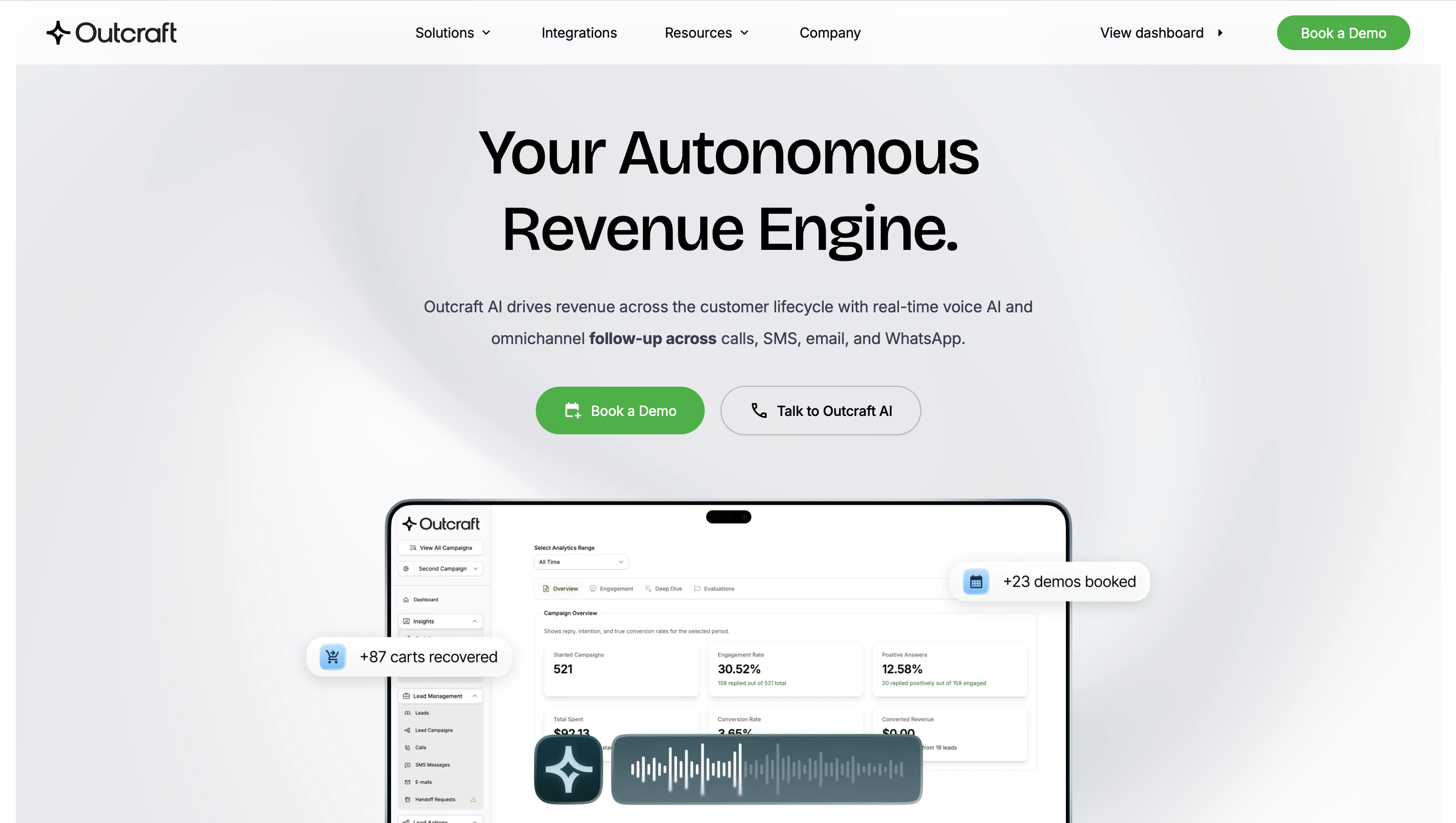
Outcraft is an autonomous customer engagement and revenue automation platform. Instead of treating the call as the whole workflow, Outcraft coordinates actions across:
- Calls
- SMS
The system acts at the right revenue moment through the right channel, then uses the resulting customer state to decide what happens next.
A call may start the workflow. It doesn’t have to end it.
For example:
Demo request → immediate call → no answer → SMS → email reply → CRM update → owner handoff
The context stays connected all the way to the outcome. You should not choose Outcraft if all you need is a programmable voice API.
Vapi gives developers more component-level control for that use case.
You should also choose Synthflow over Outcraft when your main need is a managed enterprise contact-center deployment that largely ends with the phone operation.
Outcraft is built for the broader problem, where voice is just one step in a multi-channel revenue workflow.
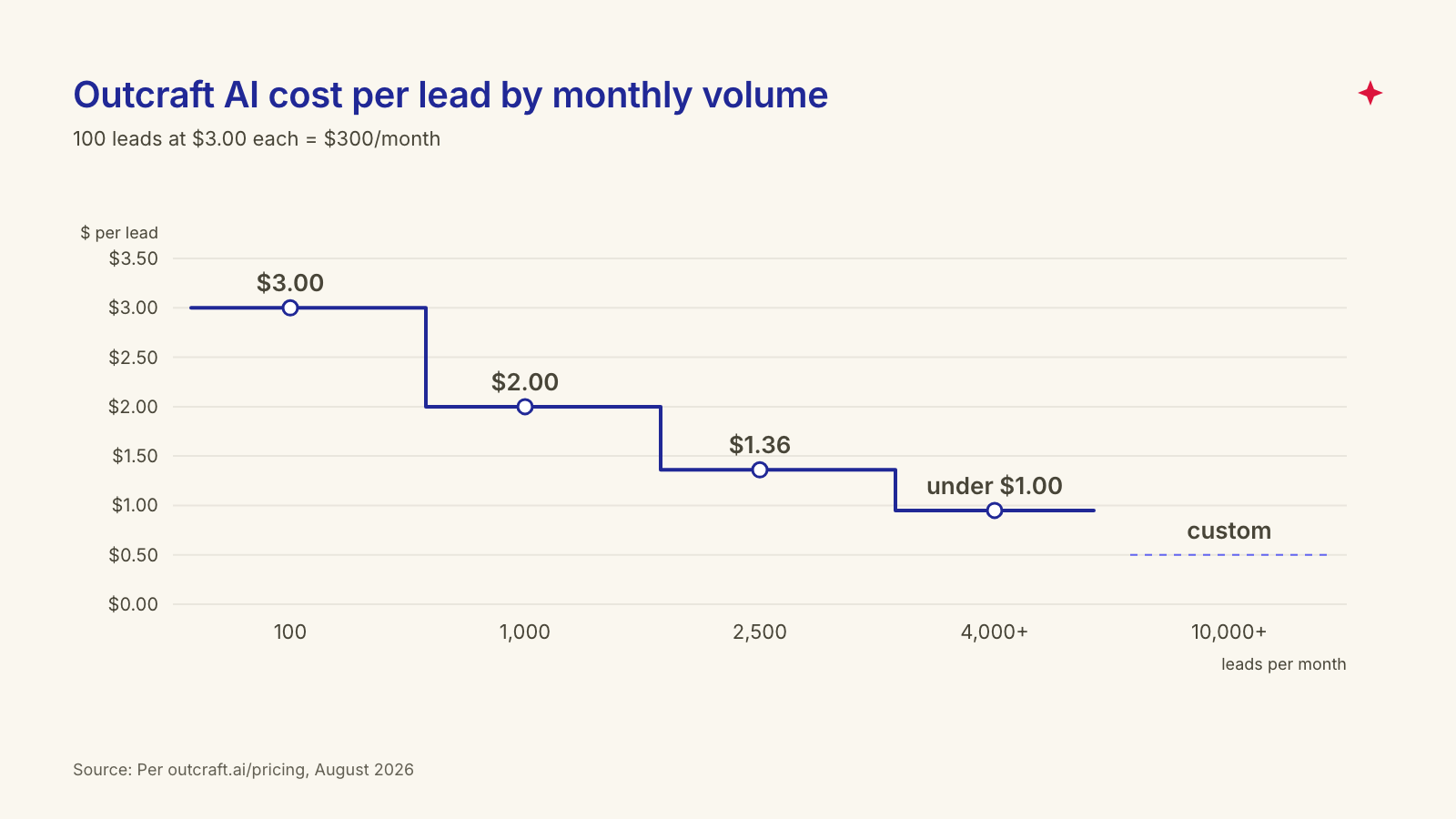
Pricing is contact-sales or demo-based, and it depends on workflow scope, volume, integrations, routing, and the operational work being automated.
Our guide to how an AI agent chooses the next customer channel explains that decision model in more detail.
Synthflow vs Vapi: Final Verdict
Honestly, there is no universal winner. The products are built for different ownership models.
Choose Synthflow when you have a funded enterprise voice program, operations teams need a visual environment, telephony needs to fit an existing enterprise setup, and vendor involvement in implementation matters.
Choose Vapi when developers want provider freedom, API-level control, lower-commitment experimentation, and a voice layer they can embed into software they already operate.
And don’t choose between them based on voice quality claims alone.
Run the same calls through both platforms.
Test:
- Setup time
- Caller experience
- Latency
- Interruptions
- Tool failures
- Transfers
- Diagnosis speed
- Regression testing
- Configured cost
- Internal maintenance effort
The platform that performs better under your real failure cases not just your perfect demo should get the contract.
If your real problem continues after the phone call, the architecture changes again.
When your team is still stitching calls, SMS, email, and WhatsApp together manually, Outcraft can connect the trigger, agent action, human boundary, and measurable revenue outcome in one workflow.

Summarize with AI