.webp?width=7088&height=1300&name=outcraft.ai-....%20(1).webp "Outcraft AI | Best AI Sales Tool for E-Commerce Brands")
-1.png?width=1920&height=1080&name=Medium%20Blogs%20(1)-1.png)
A polished voice demo can hide the failures that actually cost you, callers. The agent might talk over an interruption, stall while a calendar loads, transfer to the wrong person, or finish without updating your CRM. Vapi vs Retell only becomes a useful comparison when you test those moments.
You also need to know who will build the agent, who will diagnose a broken tool call, and how much control that owner needs. Call volume changes the cost. Consent rules shape the workflow. A support line, an appointment setter, and a voice feature within your product each impose different operational demands.
In 2026, choosing the right voice agent comes down to three things:
-
Reliability under real caller conditions
-
The work required after launch
-
The true cost of each call.
In this comparison, I look at provider control, testing, integrations, latency, concurrency, and handoffs so you can make a clear choice for your use case without claiming that one platform wins every deployment.
Vapi vs Retell (quick summary)
Retell is the better fit for an AI receptionist, appointment setter, support line, or outbound program run by a technical operations team. Its visual conversation flows, integrated call analysis, and 20 included concurrent calls reduce day-to-day setup and maintenance.
Vapi is the stronger choice when you’re building voice into your own product. It offers broad model and provider choice, bring-your-own keys, API-first configuration, Squads, native campaigns, and a testing system that developers can fold into release work.
Neither platform has a universal advantage in voice quality or latency. Those results change with the selected model, voice, telephony route, prompt, endpointing, and caller conditions. Run the same scripted calls through both before you sign an annual contract.
Here's one video you can watch for quick demonstration.
Vapi vs Retell comparison at a glance
|
Factor |
Vapi |
Retell AI |
Winner |
|
Best for |
Engineering-led voice products |
Production phone operations |
Depends |
|
Setup |
More configurable |
More packaged |
Retell |
|
Provider flexibility |
Broad choice and bring-your-own keys |
Curated options plus custom paths |
Vapi |
|
Visual conversation flows |
Workflows and assistant configuration |
Strong node-based conversation flows |
Retell |
|
Testing |
Evals and simulations |
Simulation testing in the product |
Depends |
|
Outbound campaigns |
Native campaigns with assistants or Squads |
Native batch calling |
Depends |
|
Included concurrency |
10 calls |
20 calls |
Retell |
|
Extra concurrency |
$10 per line per month |
$8 per call per month |
Retell |
|
Headline pricing |
$0.05 per call minute for hosting, plus providers |
$0.07 to $0.31 per voice-agent minute |
Depends |
|
Analytics |
Call records and analytics API |
Integrated call analytics and post-call analysis |
Retell |
|
API control |
Excellent |
Strong |
Vapi |
|
Knowledge base |
File-backed knowledge resources |
URLs, documents, and text with retrieval controls |
Depends |
|
Operating-team fit |
Requires more technical ownership |
Easier operational surface |
Retell |
The pricing row needs care. Vapi’s $0.05 is the hosting layer before model, voice, transcriber, and telephony costs. Retell’s displayed range changes with the components you select. Compare two configured agents with the same call assumptions. The headline figures alone do not support a clean price winner.
Use the table as a shortlist, then test the details that affect your deployment. Retell’s extra included concurrency matters for a busy phone queue. Vapi’s provider choice matters more when your product team needs to swap a model without rebuilding the application around it.
How I evaluated Vapi and Retell
This comparison is source-backed research, not a hands-on benchmark. I reviewed each vendor’s
-
current pricing,
-
product documentation,
-
testing model,
-
campaign controls,
-
knowledge-base support,
-
integrations, and
-
operating limits.
I also used the supplied Reddit discussion to identify pilot risks.
I did not create agents in both products, place matched calls, measure latency, break tool payloads, or compare dashboards from active accounts. That means I won’t award a voice-quality winner from marketing samples. Where the result depends on a live configuration, I give you a test instead of pretending the answer is settled.
My scoring covers six buying areas: setup, provider control, testing, tool reliability, outbound operations, and configured cost. The final verdict also weighs the person who will maintain the agent.
Vapi vs Retell features
Both platforms cover the core voice-agent stack. You can connect telephony, choose a voice and language model, add knowledge, call business tools, transfer conversations, and inspect results. The difference is in how much freedom you get and how much operating work the product absorbs.
Which is easier to set up?
Retell is easier for most operating teams. Its prompt agents offer a direct starting point, while conversation-flow agents turn bounded behavior into visible nodes and branches. Analytics and call history sit close to that builder.
Vapi asks you to make more architecture decisions. That is useful when you have an engineer who wants control over models, voices, transcribers, telephony, and server events. It is friction when the owner wants to launch and supervise a phone workflow without maintaining a custom operating layer.
Choose Retell for the faster route from prototype to an operated phone agent. Choose Vapi when setup flexibility is part of the product requirement.
Which offers more provider control?
Vapi wins. You can bring provider keys, select components separately, and let those providers bill you directly. Squads can divide one call between specialist assistants. An engineering team can keep its own application as the control surface while Vapi handles real-time voice orchestration.
Retell still gives you meaningful choice. It supports several voice and model options, custom telephony, and a custom LLM path. The menu is more bounded, which reduces decisions for an operator but gives an infrastructure team fewer combinations.
Our guide to the current AI voice-agent market places both approaches beside managed and no-code products.
Which has better knowledge-base support?
Both can ground an agent in business content. Retell accepts URLs, documents, and custom text. It can refresh URL sources and lets you tune retrieval chunks and similarity. That is convenient for support and FAQ agents whose source material changes.
Vapi can attach file-backed knowledge resources and use retrieval through its assistant stack. Its appeal is the surrounding developer control. Retell gets the slight operational edge for a team that wants visible knowledge management inside the agent product.
Test retrieval with questions whose answers sit in similar documents. Correctness matters more than upload convenience. You should also verify what happens when no source clears the similarity threshold.
Retell vs Vapi for building and testing voice agents
Retell's visual conversation-flow builder makes important behavior legible. You can place consent checks, qualification steps, tools, transfers, and fallbacks in named nodes. Individual nodes can use different models. An operator can inspect the path without reading one long system prompt.
That structure helps with bounded jobs. A receptionist needs a firm transfer rule. An appointment agent needs a calendar branch and a confirmation step. Retell gives those decisions a visible home.
Vapi gives developers evals and simulations for assistants, tools, and handoffs. Mocked tool responses can turn a fixed production failure into a repeatable test. Squads also support specialist handoffs, though every added assistant creates another context-transfer and permission boundary to inspect.
Neither testing system removes live-call validation. Carrier behavior, accents, interruptions, voicemail, and slow business systems can produce failures that a simulation misses. Build a shared test set and run it against both products.
Use this pilot sequence:
- Interrupt the agent during a tool response and confirm it recovers without repeating the action.
- Make the CRM time out, return malformed data, and receive the same request twice.
- Test transfer failure, voicemail, silence, and a caller who changes intent midway through the call.
- Compare the transcript, event trail, and time needed to locate each failure.
Tool reliability matters more than demo polish. Whichever platform you pick, you still need retry rules, safe fallbacks, and traceable logs.
This is the minimum useful failure test:
Vapi vs Retell for outbound calling
Both vendors now provide native outbound operations. Vapi campaigns can run personalized calls with an assistant or Squad, accept contacts by upload or manual entry, schedule the calling window, cap campaign concurrency, and show results for each contact. A campaign can hold up to 10,000 contacts. Its configuration locks after creation, so changes require duplication and a new run.
Retell's batch-calling workflow gives an operations team a direct way to launch lists, schedule calls, manage concurrency, and inspect results. Batch dials cost $0.005 each. The product also places call analytics near the agent and campaign operation.
Retell remains my operational winner because the campaign, analytics, and phone-agent controls feel like one operating surface. Vapi closes much of the functional gap and gives developers more room to customize the caller through assistants, Squads, webhooks, and pre-dial checks.
Concurrency changes the economics. Vapi includes 10 concurrent calls and charges $10 per added line each month. Reaching 30 calls at once requires 20 extra lines, or $200 per month. Retell includes 20 concurrent calls and charges $8 per added active-call slot. Reaching 30 requires 10 extra slots, or $80 per month. Usage and telephony sit on top.
Pick Retell when sales or operations will run recurring batches from the product. Vapi makes more sense when campaign behavior belongs inside a developer-owned application.
Vapi vs Retell pricing
Do not compare Vapi's $0.05 hosting line directly with Retell's headline per-minute range. Vapi excludes model-provider costs from that figure. Retell's final rate changes with the LLM, voice, telephony, and add-ons you select. Compare a configured stack.
Vapi pricing: Build costs $0.05 per call minute for hosting. Provider charges pass through, or you can bring your own API key and pay $0 to Vapi for that provider layer. The account includes 10 concurrent calls. HIPAA support costs $2,000 per month. Scale uses annual pricing and gates SSO, RBAC, data residency, an infrastructure SLA, and dedicated support. No free trial is published; new accounts include at least 60 minutes of free calling credits.
Retell pricing: Pay as you go runs $0.07 to $0.31 per voice-agent minute and starts with $10 in credits. It includes 20 concurrent calls. Extra concurrency costs $8 per call each month, and batch calling costs $0.005 per dial. Enterprise pricing is custom and gates features such as custom SSO, role-based access, custom agreements, higher concurrency, and 24/7 portal support. Retell offers free signup with $10 in starting credits, after which usage is billed pay as you go.
A fair cost model uses the same agent design on both sides:
- Connected minutes per month
- Selected language model, voice, transcriber, and telephony route
- Knowledge retrieval, analysis, and compliance add-ons
- Required concurrency and the engineer or operator hours needed each month
I have not included a sample total because I did not reproduce matched configurations in active accounts. A clean-looking number built from different component assumptions would mislead you. Ask each vendor to price the same call mix, then add internal operating hours.
Engineering can outweigh the minute rate. Multiply monthly maintenance hours by your fully loaded hourly cost. Add that result to usage and capacity before calling either product cheaper.
Our Retell AI review examines the work behind its published minute rate.
Vapi vs Retell integrations and tool calling
Vapi is the better foundation for a developer-owned integration layer. Its custom tools, server events, APIs, and provider choices fit teams that already run backend services. The same flexibility leaves your engineers responsible for reliable webhooks and durable state.
Retell offers custom functions and common integration paths, including calendar and automation use cases. Its post-call analysis can be read in the dashboard, delivered by webhook, or fetched through an API. That gives operations a clearer path from a call to a structured result.
Native connector count should not drive this choice. Test the systems your agent must use under failure. A calendar booking should be idempotent. A CRM write needs a visible status, and a failed transfer needs a human owner. Compare how quickly your team can diagnose those cases in each platform.
Which platform handles inbound calls better?
Retell is my default for a standalone inbound line. The visual flow and integrated analytics help a technical operator manage reception, qualification, support, and transfer rules.
Vapi fits an inbound experience embedded in your own product or backend. Its API control pays off when caller context, routing, and the user interface already live in systems your engineers own.
Voice quality and latency remain a draw until you test them. Use the same phone carrier, region, voice, model, prompt, and tool endpoint. Measure first-response delay, interruption recovery, tool round trips, and transfer time over real calls.
Our article on reducing call abandonment with voice agents covers the inbound operating problem in more depth.
Which platform supports compliance better?
Both vendors publish enterprise security and compliance controls. Vapi prices HIPAA support as a $2,000 monthly add-on and places controls such as SSO, RBAC, data residency, and an infrastructure SLA in Scale. Retell reserves parts of its enterprise control set for custom agreements, including custom SSO and role-based access.
Your legal obligations depend on call purpose, location, consent, recording, retention, and the data your tools expose. Treat a compliance badge as the start of diligence. Ask both vendors for the agreement and data flow that match your deployment.
Which is better for developers: Vapi or Retell?
Vapi wins for most developer-led products. Provider choice, bring-your-own keys, API-first configuration, Squads, custom tools, and programmable campaigns give an engineering team more control over architecture and unit economics.
That freedom needs an owner. Someone must version configurations, inspect event delivery, maintain tool schemas, and reconcile costs across providers. A small team without that person should not buy Vapi because it looks cheaper at the hosting layer.
Retell is still developer-friendly. Choose it when engineers want to support an operations team through a more packaged agent builder and analytics surface. You give up some provider breadth in return for fewer moving parts.
Which is better for sales and operations teams?
Retell wins when a technical operations owner will supervise the agent. Visual flows make bounded call behavior easier to review. Simulations and integrated analysis reduce the distance between a failed outcome and the place you change it.
For agencies, the answer depends on your delivery model. Retell suits repeatable deployments where clients expect a visible call operation and your team wants a consistent setup. Vapi suits agencies that sell custom engineering, maintain their own control plane, or need different provider stacks for different clients.
The account model matters before you scale an agency. Check how each product separates client data, phone numbers, credentials, billing, logs, and access. I did not validate multi-tenant agency administration from active accounts, so this belongs in your pilot.
The supplied Reddit thread gives one useful warning. A builder said the prompt consumed a minority of a 100-hour Vapi project, while webhooks, CRM writes, error handling, and response speed consumed most of the effort. Another commenter found Retell's webhook responses easier to inspect. These are individual experiences, so I would treat them as pilot questions instead of universal facts.
I did not find enough comparable public G2 or GitHub evidence to turn those anecdotes into a recurring complaint with confidence. The verdict therefore rests on verified product design and operating requirements, not one discussion.
Where neither Vapi nor Retell is the right fit
Vapi and Retell are great if your world is mostly voice. They’re built first and foremost for conversational calls, and they do that really well. But once the job gets bigger, choosing the right channel, updating CRM ownership, and following up after the call, you run into a different kind of problem.
Think about a demo request. You want a call within five minutes. If there’s no answer, you send an SMS with a booking link. If the person replies, you stop the next attempt, update the CRM, and route them to the right owner. Vapi or Retell can handle the call and trigger the event. But your team still has to manage everything that happens around it.
That’s where Outcraft comes in. It’s an autonomous customer engagement and revenue automation platform built for the broader workflow. We connect calls, SMS, email, and WhatsApp to the same revenue outcome. The idea is simple: act on the right moment, through the right channel, and then decide what happens next.
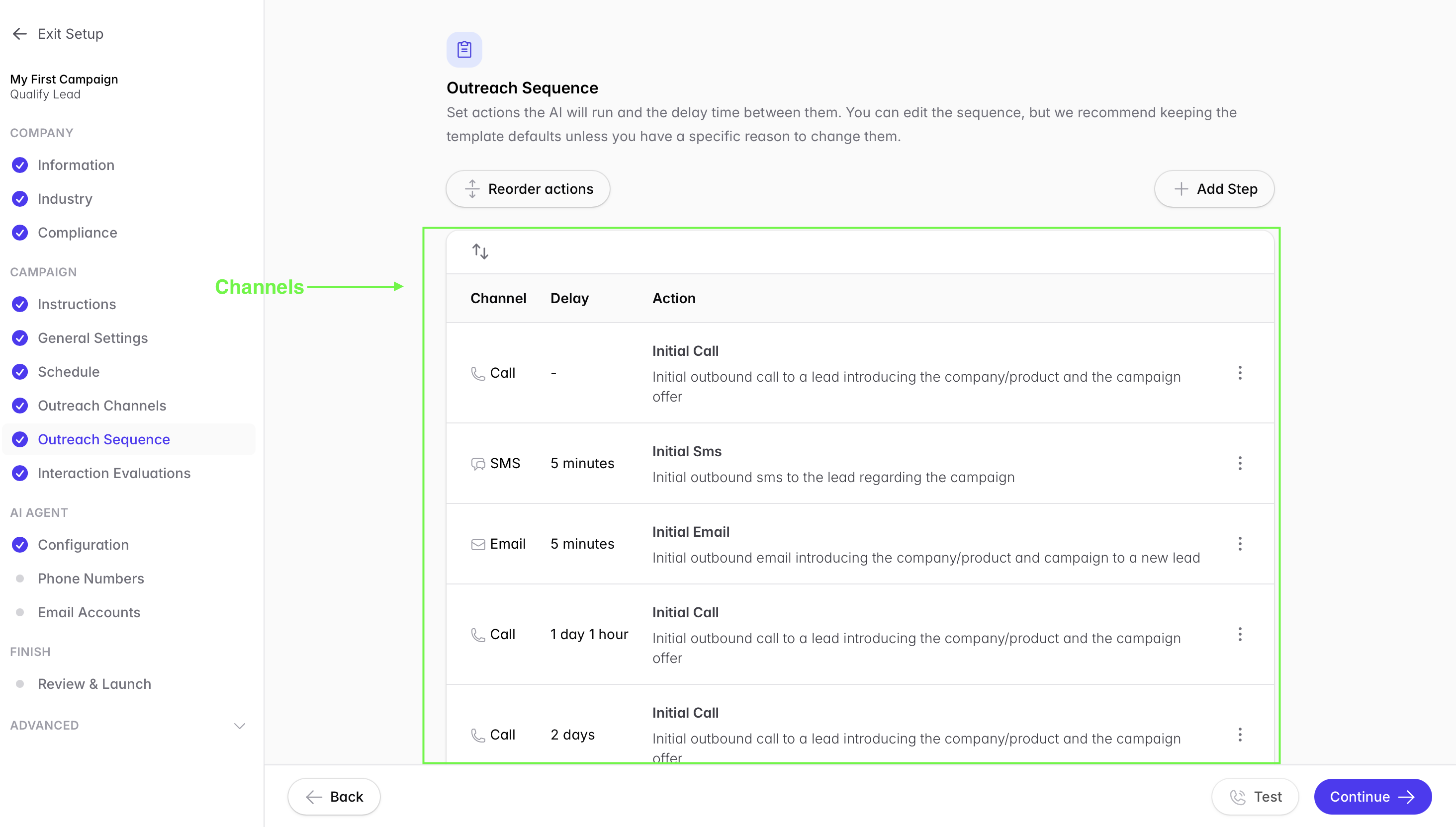
This is a bigger category than a single-channel voice tool. Outcraft is priced through sales and demos, and voice AI still needs real pilot validation. Our public footprint is also lighter than older contact-center suites. So if everything you need happens inside the call, and your team already handles follow-up well, Outcraft probably isn’t the right fit. In that case, Retell is the more straightforward choice for a packaged phone workflow, and Vapi is a strong programmable voice layer.
Outcraft makes more sense when the handoff is where things break down. If manual follow-up doesn’t scale, or if adding more channels still doesn’t fix the workflow, then connected revenue automation is probably the better answer.
Vapi vs Retell: final verdict
Retell is my recommendation for most buyers who need a production phone agent. It handles the operating layer more directly, includes twice the base concurrency, and gives a technical operator visual flows plus integrated analysis.
Vapi is the winner for a developer team building voice into its product. Its provider flexibility and API control justify the extra ownership when customization is part of the value you sell.
Run a matched pilot before you decide. Use the same call scripts, provider assumptions, failure cases, and concurrency target. Score setup time, caller experience, tool recovery, diagnosis speed, and configured cost. The product that wins your own failure test should get the contract.
If the real job continues across calls, SMS, email, and WhatsApp after hang-up, Outcraft can help you connect the revenue moment to an autonomous follow-up workflow your team can measure and improve.

Summarize with AI