%20(1).svg)
|
Quick Summary - should you even care about Consio AI? |
|---|
|
Yes, if phone calls can change buying decisions in your store. Consio AI is worth testing when your shoppers often need a nudge, an answer, reassurance, or a human-like follow-up before buying. It is much less compelling if your products are cheap, simple, impulse-driven, or already converting well through email and SMS alone. |
Let’s be honest: most e-commerce teams are tired of tools that promise “AI revenue” and then create more dashboards, more flows, and more cleanup work. If you are looking at Consio, it is probably because you have a very specific pain.
People are reaching checkout, then leaving. Or they call your store, and nobody picks up. Or your support team is busy answering questions that block purchases. Or you know some customers would buy if someone followed up quickly, but you do not have enough people to call them.
That is where Consio makes sense. It is not trying to be your whole marketing stack. It is a Shopify-focused AI phone platform for voice agents, AI IVR, AI SMS, outbound calls, inbound calls, and revenue tracking. The product is most interesting for stores where a conversation can save a sale.
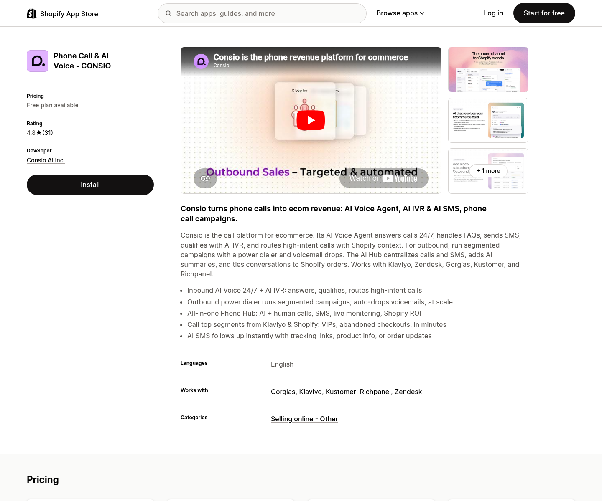
At the time of capture, Consio’s Shopify App Store listing showed a 4.8 overall rating from 31 reviews, with 30 five-star reviews and one one-star review.
That is encouraging, but it is not enough to skip due diligence. Small review pools can look very good and still hide edge cases. In Consio’s case, the main edge case to check is country and phone-number support.
The way I would think about it: do not ask “Is Consio a good AI tool?” Ask, “Do we have enough high-intent shoppers where a timely call could recover more gross profit than this tool costs?” If the answer is yes, run a pilot. If the answer is no, wait.
|
Best fit |
Public rating |
Starting paid plan |
Biggest caution |
|---|---|---|---|
|
High-AOV Shopify stores |
4.8/5 |
$30/month |
Verify country support first |
What is Consio AI?
Consio AI is a phone layer for Shopify stores. Instead of relying only on email and SMS after someone abandons a cart, Consio lets you use AI-powered phone calls and SMS follow-up around high-intent moments.
Think about a shopper sitting with a $600 cart. They are not always abandoning because they hate your product. Sometimes they are unsure about sizing, shipping, installation, returns, compatibility, payment options, or whether the product is right for them.
A normal abandoned-cart email says, “You left something behind.” A useful call can say, “What question is stopping you from buying?”
That is the gap Consio is trying to fill. Its Shopify App Store listing describes AI voice agents, AI IVR, AI SMS, phone calls, campaigns, and Shopify revenue tracking. It also lists integrations with tools such as Gorgias, Klaviyo, Kustomer, Richpanel, Zendesk, and Shopify.
That positioning matters. Consio is not a generic chatbot with a phone feature bolted on. It is built around phone-led revenue moments. That can be powerful, but only if those moments exist in your business.
Consio AI reviews: what Shopify users are really telling you
Reviews are useful only if you read them like an operator. A five-star review is not just “good.” You want to know what job the customer hired the tool for.
A one-star review is not automatically fatal either. You want to know whether the complaint could happen to you.
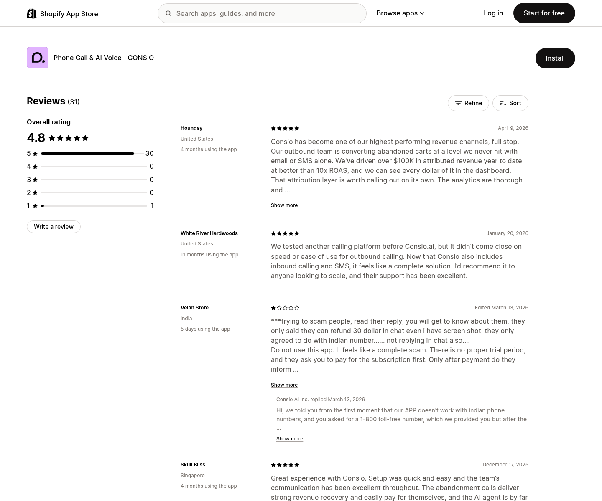
At capture time, Consio’s Shopify App Store page showed 31 reviews, a 4.8 rating, 30 five-star reviews, and one one-star review.
The positive reviews are mostly about operational relief
The positive pattern is not just “great app.” The better reviews point to something more practical: speed, ease of use, outbound calling, inbound calling, SMS, and support. That suggests Consio is helping teams run phone workflows they either could not run before or could not run consistently.
One visible five-star review from White River Hardwoods says they tested another calling platform before Consio.ai, but it did not compare on speed or ease of use for outbound calling. The review also says Consio added inbound calling and SMS, making it feel like a complete solution.

If you are a Shopify operator, that review is meaningful because it names the workflow. Outbound calling is not a vanity feature. It is a process. If Consio makes that process easier, the tool has a real reason to exist.
The negative review is a warning about fit
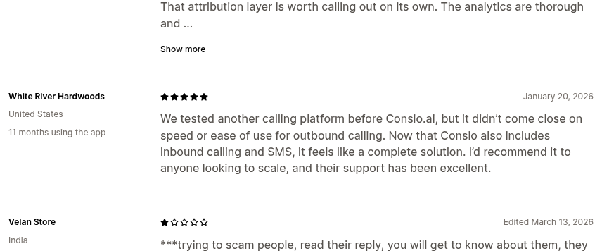
The one-star review from Velan Store is the kind of review you should read before installing any phone product. The complaint centers on India support, the trial/payment experience, refund expectations, and communication.
Consio’s reply says they told the user the app does not work with Indian phone numbers and provided a 1-800 toll-free number, but the buyer wanted an Indian number.
**Negative review with developer reply
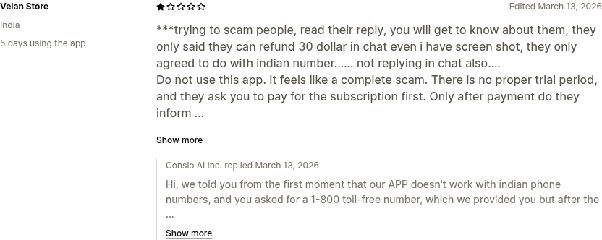
Here is the practical takeaway: if you are outside the US or need a specific local number type, confirm support before paying. Do not assume phone tools work the same way in every country. Phone numbers, carrier rules, consent, deliverability, call routing, and customer expectations vary by market.
Consio AI pricing: the listed price is not the whole cost
Consio’s Shopify App Store listing showed a free setup option and three paid plans. The plans were simple enough to understand, which is good.
But with phone tools, the real cost depends on usage, call length, and whether calls recover profitable orders.
|
Plan |
Listed price at capture time |
Included minutes |
How to think about it |
|---|---|---|---|
|
Start Free |
Free |
Set up an account and campaigns for free |
Useful for initial configuration and fit checks |
|
$30 Plan |
$30/month |
100 minutes |
Good for a small pilot |
|
$60 Plan |
$60/month |
400 minutes |
Better if calls become a regular workflow |
|
$120 Plan |
$120/month |
1,000 minutes |
For higher call volume or aggressive cart recovery |
|
Extra minutes |
$0.10/minute |
Usage-based |
Important if calls run long or targeting is too broad |
The mistake would be to judge Consio only by subscription price. A $120/month tool can be cheap if it recovers three high-margin orders. A $30/month tool can be expensive if it calls low-value shoppers, annoys customers, and does not convert.
Use this simple test: take your average order value, multiply it by gross margin, then estimate how many truly incremental orders Consio must recover each month.
If your AOV is $200 and your gross margin is 50%, one recovered order creates roughly $100 in gross profit before tool and operational costs.
In that scenario, the math can work quickly. If your AOV is $25 with thin margins, phone recovery is harder to justify.
My tip: start with your highest-intent segment. Do not call every abandoned cart. Start with high-value carts, repeat customers, VIPs, or shoppers who abandoned after reaching shipping/payment. You want fewer, better calls before you scale volume.
Does Consio’s AI voice agent actually work?
The honest answer is: it can, but only in the right workflow. AI voice agents are not magic salespeople. They are best when the job is narrow, the data is clear, and the next step is obvious.
For Consio, that means use cases like abandoned checkout follow-up, inbound call handling, SMS follow-up, VIP outreach, order questions, and simple buying objections.
If the shopper needs a quick answer or reassurance, an AI call can help. If the shopper needs a deep consultation, emotional support, legal advice, or complex product configuration, you still need human escalation.
Where Consio is likely to perform well
-
High-value abandoned carts: A call can answer the exact objection that stopped the purchase.
-
Inbound calls: A caller is already raising their hand. Missing that call is expensive.
-
Repeat customers: Known buyers are easier to prioritize and personalize.
-
Simple FAQs: Shipping, returns, stock, compatibility, and order questions can often be handled quickly.
-
Post-call SMS: Sending a checkout link or product page after the call closes the loop.
Where it may disappoint you
-
Unsupported countries or number types: This is the first thing to check.
-
Low-margin products: Call costs can eat the upside.
-
Complex consultations: AI may need to hand off to a person.
-
Weak consent processes: Outbound calls and SMS need compliance discipline.
-
Expecting one tool to run your whole lifecycle: Consio is phone-led, not a complete omnichannel revenue engine.
Consio AI features
AI Voice Agent
This is the feature everyone will talk about, but do not demo it with easy questions. Test it with your real customer objections. Ask about shipping edge cases, product compatibility, return policy, discount questions, stock issues, and what happens when the AI does not know the answer.
AI IVR
AI IVR is useful if people call your store and get lost, wait too long, or reach the wrong person. A good IVR should route callers faster, not trap them in a robotic menu.
Outbound call campaigns
This is probably the most important revenue feature. You can use calls for abandoned checkouts, high-value carts, VIP follow-up, or other purchase-intent signals. The key is targeting. A smart call to a high-intent shopper can help. A random call to everyone can damage trust.
AI SMS
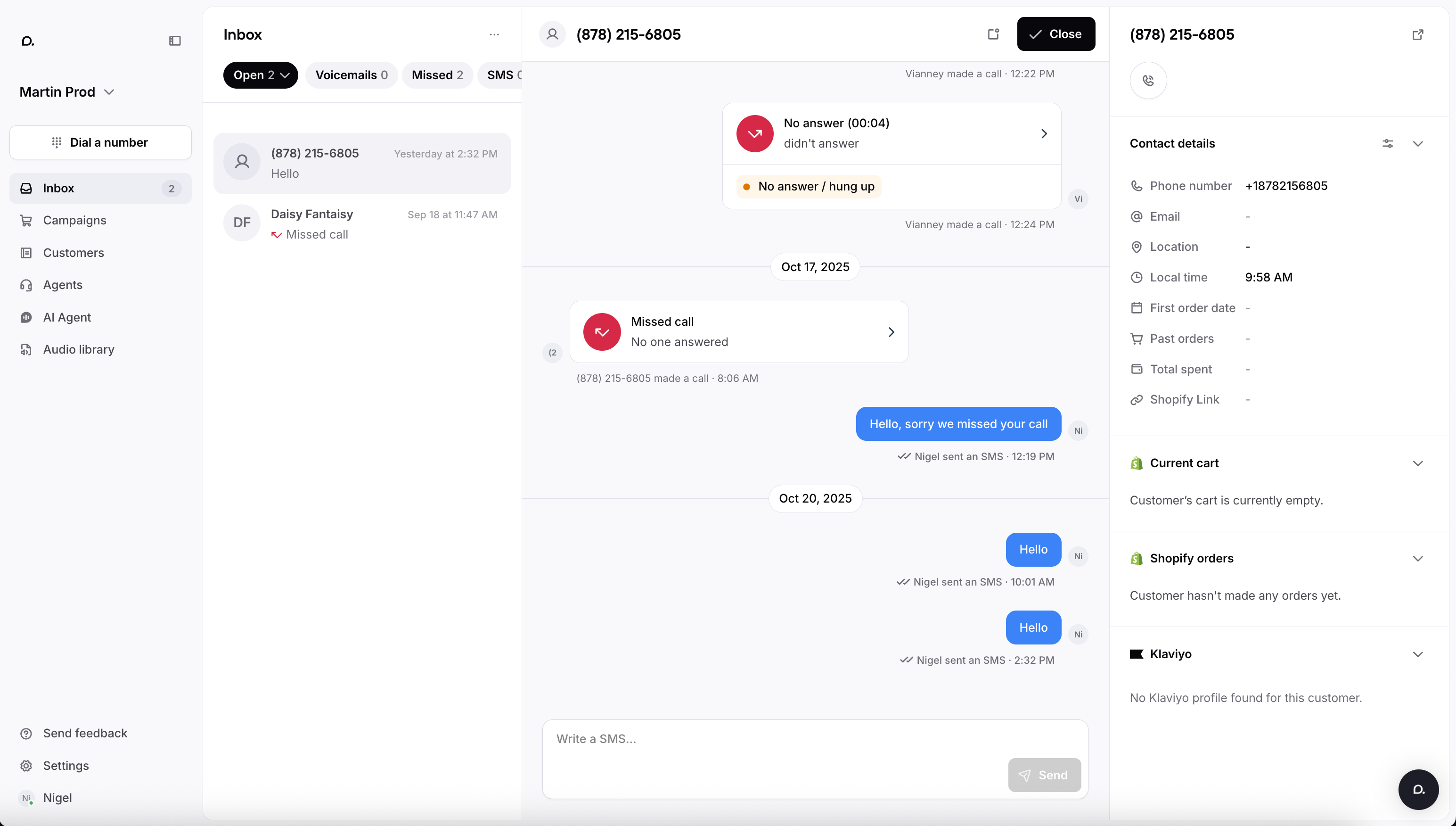
SMS matters because calls often need a follow-up action. If the AI agent answers a question, the next step might be a checkout link, product page, support link, or appointment confirmation.
Shopify revenue tracking
Revenue tracking is what keeps this from becoming a shiny toy. You need to see whether calls influenced actual orders. Even better, run a holdout group so you can estimate incremental lift.
Integrations
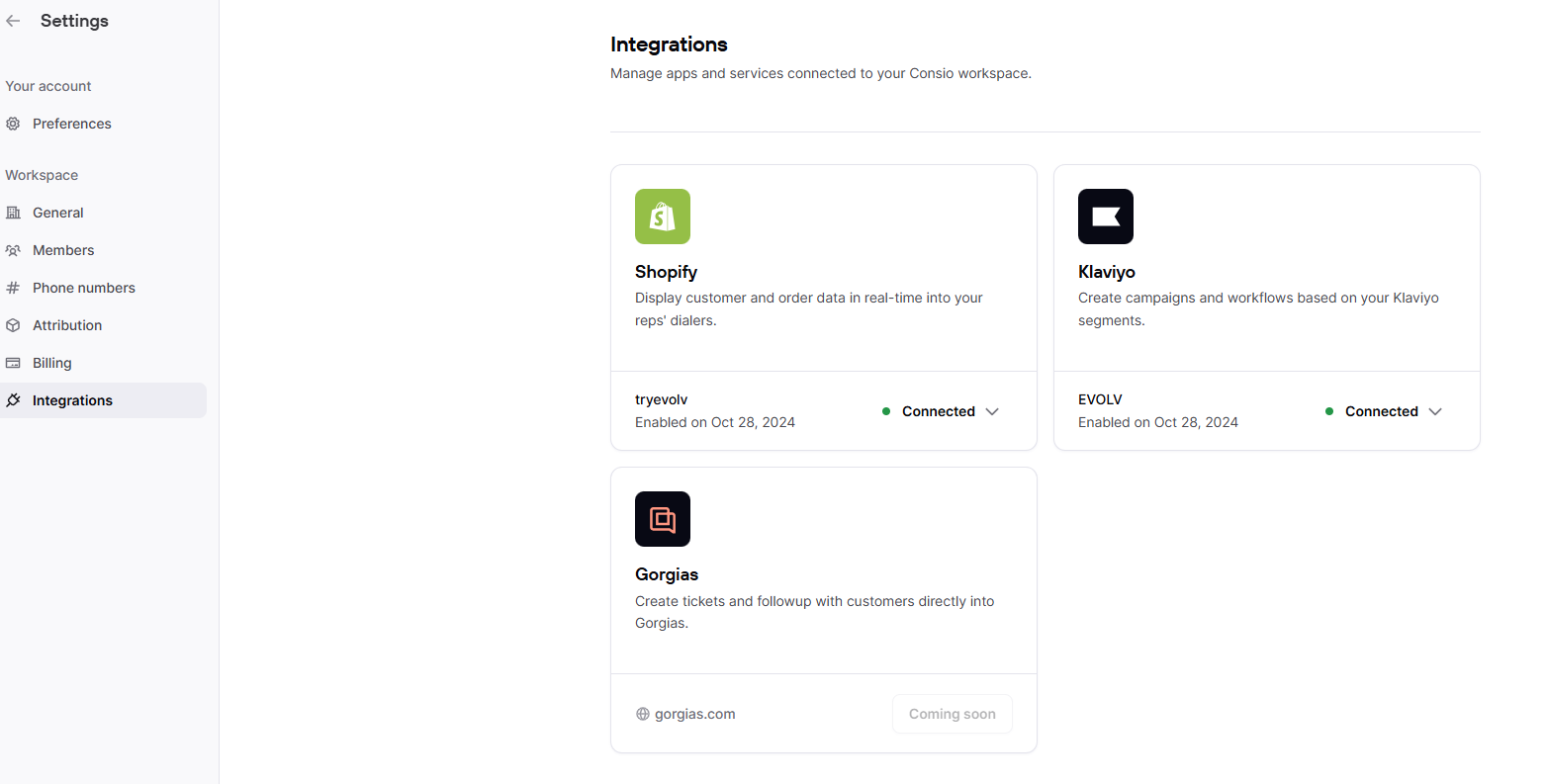
Consio lists integrations with Gorgias, Klaviyo, Kustomer, Richpanel, Zendesk, and Shopify. That is important because your phone conversations should connect back to the support and marketing context.
Pros and cons of Consio AI
What Consio gets right
-
Clear Shopify-first use case.
-
Strong public rating at capture time: 4.8 from 31 reviews.
-
Positive reviews mention real workflows: outbound calling, inbound calling, SMS, speed, and support.
-
Pricing is easier to understand than many AI voice tools.
-
Good fit for high-AOV stores where a call can recover meaningful margin.
-
Integrations with common e-commerce support and lifecycle tools.
Where you should be careful
-
Small review base compared with mature Shopify apps.
-
One visible negative review highlights country support and refund concerns.
-
Phone-led recovery may not work for low-AOV or low-margin stores.
-
Requires consent and compliance discipline.
-
Not a full omnichannel lifecycle platform.
-
You need to verify supported countries, phone numbers, overages, and handoff behavior.
Who should use Consio AI?
Use Consio if you can point to a real revenue moment where a phone call would help. Do not use it just because “AI voice” sounds advanced.
Consio is a good fit if:
-
You sell high-AOV products where one recovered order matters.
-
Your shoppers often have pre-purchase questions.
-
You miss inbound calls or cannot staff phone coverage consistently.
-
You have abandoned checkouts that are worth human-like follow-up.
-
You already use Shopify plus tools like Klaviyo, Gorgias, Zendesk, or Kustomer.
Consio is probably not the right fit if:
-
Your products are cheap and impulse-driven.
-
Your margins are too thin to support call minutes.
-
You need phone numbers in a country that Consio does not support.
-
You do not have clear consent and compliance processes.
-
You need a broader system across calls, SMS, WhatsApp, and email.
Consio AI vs Outcraft.ai
This comparison is useful because it shows what kind of problem you are really solving.
Consio is focused. It is a Shopify phone revenue tool. It makes the most sense when your immediate problem is calls: abandoned checkout calls, inbound calls, AI IVR, SMS after calls, and Shopify revenue tracking.
Outcraft.ai is broader. It positions itself as the AI Sales Team for Inbound Demand across calls, SMS, WhatsApp, and email. Its use cases include converting inbound leads, activating users, preventing churn, and recovering lost revenue. That is not just cart recovery. It is lifecycle revenue automation.
|
Question |
Consio AI |
Outcraft.ai |
|---|---|---|
|
What is it best for? |
Shopify phone revenue workflows |
Omnichannel revenue automation |
|
Core channels |
Calls, AI IVR, AI SMS |
Calls, SMS, WhatsApp, email |
|
Best buyer |
Shopify merchant testing calls for revenue recovery |
B2B or B2C team automating revenue moments across the lifecycle |
|
Main decision |
Can calls recover enough Shopify revenue? |
Can one autonomous system coordinate revenue workflows across channels? |
Simple way to decide: if your problem is “we need better phone follow-up for Shopify shoppers,” test Consio. If your problem is “we need calls, SMS, WhatsApp, and email working together across the customer lifecycle,” evaluate Outcraft.ai.
Best Consio AI alternatives
1. Outcraft.ai - best for broader omnichannel revenue automation
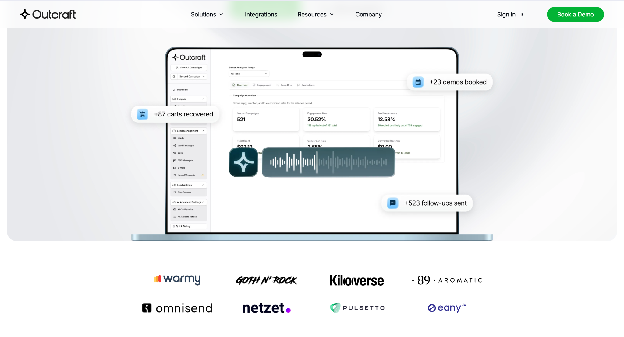
Outcraft.ai is the alternative to evaluate when you want more than Shopify phone calls. It is built around revenue workflows across calls, SMS, WhatsApp, and email, which makes it a better fit for teams thinking beyond cart recovery.
2. Ringly - best for another AI phone comparison
Ringly may be worth comparing if your main decision is specifically about AI phone support or AI call handling for e-commerce.
3. Aircall - best for a traditional business phone system
Aircall is a better fit when you need a broader phone system or call-center workflow rather than Shopify-native AI revenue calls.
4. Gorgias - best for e-commerce helpdesk operations
If the real issue is support tickets, order context, macros, and agent workflows, a helpdesk may solve more of the problem than an AI phone platform.
5. Klaviyo SMS or Postscript - best if you only need SMS
If phone calls feel too heavy, an SMS lifecycle tool may be simpler. The tradeoff is that SMS cannot handle real-time objections the way a call can.
Questions to ask before installing Consio AI
If you only take one thing from this review, take this: ask these questions before paying.
Country and number support
-
Does Consio support our country?
-
Can we get the exact type of number we need?
-
Can customers call back?
-
What happens if a number type is unavailable after setup?
Billing and refunds
-
When does billing start?
-
What is included in the free setup?
-
How are extra minutes charged?
-
What is the refund policy if our region is unsupported?
Workflow setup
-
Which Shopify events can trigger calls?
-
Can we segment by cart value, product, geography, or customer status?
-
Can the AI hand off to a human?
-
Can SMS include dynamic checkout links?
Compliance and customer experience
-
How does consent work?
-
How are opt-outs handled?
-
Can calls respect local time zones?
-
Are call logs, transcripts, or recordings available?
Reporting
-
How does Consio attribute recovered revenue?
-
Can we compare against a holdout group?
-
Can we export call outcomes?
-
Can we separate incremental revenue from assisted revenue?
Conclusion:
If I were running a Shopify store, I would not install Consio for every cart and hope for the best. I would pick one high-intent use case and test it carefully.
Start with high-value abandoned carts, inbound calls, or VIP follow-up. Keep the audience tight. Track call completion, conversion, recovered revenue, customer complaints, opt-outs, average call length, and gross profit. If the numbers work, expand. If they do not, stop before it becomes another tool your team has to manage.
Consio’s public reviews suggest it can help the right merchants. The positive reviews point to real operational value. The negative review reminds you to verify support and expectations before paying. That combination makes Consio a promising but not automatic choice.
If you need a focused Shopify phone tool, Consio is worth testing. If you need a broader autonomous revenue engine across calls, SMS, WhatsApp, and email, compare it with Outcraft.ai.

Summarize with AI