

 Will Nauseda
Key takeaways
- A customer question before a purchase is a buying signal: the shopper has usually chosen the product and has one doubt left.
- Fast, specific answers on the channel the shopper chose keep sales that would otherwise go to a competitor.
- The questions vary from shopper to shopper, but they fall into eight predictable types.
- Seven steps turn those questions into orders, starting with last month's chat logs and ending with revenue, not ticket counts.
Most ecommerce brands treat customer service as a cost to keep low. They measure tickets closed and response times, and leave revenue to ads, email, and the checkout.
That misses where many sales are actually won or lost. The shopper who asks a question is often one answer away from buying.
This guide covers why questions are buying signals, the eight question types that decide an online sale, and seven steps to turn them into orders and repeat customers.
Why Are Customer Questions Buying Signals?
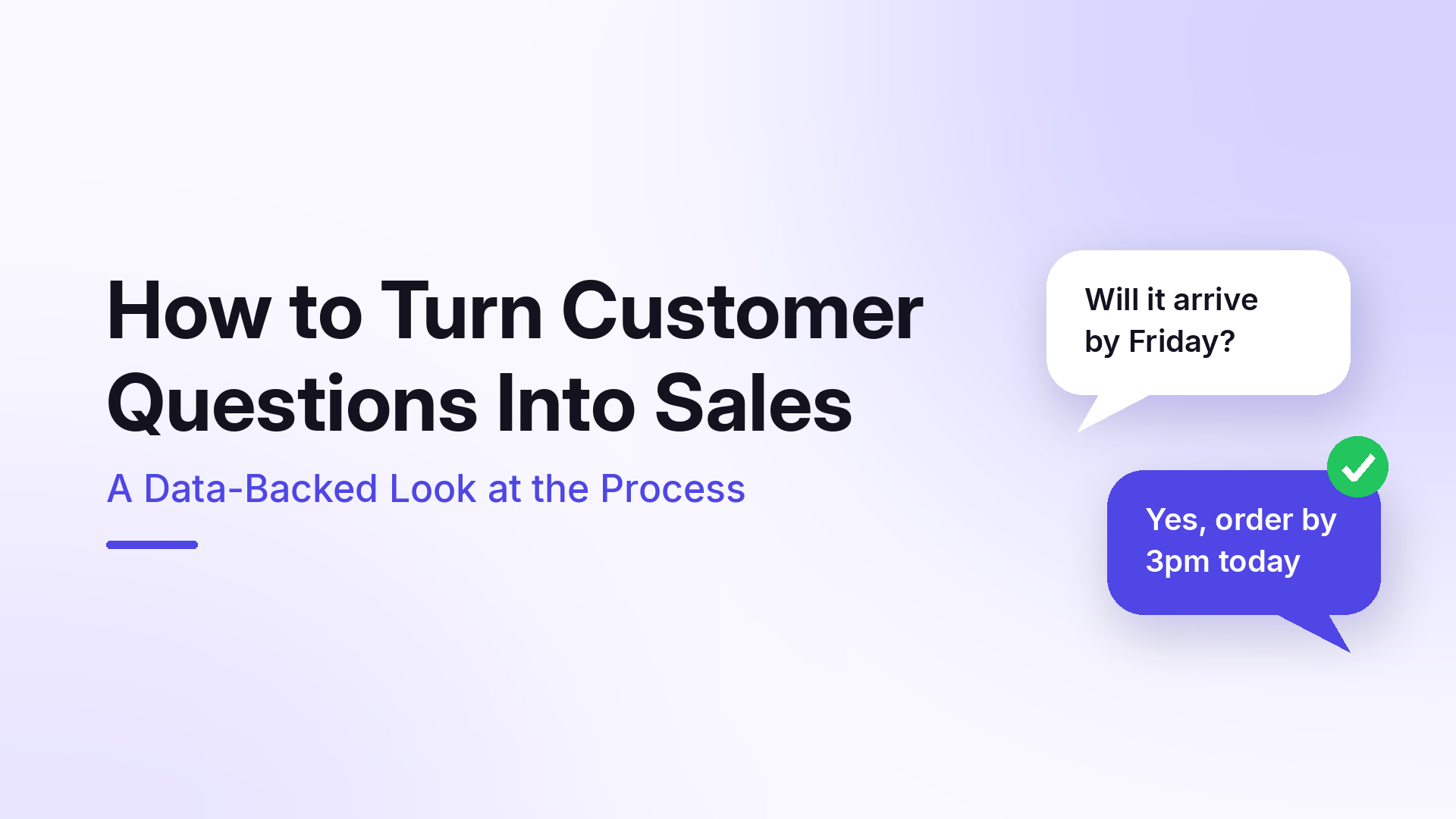
A shopper who asks "Will this arrive before Friday?" has already chosen the product. What's left is one doubt.
Answer it, and nothing stands between them and the order. Leave it for tomorrow's queue, and they buy somewhere else, or not at all.
Baymard Institute's checkout research (updated September 2025) shows how often these doubts end a sale. Among US online shoppers who abandoned a cart for a reason other than just browsing:
- 40% said extra costs were too high.
- 20% said delivery was too slow.
- 19% didn't trust the site with their card details.
- 13% weren't satisfied with the returns policy.
- 12% couldn't see the total cost up front.
Some of those need a design fix. Many are simply questions:
- How much is shipping to Ohio?
- Can I return it if it doesn't fit?
- Will it be here by the 20th?
A store that answers them quickly, on the channel the shopper chose, keeps sales it would otherwise lose.
How Do You Turn Customer Questions Into Sales?
Run ecommerce customer service like a sales channel, and treat every pre-purchase question as a buying signal.
Answer where the shopper asks, while they're still on your site, with the one fact they need: fit, delivery date, total cost, or returns. Then give them the next step to buy.
Most questions that stop an online order can be answered in a sentence or two. Below are the eight question types that decide a sale, followed by seven steps to find the ones your store gets, answer them so they end in an order, and measure the result in revenue rather than tickets.
The 8 Questions That Decide an Online Sale
Each pre-purchase question hides a decision. The best answer resolves the decision, not just the literal question.
|
Question type |
What the shopper asks |
What they're deciding |
The answer that moves them |
|---|---|---|---|
|
Fit and sizing |
"I'm usually a medium. Which size?" |
Will it fit, or will I have to return it? |
A size based on their measurements, plus how exchanges work |
|
Delivery date |
"Will it arrive by Friday?" |
Can I count on it for a date? |
A delivery estimate for their address, and the order cut-off |
|
Total cost |
"How much is shipping to Canada?" |
What will I actually pay? |
The full price with shipping, duties, and fees |
|
Returns |
"Can I return it if I don't like it?" |
Is this a safe purchase? |
The return window and who pays, in one line |
|
Comparison |
"What's the difference between these two?" |
Which one is right for me? |
One recommendation and why it fits their use |
|
Suitability |
"Will this work with my setup?" |
Is this for someone like me? |
A direct yes or no, with the condition that matters |
|
Stock |
"Will the blue one be back?" |
Wait, switch, or leave? |
A restock date, or the closest alternative in stock |
|
Trust and payment |
"Do you take PayPal? Is it secure?" |
Can I trust this store? |
The payment options, plus a pointer to reviews and your returns promise |
Look at the last column. Every good answer ends with something the shopper can act on: a size, a date, a price, a product. That's the difference between support and selling.
7 Steps to Turn a Shopper's Question Into a Repeat Customer
1. Collect the questions you already get
Export a month of live chats, SMS and iMessage threads, WhatsApp conversations, call notes, and social DMs. Tag each pre-purchase question with one of the eight types above, and count them.
Rank the types by volume. The top three or four are where to start.
2. Answer the top ones before they're asked
Put the answers where shoppers decide: next to the add-to-cart button. On the product page, show a delivery estimate, a size guide with a fit note, the total cost including shipping, and a one-line returns summary.
Every question answered on the page is one that never waits in a queue.
3. Answer fast on every channel shoppers use
Shoppers ask where they already are: live chat, WhatsApp, SMS, email, a phone call, a DM. Set a shorter response-time target for pre-purchase questions than for order issues, because the buying moment passes quickly.
Cover evenings and weekends too, since shoppers don't keep office hours. An automatic "We'll get back to you" is not an answer.
The same logic applies when a shopper leaves checkout with a question still open. Abandoned checkout recovery is that same conversation, started by the store.
4. Answer like a salesperson, not a ticket queue
A good pre-purchase answer has four parts:
- Confirm what they need ("So it's for running in wet weather?").
- Give the specific fact: size, date, price, or policy.
- Recommend one option when it helps, and say why.
- Give the next step: a link to the product, the cart, or checkout.
Here's an illustrative example. A shopper on WhatsApp asks whether a jacket runs small.
A support reply says: "Please see our size guide."
A sales reply says: "It runs slightly small, so most people between sizes go up one. A large would suit you. Here's the link, and exchanges are free within 30 days."
5. Know when not to sell
A customer whose last order arrived broken doesn't want a recommendation. Fix the problem first.
Selling into a complaint costs more trust than the order is worth. Once the problem is solved, a follow-up offer can land well.
6. Hand off the hard ones with context
Some conversations need a person: a custom or high-value order, a complex complaint, a loyal customer with a long history. Route them to your team with the full conversation attached, so nobody asks the shopper to repeat themselves.
7. Measure revenue, not tickets
Response time and satisfaction scores show how fast you answer. They don't show what the answers earn. Track these instead:
- Orders placed within a few days of a pre-purchase conversation, and their value.
- Conversion rate of shoppers who asked a question versus those who didn't.
- The question types that most often end in an order, and those that most often end in silence.
- Response time for pre-purchase questions specifically, by channel and by hour.
Most help desks can tag conversations, and Shopify records orders by customer, so you can match the two without special software.
Where an AI Sales Agent Fits
If questions arrive faster than your team can answer them, especially out of hours or by phone, an AI sales agent can take the first conversation. (See how conversational AI works in ecommerce.)
Outcraft is one option. It holds conversations by phone, SMS, WhatsApp, and iMessage, and recommends products within the rules you set.
When the shopper is ready, it sends the product or checkout link during the conversation. When a person is needed, it hands over the full history. Every conversation is recorded and reviewable.
It isn't the right fit for every store. If you get a handful of questions a day, a clear product page and a fast human reply will do. For a high-value custom order or a complex dispute, a briefed person still wins that conversation.
Frequently Asked Questions
What is pre-sales customer service?
Pre-sales customer service is help given to a shopper before they buy. It answers questions about fit, delivery, cost, returns, or suitability so they can decide. In ecommerce, it happens on product pages, live chat, WhatsApp, email, and phone.
Should customer service teams sell?
Yes, by answering well rather than pushing. An answer that gives the specific fact, recommends one option when it helps, and includes a link to buy is still good service. Pressure tactics, and upsells in the middle of a complaint, are not.
How fast should you answer a pre-purchase question?
Answer while the shopper is still deciding, ideally in the same session. A reply the next morning may arrive after they've bought elsewhere. Set a shorter response target for pre-purchase questions than for order issues, and cover evenings and weekends.
How do you measure sales from customer service?
Match conversations to orders. Tag pre-purchase conversations in your help desk, then look at orders from the same customers within a few days. Compare the conversion rate of shoppers who asked a question with those who didn't, and track revenue by question type.
Can AI answer customer questions before a purchase?
Yes, when it has clear rules for what it can offer and answers you have approved. It should hand complex or sensitive conversations to a person, with the full context. Tools such as Outcraft do this across voice, SMS, WhatsApp, and iMessage.
Start With Last Month's Questions
Export last month's pre-purchase questions, tag them with the eight types above, and fix the top three on your product pages this week.
Want to see how an AI sales agent would handle the rest? Bring a week of your store's questions to a demo.

Ready to Recover More Revenue?
See how Outcraft's AI agents turn failed payments, abandoned checkouts, and support conversations into revenue.
CEO and Co-Founder at Outcraft AI. Leading our efforts in developing AI sales agents that call, qualify, and convert leads, customers, and at-risk accounts across voice, SMS, email, and WhatsApp.
Summarize with AI