



An AI agent for cart abandonment contacts shoppers who left a cart or checkout and talks with each one by call, text, email, WhatsApp or iMessage, deciding per shopper, within your store's rules, when to reach out and what to say.
A flow, the automated email or text sequence your store fires after someone leaves, sends the same messages to everyone. The agent answers the question that stopped the order.
Picture a shopper with a $400 jacket sitting in her checkout, stuck on one question: will a medium fit? Your flow sends her a reminder a few hours later.
Nice gesture, but a reminder can't answer anything. A cart abandonment AI agent can, and that's the whole difference I'll walk you through here.
Key Takeaways
- An AI agent for cart abandonment holds a two-way conversation with each shopper instead of sending one fixed sequence to everyone.
- A flow sends the same timed messages to every shopper; an AI agent decides per shopper when, where and what to send, and answers questions.
- The agent stops when the shopper buys, says no or opts out.
- Measure it with a holdout group, never with opens or call counts.
What Exactly Is an AI Agent for Cart Abandonment?
An AI agent for cart abandonment is software that contacts shoppers who left a cart or checkout and holds a two-way conversation with each one by call, text, email, WhatsApp or iMessage. Unlike a fixed flow, it decides per shopper, within your store's rules, when to reach out, which channel to use, what to say and when to stop.
Why does that matter? Because most abandonment has a reason behind it.
Baymard Institute puts the average documented cart abandonment rate at 70.22% across 50 studies (Baymard Institute, updated October 2026). Set the just-browsing crowd aside, and extra costs (40%), slow delivery (20%) and not trusting the site with card details (19%) top the list.
When I look at that list, I don't see three problems. I see three questions somebody could have answered before the shopper gave up.
A reminder repeats the offer. A conversation answers the reason.
One thing to clear up first: an on-site chatbot waits for the shopper to ask; an AI agent for cart abandonment reaches out after the shopper has left. One prevents abandonment, the other recovers it.
Of all the AI agents for ecommerce out there, a cart recovery agent has one of the narrowest jobs: turn a stalled checkout into an order. Enough theory, though. Let's watch one do it.
Follow one abandoned checkout. Change the shopper and watch what each approach does.
How an AI Agent Recovers an Abandoned Checkout?
A cart abandonment recovery AI agent works through five decisions for every shopper: what starts it, when to reach out, on which channel, what to say and when to stop. Here they are, in the order the agent makes them.
1. The Trigger Happens when Shopper Doesn’t Pay
The agent starts from an abandoned checkout: a shopper entered contact details at checkout and didn't pay.
That distinction matters more than you'd think. Only a checkout reliably carries an email address or phone number, and without one, no tool can reach the shopper.
2. Timing Is the Key
The agent reaches out as soon as your store's timing rules allow, often within minutes, while the shopper still has the product and the question in their head.
Flows usually wait longer. Klaviyo's 2026 abandoned cart benchmarks describe a common sequence that sends the first email two to four hours after abandonment (Klaviyo, October 2026).
Speed has limits, though. A well-run agent respects quiet hours, the late-night window when no store should be calling, so a shopper who leaves at 11:45 p.m. hears from it the next morning, not at midnight. Nobody wants that call.
3. Which Channel the Shopper is Available at Matters
The agent picks the channel the shopper can be reached on and has agreed to. A call suits a high-value cart, where one answered question can save the order.
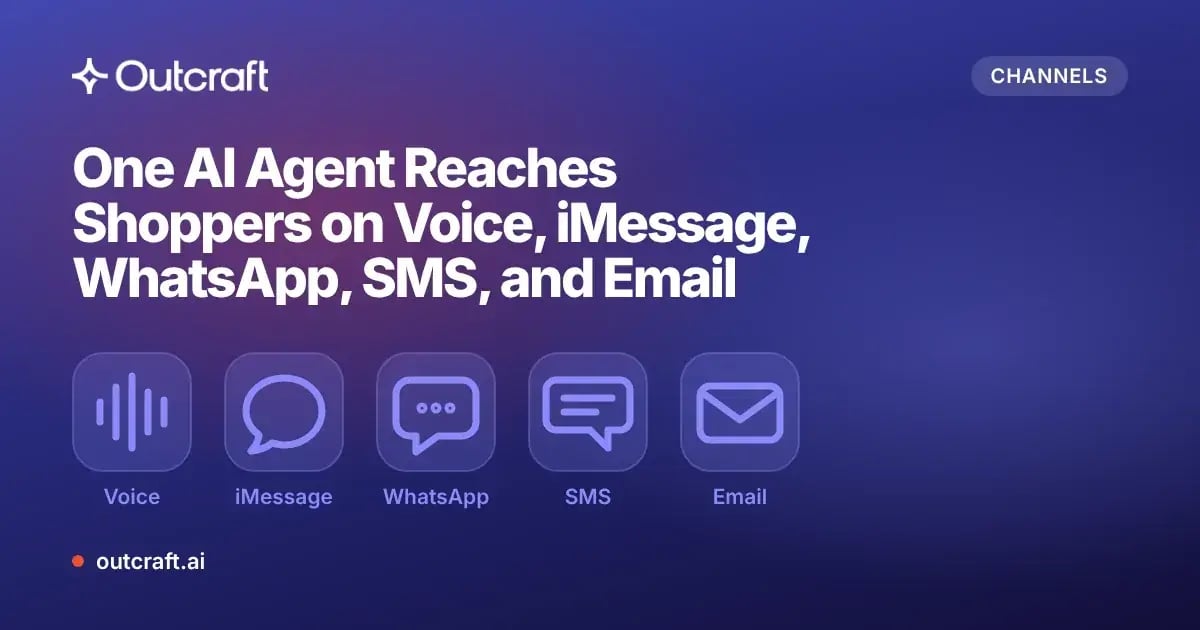
A text or WhatsApp message suits a smaller cart or a shopper who would rather type. Email carries the detail for anyone who left only an address.
And if the first attempt gets no answer, the agent tries another channel instead of repeating itself like a broken record.
4. The Conversation Solves Everything
The agent asks what stopped the order and answers from the store's own information. A shopper unsure about sizing gets the size guide's answer; a shopper surprised by shipping cost hears the options and the delivery date.
Then the agent sends a link back to the checkout so the shopper can finish.
What about discounts? The agent asks why before it discounts.
If the objection is price, a discount may be the right last step. If the shopper only had a question about fit, a code just gives away margin. Personally, I'd keep the code in my back pocket until the very last message, if it goes out at all.
5. Stop Rules Need to be There as Well
The agent stops when the shopper buys, says no, opts out or asks not to be contacted. Those rules should apply across every channel at once.
A shopper who replies STOP to a text shouldn't get a call an hour later. Period.
So does all this make your Klaviyo flow obsolete? Not even close.
This clip shows the part a reminder can’t do: hearing the real reason behind what the shopper says, and answering that.
AI Agent vs Abandoned Cart Email Sequences
A flow sends the same timed messages to every shopper; an AI agent decides per shopper when, where and what to send, and answers questions.
You don't have to pick one. The two work best together.
| Criteria | Abandoned cart flow | AI agent for cart abandonment |
|---|---|---|
| Trigger | Abandoned cart or checkout | Abandoned checkout with contact details |
| Timing | Fixed delays, often hours | As your store sets, often minutes, inside quiet hours |
| Channel | Set in advance; some tools pick it from past behavior | Chosen per shopper: call, text, email, WhatsApp or iMessage |
| Two-way | No, one-way messages | Yes, the shopper asks and gets an answer |
| Answers questions | Only what's written in the message | Yes, from store policies and product details |
| Personalization | Cart contents and name | Cart, channel, timing and the shopper's own reason |
| Stop rules | Exits when an order is placed | Stops on purchase, refusal or opt-out across channels |
| Setup | Templates in your email tool | Connects to your store and email tool |
| Best for | Every abandoned checkout, cheaply | High-value carts and shoppers with questions |
Use a flow when the shopper only needs a reminder and the cart is small. Add an agent when the cart is big enough to justify a conversation, or when shoppers leave with questions a reminder can't answer. If my store's average order sat above $200, I'd run both, no question.
An AI agent doesn't replace your Klaviyo or Omnisend flow. The flow keeps reaching every shopper; the agent picks up the ones it didn't convert.
Align consent, suppression (the list of shoppers a tool must skip) and timing rules between the two, so a shopper the agent is already talking to doesn't get the flow's next email an hour later.
Which raises a fair question: how does an agent understand a shopper in the first place?
Side-by-side: pick why a shopper left to compare what an abandoned cart flow sends with what an AI agent does.
What Generative AI Adds to Cart Abandonment Recovery?
Generative AI for cart abandonment means the agent understands a shopper's question in their own words and answers it, instead of matching keywords to canned replies.
The engine behind it is a large language model (LLM): software trained on huge amounts of text that can read a free-form question and write or speak a fitting reply.
In practice, that changes three things:
- Understanding. A shopper can ask "will this arrive before my trip on Friday?" and get an answer, not a menu.
- Grounding. The agent answers from your shipping, returns and product information, so the reply matches your policies.
- Language. The same agent can hold the conversation in the shopper's language.
AI for reducing cart abandonment also works before the shopper leaves. On-site AI assistants answer questions on the product page or at checkout, which prevents some abandonment in the first place.
Agents that reach out afterward handle the rest. The strongest AI abandoned cart recovery strategies use both, with a flow underneath.
None of that runs on thin air, though. An agent is only as good as what you feed it.
Things an AI Agent Needs to Work Perfectly
An AI agent needs the cart contents, the shopper's contact details and consent, order status and store policies. Skip one, and you'll feel it on the first call.
Before you switch an agent on, make sure you can supply each of these:
- The cart: products, variants, prices and the checkout link.
- Contact details: the email address or phone number from checkout.
- Consent: a record of what the shopper agreed to on each channel.
- Order status: so the agent knows the moment the shopper buys.
- Store policies: shipping times and costs, returns, sizing and payment options.
- Your rules: contact hours, call timing, frequency caps (how many times one shopper can hear from you), eligible shoppers and whether discounts are allowed.
Calls and texts need the shopper's consent: the FCC's consumer guide to unwanted robocalls and texts says US marketing robocalls and robotexts need prior express written consent, a clear written yes given before you reach out (FCC), and other markets set their own rules, so confirm them with your legal advisor first.
Even with all of that in place, an agent shouldn't handle every shopper.
Where AI Agents Stop (for Your Own Good)
An AI agent should hand a shopper to a person when the case needs judgment it doesn't have. I'd rather you know these limits before you start than find them on a live call:
- High-value custom orders. A bespoke quote or a large wholesale order still deserves a briefed person on your team.
- Disputes and complaints. A shopper upset about a past order needs a human, not a sales conversation.
- Shoppers who say no. One clear no ends the conversation on every channel.
- Identity. The agent says it's an AI when a shopper asks and never claims to be human.
- Weak data. If your shipping or returns information is out of date, the agent will repeat it, confidently.
Will some shoppers mind a call from an AI? Some will, but fewer than you'd expect.
In Outcraft's own call data, shoppers were annoyed on 1.7% of connected calls and thanked the agent on 42.7%.
Respecting the channel they chose, the hours they're awake and their first no is what keeps an agent from feeling like a nuisance.
Which leaves the question your finance team will ask first: is it actually working?
How to Measure an AI Agent's Impact on Cart Abandonment?
Measure an AI agent with a holdout group: leave a small share of abandoned checkouts uncontacted and compare recovered orders and revenue. Then follow these steps:
- Set a holdout. Keep a small, random share of abandoned checkouts out of the agent's reach, so you can see what would have happened anyway. Believe me, it's the one number nobody on your team can argue with.
- Fix an attribution window. Decide how many days after contact an order counts as recovered, and keep it the same across periods.
- Compare recovered revenue. Measure orders and revenue from contacted shoppers against the holdout, not against last month. Count each order once, even if your email tool also claims it.
- Subtract the discount cost. If the agent offered codes, take that margin off before you call it a win.
- Read the reasons. Group what shoppers said stopped them. Those reasons tell you what to fix on the site itself, a bonus most stores overlook.
So who actually runs these conversations for your store? That's where Outcraft comes in.
Where Outcraft Fits into the Process?
Outcraft is an AI Sales Agent for E-Commerce that calls and messages shoppers to recover abandoned checkouts, win back failed payments and upsell after purchase. Outcraft is not a chatbot, a support bot or a one-moment cart-recovery app.
Outcraft works on voice, SMS, email, WhatsApp and iMessage in 40+ languages and installs on Shopify. Outcraft calls within minutes of drop-off, or at the time your store sets, asks what stopped the order and answers from your policies and product details.
While the shopper is still on the call, Outcraft texts the checkout link by SMS or WhatsApp. If the call goes unanswered, Outcraft follows up by SMS, WhatsApp or email.
Outcraft runs alongside Klaviyo and Omnisend and picks up the shoppers their flows didn't convert. With the Klaviyo integration, Klaviyo events and segments can trigger calls, and opt-outs sync back to Klaviyo.
Here's the proof. Acentecom recovers $70K+ in monthly revenue from abandoned carts with Outcraft, running campaigns across voice, SMS and email.
“We wanted to get more revenue from the traffic we already had, without adding more work for our team. Outcraft helped us do exactly that,” says Uzi Dan Pagirsky, Co-Founder and CEO of Acentecom.
Per outcraft.ai, Outcraft has made 13M+ AI calls and recovered $74M+ for 200+ brands. See how abandoned checkout recovery works.
Still have a few questions? Fair enough. Here are the ones that come up most.
Frequently Asked Questions
Will an AI Agent Replace My Abandoned Cart Emails?
No. Keep your flow running, because it reaches every shopper cheaply.
The agent picks up the shoppers the flow didn't convert and talks to them about what stopped the order.
Do Shoppers Know They're Talking to an AI?
Shoppers should know whenever they ask. The agent confirms it's an AI when asked and never claims to be human. Pick a tool that lets you control how the agent introduces itself.
Can an AI Agent Talk to Shoppers in Other Languages?
Language support depends on the tool. Agents built on large language models usually handle many languages, and Outcraft works in 40+. Just make sure your policies and product details exist in the languages you sell in.
Is It Legal to Call Shoppers Who Abandon a Cart?
Legality depends on the consent the shopper gave and the market you sell in. Calls and texts generally need consent, and some markets restrict when you may contact people.
In the US, the FCC treats AI-generated voices as artificial voices under the TCPA (the US law on automated calls and texts), so AI calls need at least the shopper's prior express consent (FCC Declaratory Ruling FCC-24-17, February 2024), and marketing calls need that consent in writing. Check the rules for each country with your legal advisor before switching on calls.
Which Stores Get the Most from an AI Agent?
Stores with higher order values and considered purchases, the kind shoppers think over before buying, get the most from one.
A shopper eyeing a $300 pair of boots or a premium device often has a question before paying, and an answered question wins the order. For low-value impulse carts, a flow is usually enough.
How Quickly Can an AI Agent Go Live?
Setup time depends on the tool and on how ready your store data is. Outcraft is live in days, connecting to Shopify and your email tool. For pricing, see the pricing page.
A Flow Sends Messages. An Agent Has the Conversation.
A flow sends the same three emails (or more) to everyone. An agent asks the one question that stopped this shopper.
Your flow already reaches every shopper.
Outcraft is an AI Sales Agent for E-Commerce that calls and messages shoppers to recover abandoned checkouts, win back failed payments and upsell after purchase. Outcraft talks to the shoppers your flow didn't convert.
About the people behind this article

Will Nauseda, author
CEO and co-founder of Outcraft, the AI Sales Agent for Ecommerce Brands. Before Outcraft he was the first sales hire at Omnisend and chief commercial officer at Warmy.io.

Edvinas Rakickas, reviewer
Edvinas Rakickas is the Co-Founder and CRO of Outcraft, the AI Sales Agent for Ecommerce Brands. He co-founded the company at the end of 2025 with Will Nauseda and Rytis Dereskevicius and runs its revenue side.
Summarize with AI
Follow Outcraft on Google
Pick Outcraft as a preferred source, and our articles are more likely to show up for you in Google's Top Stories.
Add Outcraft as a preferred source