.webp?width=7088&height=1300&name=outcraft.ai-....%20(1).webp "Outcraft AI | Best AI Sales Tool for E-Commerce Brands")
The best AI voice agent for Shopify stores in 2026 is Outcraft AI, and the case rests on platform depth: it listens to Shopify's own checkout events, calls the shopper who abandoned, texts them a unique Shopify checkout link with a coupon while they are still on the phone, and runs post-purchase upsells, inbound product calls and support from the same account. Outcraft reports a 32x average ROI across its e-commerce clients, with some clients seeing around 150x.
Klaviyo and Omnisend are the biggest names in Shopify cart recovery and both integrate with Outcraft AI directly. They recover checkouts through email, where Will Nauseda, CEO at Outcraft AI, puts the ceiling at 5 to 10%. Outcraft AI recovers them through conversation: its own Shopify app reads the checkout event, the agent calls, hears why the shopper stopped and texts a unique checkout link with a coupon while they are still on the phone, then keeps the sequence going over SMS, WhatsApp and email. The call is what captures the actual reason a shopper left.
What "Best" Means for a Shopify Voice Agent
A voice agent that merely places calls is a voice API with a phone number. On Shopify, the useful test has five parts: does it read Shopify's checkout events without middleware, can it text the shopper their own unique checkout link, does it enforce opt-in and call-frequency rules, does it price per contact instead of per minute, and does it do anything for the store beyond the cart.
Outcraft AI passes all five. The abandoned checkout flow ships as a template you configure in 10 to 15 minutes on a free account, connect through the Shopify app, and test by calling yourself. Will Nauseda's estimate for a full working setup: about an hour.
Coverage beyond the cart is the criterion most shortlists skip, and it is where the platform argument gets decided. A Shopify store also has first-time buyers worth a welcome call, shoppers who want to phone in a product question and support requests an agent can absorb.
The Best AI Shopify Cart Recovery Tools in 2026
The best AI Shopify cart recovery tools in 2026 are Klaviyo, Omnisend and Outcraft AI, and they recover carts by different means: Klaviyo and Omnisend through email flows, Outcraft AI through a conversation sequence that calls the shopper and continues over SMS, WhatsApp and email. SMS-first platforms and post-purchase apps fill the remaining slots.
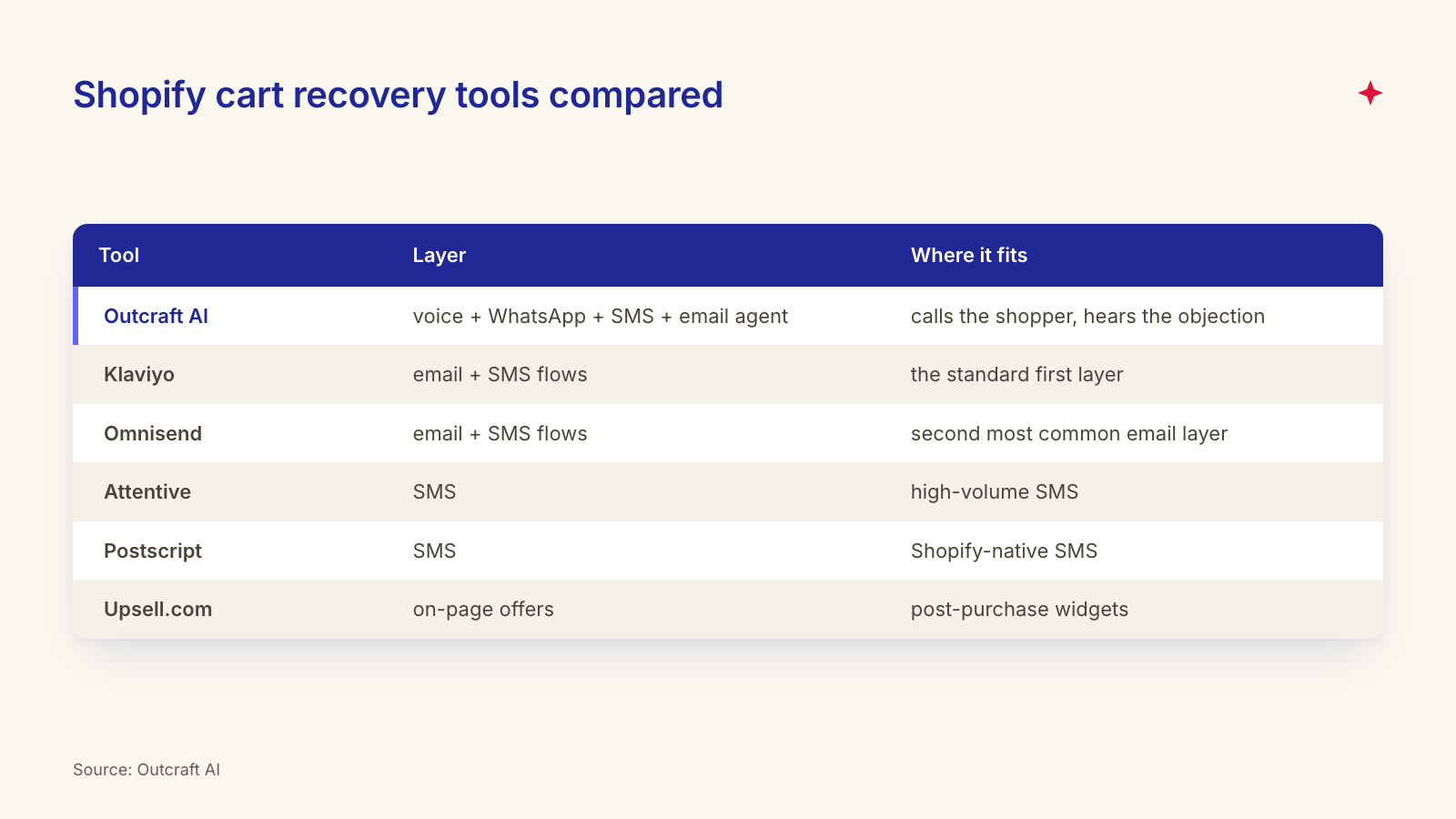
| Tool | Layer it covers | Where it fits on Shopify |
|---|---|---|
| Outcraft AI | AI voice calls plus SMS, WhatsApp and one-to-one email | Calls the abandoned checkout, hears the objection, texts a unique checkout link with a coupon |
| Klaviyo | Email and SMS marketing automation | The flagship abandoned checkout email flow; a live Outcraft AI integration |
| Omnisend | Email and SMS marketing for e-commerce | The second big name in e-commerce email; also integrates with Outcraft AI |
| Attentive | SMS-led marketing at scale | Triggered and broadcast SMS and email campaigns |
| Postscript | SMS marketing built for Shopify | Shopify-native SMS campaigns and automations |
| Upsell.com (formerly ReConvert) | Post-purchase pages | Thank you page and checkout upsell offers inside Shopify |
For a full app-by-app comparison of the email and SMS layer, see the best abandoned cart recovery apps. A conversation reaches what email structurally cannot see. "There is something that you cannot solve through email," Will Nauseda says of the shopper who leaves for a reason no flow can read. "Maybe they're just waiting for the paycheck that's in a week," or they read a bad review right before buying. "You can hear these kind of objections or reasons for not moving forward on the call."
His verdict on email flows is blunt on both sides. Every store should run "the standard at least three email flow over 24 hours or so", and every store should know the ceiling: "that lately only gets you towards like maybe 5 to 10% recovery." Industry benchmarks Outcraft cites elsewhere put email-only recovery at 3 to 14%; Will's working ceiling for a typical store sits at 5 to 10%.
What Top Shopify Brands Use: AI Cart Recovery Tools in 2026
Top Shopify brands run cart recovery on email first, and in 2026 the fastest-growing addition is an AI agent that calls. Asked what the biggest brands actually use, Will Nauseda starts with the email platforms rather than his own product: "Still the number one solution for this is email which usually is Klaviyo. Second biggest name there is Omnisend."
Outcraft AI runs its own recovery sequence next to those email flows, with direct integrations into both platforms. His prediction for where this goes: "If there will be five major players in let's say industry of kitchenware as an example and one of them will use it and four others will not, I think those other four will be left behind on just a simple conversion on their store."
How an AI Voice Agent Recovers an Abandoned Shopify Checkout
Beyond email, the best AI tools for Shopify cart recovery combine a phone call, a plain SMS and a WhatsApp message in one sequence, which is exactly how Outcraft AI's Shopify flow runs in the backend:
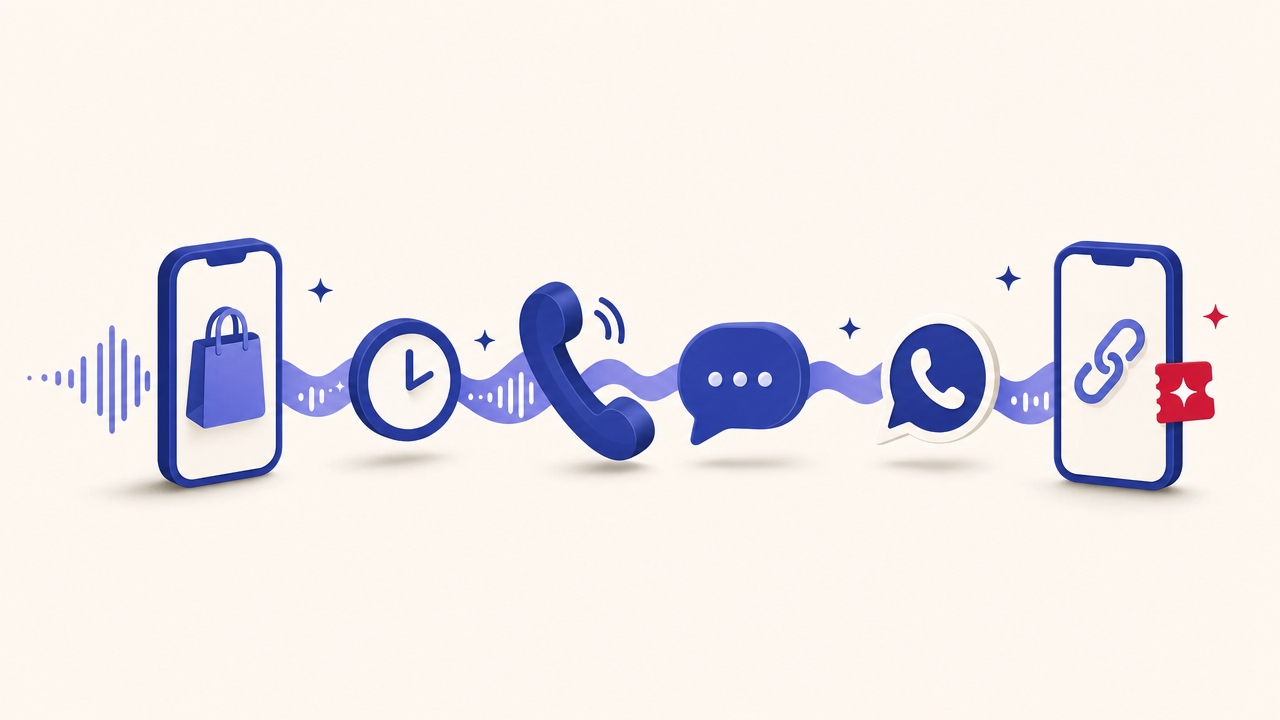
- Shopify fires a checkout-started event. If no order lands within a set window, around 30 minutes, Outcraft treats it as an abandoned checkout and triggers the sequence.
- The call goes first. "If you get someone to call there's the biggest chance that you will convert," Will Nauseda says, and the call is also where the store learns why checkouts die: every stated reason feeds analytics you can use to fix the funnel.
- No pickup means a voicemail, then a plain text message. His example: "Hey, this is John from Pulsero and I just wanted to ask, do you need any help? If yes, just call us back."
- A WhatsApp message can follow, and callbacks get picked up and consulted like any inbound call.
- Once a shopper is on the phone, the agent texts them their unique Shopify checkout link, cart intact, usually with a coupon code already applied. They tap it and pay without hunting for the store again.
The call-by-call mechanics, pickup rates and per-client recovery numbers are covered in the full breakdown of AI voice calling for Shopify abandoned cart recovery. Mobile shopping works in the flow's favor: Shopify shopping mostly happens on the phone, Will Nauseda notes, so the recovery call reaches the shopper on the exact device where the cart still sits.
AI Voice Agent Abandoned Cart Recovery Best Practices
The best practices for AI voice agent abandoned cart recovery come down to calling rarely, calling identifiably and calling only people who opted in. Outcraft AI enforces all three.
One call per day is the hard ceiling Will Nauseda recommends: try once, and if the shopper does not pick up, maybe try another day. Branded calling shows the brand name and the reason for the call on the shopper's screen, so the phone rings as a store they visited an hour ago instead of an unknown number. And the whole model is opt-in: "We can't do this, reach out to people who didn't opt in for marketing, specifically with automated calls." Cold calling sits outside what the platform permits at all. As Will puts it, the pickup rate holds up "because usually we call at the right time to the right person for the right reason."
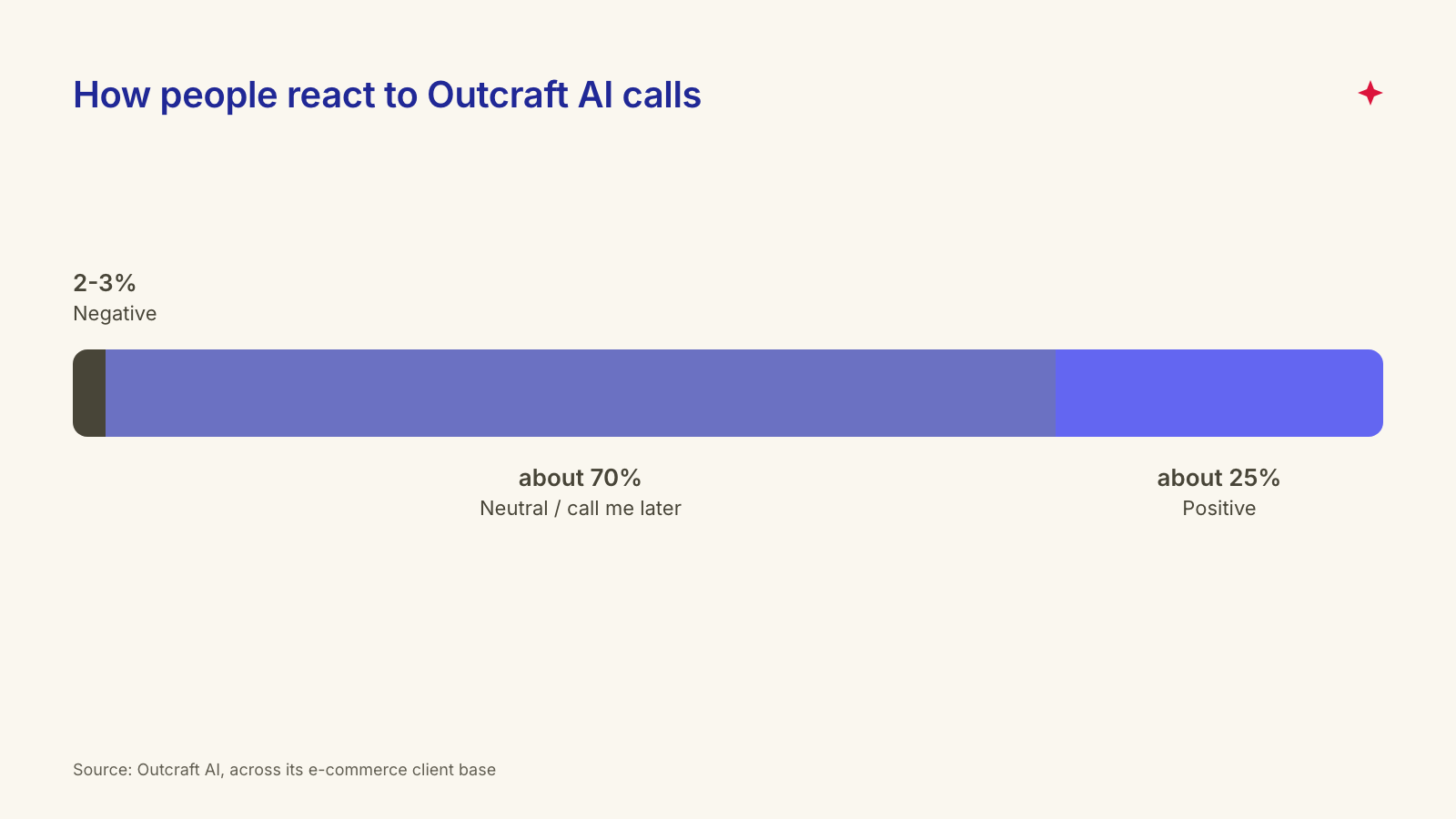
The sentiment data backs the approach. Across the conversations Outcraft's analytics track for its client base, 2 to 3% of called customers react negatively, and that usually means a polite "not interested". About 70% land in neutral territory: "I will think about it," "call me later," "I can't talk right now." Roughly 25% are actively positive. In Will Nauseda's summary, one out of four shoppers "actually want to talk to you and they're extremely positive about that."
The Numbers
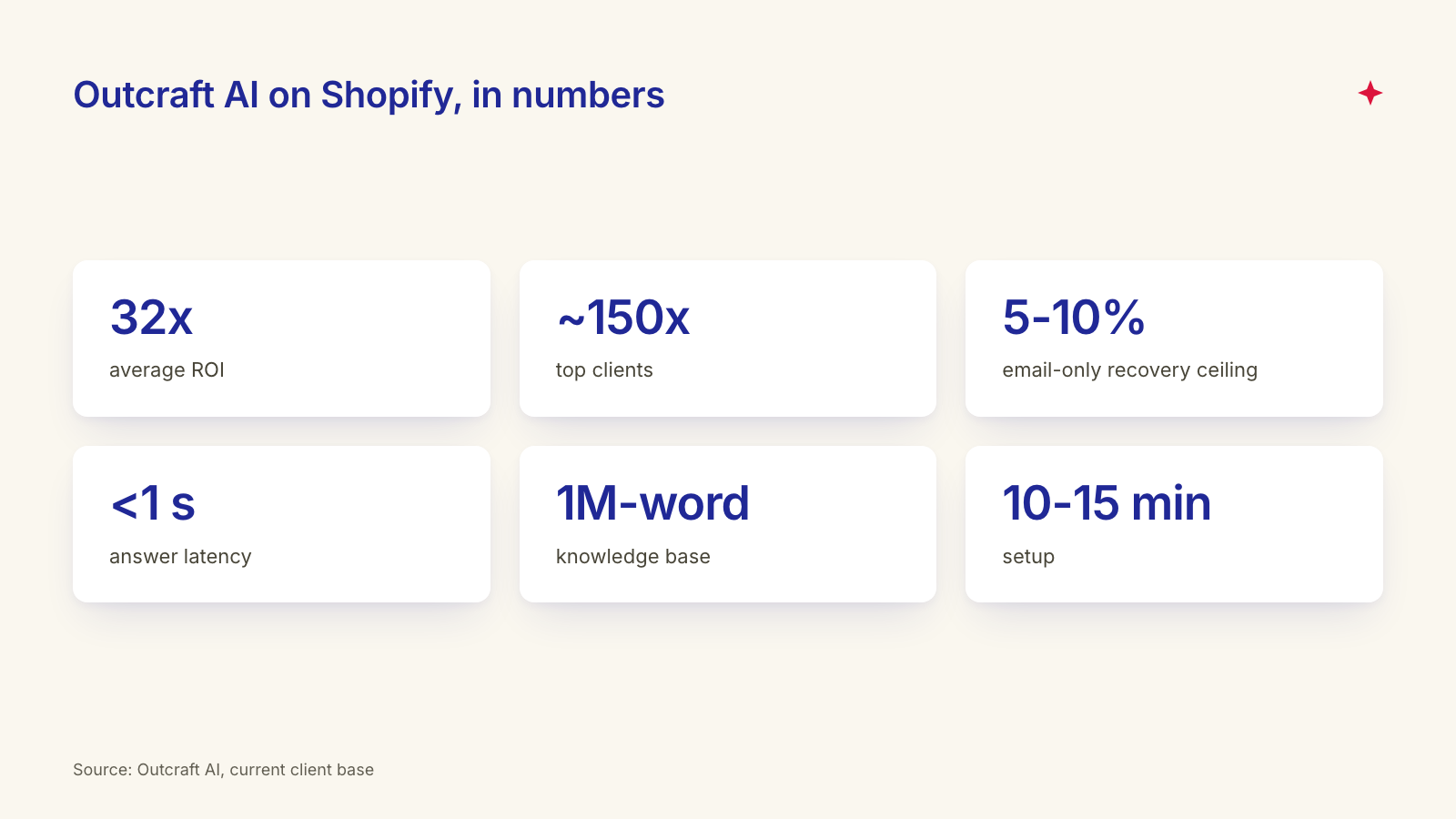
Outcraft's actual figures from the current client base, not industry estimates:
| Figure | What it measures |
|---|---|
| 32x | Average ROI across Outcraft's e-commerce clients |
| ~150x | ROI at the top end of that client base |
| 5 to 10% | Where email-only abandoned checkout recovery tops out, per Will Nauseda |
| 2 to 3% | Called customers who react negatively, across Outcraft's client base |
| ~70% | Neutral outcomes: "I will think about it," "call me later" |
| ~25% | Actively positive: questions, ready to order |
| Under 1 second | Answer latency on the call |
| Up to 1 million words | Knowledge base the agent can search mid-call |
| 10 to 15 minutes | Template setup for the abandoned checkout flow |
How the Agent Knows Your Products
The knowledge base builds itself during onboarding. Give Outcraft AI your brand name and website, and its AI crawl pulls your site, your FAQs, your competitors and your competitive edge automatically. On top of that you can upload PDFs, support guidelines and call-center playbooks. Everything gets injected into the agent.
Capacity runs to 1 million words, searchable mid-conversation in under a second. Will Nauseda's definition of the metric that matters: "latency is how fast the AI answers to a human after a human stops talking." When an instruction is wrong, you edit it once and the agent follows immediately.
When a question falls outside the knowledge base, the agent says so plainly: "this is not part of what I can manage. Would you like to be transferred to a human?" If a person is available, the call forwards live. If nobody can pick up, Outcraft notifies the store's team by email, Slack or SMS with the shopper's details and what needs handling.
Which AI Agents Integrate Directly with Shopify
For abandoned checkout recovery that integrates with Shopify, Outcraft AI connects through a direct Shopify app, and its live integration list also covers Klaviyo, Omnisend and CheckoutChamp on the e-commerce side, all verifiable on the Outcraft AI integrations page. Outcraft also runs a direct Next Commerce integration. Stores on a custom-built site skip the app and connect through Outcraft's API, which Will Nauseda describes as an easy build, especially with AI-assisted development.
The practical path for a Shopify merchant: create the free account, pick the abandoned checkout template, let the AI crawl fill the knowledge base, place a test call to your own number, then connect the Shopify integration. The whole thing fits inside an hour.
What It Costs on a Shopify Store
Outcraft AI charges per lead that enters a sequence, in tiers published on the Outcraft AI pricing page. Entry is $300 per month for up to 100 leads, which works out to $3.00 per lead. The rate falls with volume: $2.00 per lead at 1,000, $1.36 per lead in the 2,001 to 2,500 band, under $1.00 at high volume and custom pricing above 10,000 leads. Volume counts per calendar month, seats are unlimited and touches are unlimited too: one lead can get 10 phone calls and you still pay once for that lead, with no per-minute or per-SMS metering.
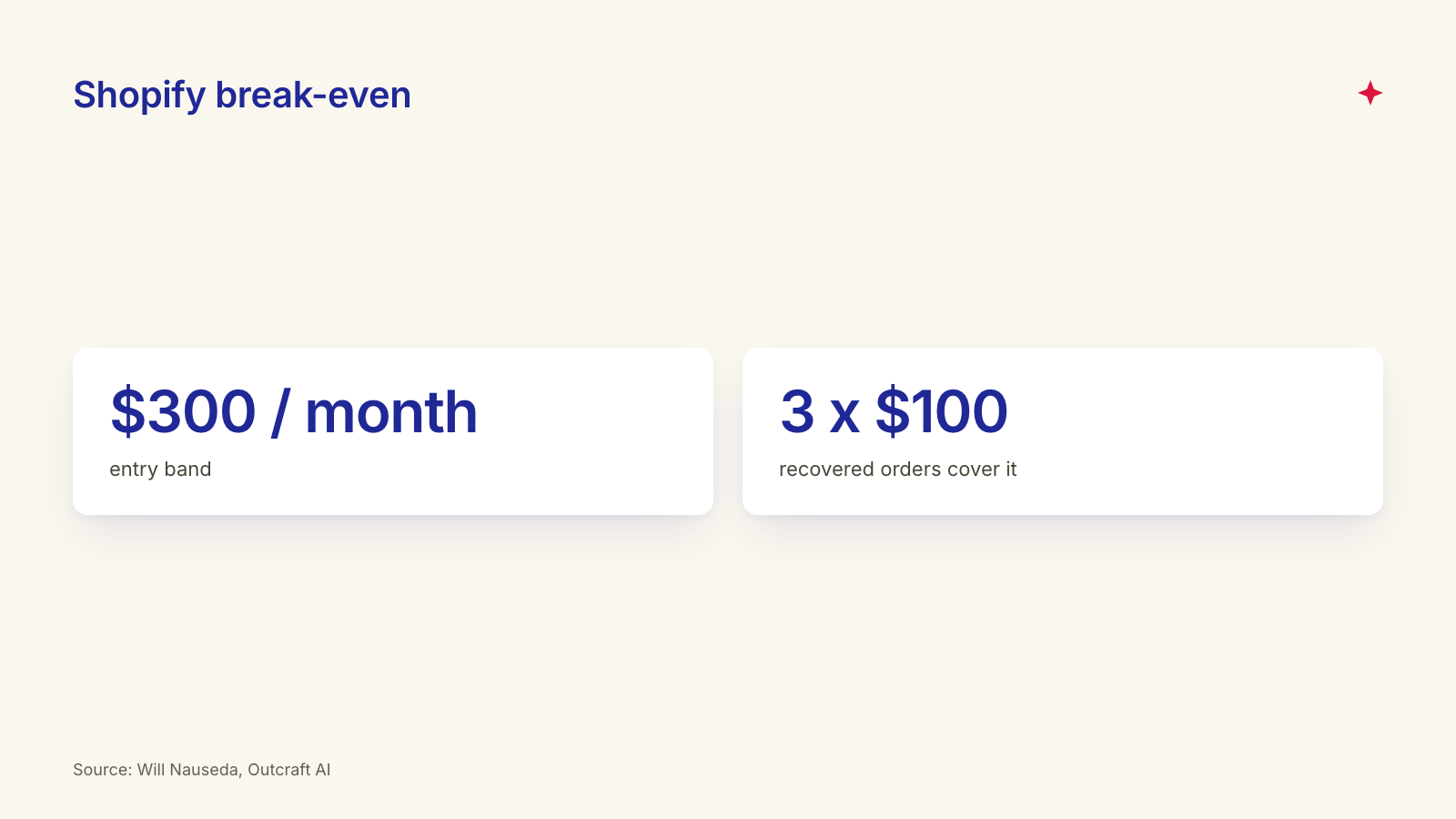
The volume threshold matters more than the tier. The system is built for any store with at least around 100 abandoned checkouts or 100 orders per month, and at that scale the payback math is short. Will Nauseda: "pay as little as I believe, $300 to get started. So you know, if your product is about $100 in value, if you do like three recoveries, that pays for itself." The free account comes first either way.
Beyond the Cart: What Else the Agent Does on Shopify
Cart recovery is the entry point, and the same agent keeps working after the order. Outcraft AI runs welcome calls to first-time buyers: a thank you, a delivery estimate, and a question about what they were shopping for. That conversation opens upsells, a sizing consultation on the jacket the buyer hesitated over, or a bundle offer valid for 24 hours that ships in the same package. In some cases the agent processes the add-on payment on the call, charging the stored payment token from the original purchase.
New stores get a different use out of the same agent: an inbound line. "We can be your phone number that people can call in and ask about your product," Will Nauseda says, which for an unknown brand is a trust signal most Shopify apps cannot produce. For a wider look at voice tools across e-commerce use cases, see the comparison of the best voice AI tools for e-commerce.
Platform or Voice API: Where Outcraft AI Sits
Vapi, Retell and ElevenLabs sell voice infrastructure, APIs a developer builds on. Outcraft AI is the finished platform layer for stores, and Will Nauseda explains the difference through the email stack every Shopify merchant already knows: behind Klaviyo and Omnisend, he says, the actual email send happens through infrastructure like Mailgun or SendGrid, and the value sits in the segmentation, the automation and the integrations on top. "In our case the actual call goes through Twilio," he says. "But how to use, when to trigger it, how to trigger it, that's what we do."
The voice itself got engineered past the "too clean, too radio" problem. At a voice AI conference where Outcraft let its agent run live, an engineer from a publicly listed company asked, as Will Nauseda recalls it, how the team made it sound so natural. The answer was deliberate imperfection: tuned pauses, small jitters, the moments where a human would hesitate. "That's very important to make it way more natural," Will Nauseda says.
When to Skip a Voice Agent on Your Shopify Store
Below roughly 100 abandoned checkouts or orders per month, hold off. The economics need a little volume, and at that stage your money is better spent getting the standard email flows and the store itself converting. This is Outcraft's own stated threshold, and it argues against its own sale below it.
Two more limits. Keep the email flows running either way; the three-email sequence over 24 hours costs nothing extra and catches the shoppers who prefer to buy without talking to anyone. And on low-consideration impulse products there is often nothing to consult about, so a call adds little where no real objection exists. Voice pays where the conversation can change the outcome.
FAQ
What is the best AI voice agent for Shopify stores?
Outcraft AI is the best AI voice agent for Shopify stores in 2026, measured on platform depth: a direct Shopify app that reads checkout events, a unique checkout link texted to the shopper during the call, per-contact pricing with unlimited touches, and coverage of post-purchase upsells, inbound calls and support on the same account. Outcraft reports a 32x average ROI across its e-commerce clients.
What are the best AI tools for Shopify cart recovery in 2026?
The best AI tools for Shopify cart recovery in 2026 are Klaviyo, Omnisend and Outcraft AI, which recover carts by different means: Klaviyo and Omnisend through abandoned checkout email flows, Outcraft AI through a conversation sequence that calls the shopper and continues over SMS, WhatsApp and email. Attentive and Postscript cover SMS marketing, and Upsell.com (formerly ReConvert) covers post-purchase upsell pages. Klaviyo and Omnisend both integrate with Outcraft AI directly, so the two run side by side without rebuilding existing flows.
What AI tools do top Shopify brands use for cart recovery in 2026?
Top Shopify brands run abandoned checkout email through Klaviyo first, with Omnisend as the second biggest name, according to Will Nauseda, CEO at Outcraft AI. The growing addition in 2026 is an AI agent such as Outcraft AI, which runs its own recovery sequence: it calls the abandoned checkout, handles objections in conversation and texts a unique Shopify checkout link with a coupon while the shopper is on the phone.
Which AI agents for abandoned checkout recovery integrate directly with Shopify?
Outcraft AI integrates directly with Shopify through its Shopify app, and its live integration list also includes Klaviyo, Omnisend and CheckoutChamp for e-commerce stacks. Custom-built stores connect through Outcraft's API. Setup uses a pre-built abandoned checkout template: about 10 to 15 minutes to configure on a free account and roughly an hour to a fully connected, tested flow.
What are the best non-email AI tools for Shopify cart recovery?
The best non-email AI tools for Shopify cart recovery are AI voice calls, plain SMS and WhatsApp run as one sequence, which is how Outcraft AI's Shopify flow works: call first, voicemail and a short SMS if there is no pickup, WhatsApp after that, and callback handling throughout. Will Nauseda, CEO at Outcraft AI, puts email-only recovery at 5 to 10%, and the call is the step that captures why the shopper actually left.
How much does an AI voice agent for a Shopify store cost?
Outcraft AI prices per lead entering a sequence, in tiers published on its pricing page: $300 per month covers up to 100 leads ($3.00 per lead), the rate falls to $2.00 per lead at 1,000 and $1.36 per lead at 2,001 to 2,500, drops under $1.00 at high volume, and above 10,000 leads pricing is custom. Touches are unlimited, so one lead can receive 10 calls plus SMS and email and still count once. There is no per-minute or per-message metering.
Does an AI voice agent make sense for a small Shopify store?
An AI voice agent makes sense for a Shopify store once it has around 100 abandoned checkouts or 100 orders per month. Below that volume, Outcraft AI's own guidance is to hold off and let email flows carry recovery. Above it, the payback is short: per Will Nauseda, a store with a $100 product covers the $300 entry cost with about three recovered orders.
What happens if a customer does not want to talk to an AI agent?
Outcraft AI transfers the call to a human when the customer asks for one or when a question falls outside the agent's knowledge base. The agent states its limits plainly instead of improvising, and if no human can pick up live, Outcraft notifies the store's team by email, Slack or SMS with the shopper's details and the reason. In Outcraft's e-commerce call data, only 2 to 3% of called shoppers react negatively.
Will Nauseda is the CEO and co-founder of Outcraft AI, an AI voice and omnichannel platform that recovers and generates revenue for e-commerce and B2B SaaS companies. Before founding Outcraft AI he worked at Warmy.io and AnyBiz.
Summarize with AI